







Question: data science course 2. Nearsightedness Study (5 Points) Myopia, or nearsightedness, results from a number of genetic and environmental factors, In 1999, Quinn et al
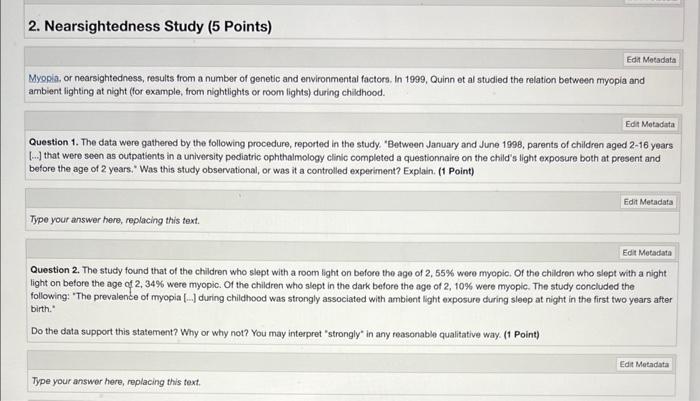
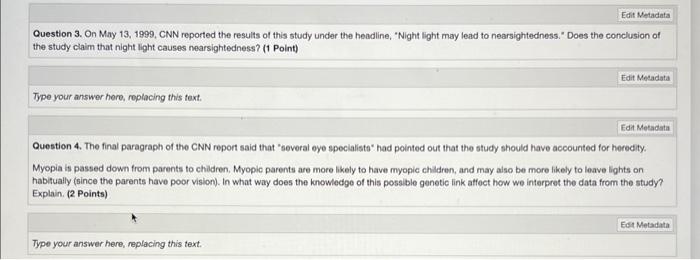
2. Nearsightedness Study (5 Points) Myopia, or nearsightedness, results from a number of genetic and environmental factors, In 1999, Quinn et al studied the relation between myopia and ambient lighting at night (for example, from nightlights or room lights) during childhood. Question 1. The data were gathered by the following procedure, reported in the study. "Between January and June 1908 , parents of children aged 2 -16 years [..] that were seen as outpatients in a university pediatric ophthalmology clinic completed a questionnaire on the child's light exposure both at present and betore the age of 2 years." Was this study observational, or was it a controlled experiment? Explain. (1 Point) Type your answer here, replacing this text. Question 2. The study found that of the children who slept with a room light on before the age of 2,55% wore myopic, Of the children who slept with a night light on betore the age of 2,34\% were myopic. Of the children who slept in the dark before the age of 2, 10\% were myopic. The study concluded the following: "The prevalence of myopia [...] during childhood was strongly associated with ambiont light exposure during sleep at night in the first two years after birth." Do the data support this statement? Why or why not? You may interpret "strongly" in any reasonable qualitative way. (1 Point) Question 3. On May 13, 1999, CNN reported the results of this study under the headline, "Night light may lead to nearsightedness." Does the conclusion of the study claim that night light causes nearsightedness? (1 Point) Type your answer here, roplacing this text. Question 4. The final paragraph of the CNN report said that "several eye speclaliste" had pointed out that the study should have accounted for heredity. Myopia is passed down from parents to chidren. Myopic parents are more likely to have myopic children, and may also be more likely to leave lights on habitually (since the parents have poor vision). In what way does the knowledge of this possible genetic link atfect how we interpret the data from the study? Explain. (2 Points)
Step by Step Solution
There are 3 Steps involved in it

Get step-by-step solutions from verified subject matter experts
 Study Help