







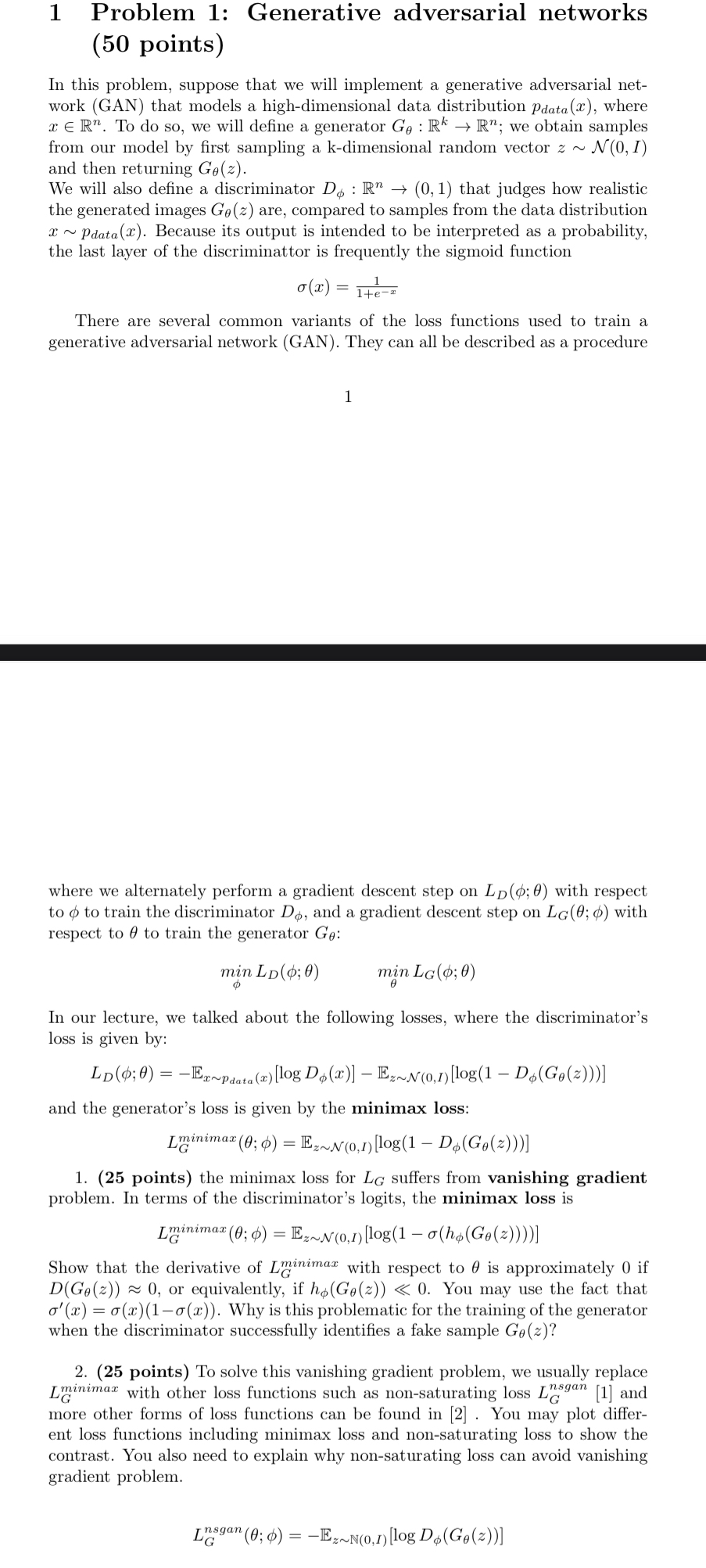
Question: 1 Problem 1 : Generative adversarial networks ( 5 0 points ) In this problem, suppose that we will implement a generative adversarial net -
Problem : Generative adversarial networks
points
In this problem, suppose that we will implement a generative adversarial net
work GAN that models a highdimensional data distribution where
To do so we will define a generator :; we obtain samples
from our model by first sampling a kdimensional random vector
and then returning
We will also define a discriminator : that judges how realistic
the generated images are, compared to samples from the data distribution
Because its output is intended to be interpreted as a probability,
the last layer of the discriminattor is frequently the sigmoid function
There are several common variants of the loss functions used to train a
generative adversarial network GAN They can all be described as a procedure
where we alternately perform a gradient descent step on ; with respect
to to train the discriminator and a gradient descent step on ; with
respect to to train the generator :
;;
In our lecture, we talked about the following losses, where the discriminator's
loss is given by:
;
and the generator's loss is given by the minimax loss:
;
points the minimax loss for suffers from vanishing gradient
problem. In terms of the discriminator's logits the minimax loss is
;
Show that the derivative of with respect to is approximately if
~~ or equivalently, if You may use the fact that
Why is this problematic for the training of the generator
when the discriminator successfully identifies a fake sample
points To solve this vanishing gradient problem, we usually replace
with other loss functions such as nonsaturating loss and
more other forms of loss functions can be found in You may plot differ
ent loss functions including minimax loss and nonsaturating loss to show the
contrast. You also need to explain why nonsaturating loss can avoid vanishing
gradient problem.
;
Step by Step Solution
There are 3 Steps involved in it
1 Expert Approved Answer
Step: 1 Unlock

Question Has Been Solved by an Expert!
Get step-by-step solutions from verified subject matter experts
Step: 2 Unlock
Step: 3 Unlock
 Study Help