







Question: 1 Production & Order Processing System 2 Case Study 1 3 Spring 2023 CIS 3300 Systems Analysis 4 Top managers at We Build Stuff (WBS)
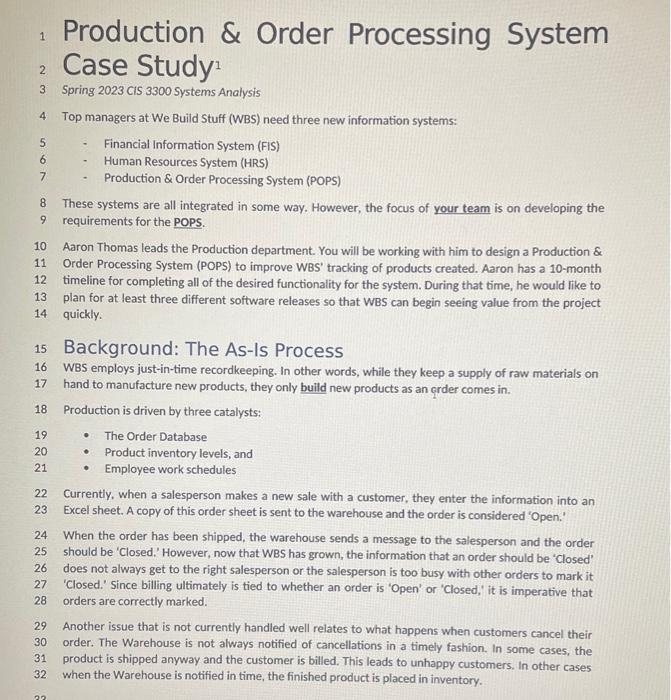
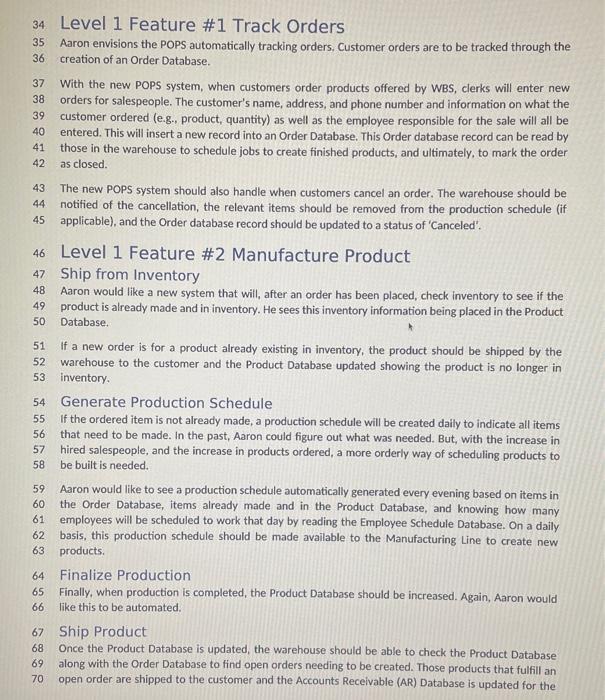
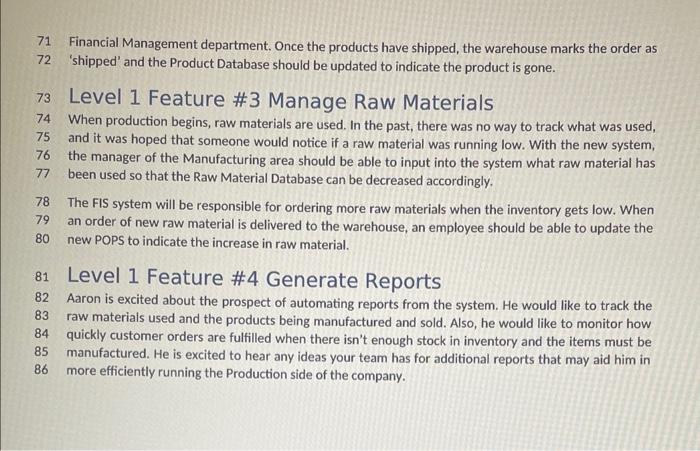

1 Production \& Order Processing System 2 Case Study 1 3 Spring 2023 CIS 3300 Systems Analysis 4 Top managers at We Build Stuff (WBS) need three new information systems: 5 - Financial Information System (FIS) 6 - Human Resources System (HRS) 7 - Production \& Order Processing System (POPS) 8 These systems are all integrated in some way. However, the focus of your team is on developing the 9 requirements for the POPS. 10 Aaron Thomas leads the Production department. You will be working with him to design a Production & 11 Order Processing System (POPS) to improve WBS' tracking of products created. Aaron has a 10-month 12 timeline for completing all of the desired functionality for the system. During that time, he would like to 13 plan for at least three different software releases so that WBS can begin seeing value from the project 14 quickly. 15 Background: The As-Is Process 16 WBS employs just-in-time recordkeeping. In other words, while they keep a supply of raw materials on 17 hand to manufacture new products, they only build new products as an crder comes in. 18 Production is driven by three catalysts: 19 - The Order Database 20 - Product inventory levels, and 21 - Employee work schedules 22 Currently, when a salesperson makes a new sale with a customer, they enter the information into an 23 Excel sheet. A copy of this order sheet is sent to the warehouse and the order is considered 'Open.' 24 When the order has been shipped, the warehouse sends a message to the salesperson and the order 25 should be 'Closed.' However, now that WBS has grown, the information that an order should be 'Closed' 26 does not always get to the right salesperson or the salesperson is too busy with other orders to mark it 27 'Closed.' Since billing ultimately is tied to whether an order is 'Open' or 'Closed,' it is imperative that 28 orders are correctly marked. 29 Another issue that is not currently handled well relates to what happens when customers cancel their 30 order. The Warehouse is not always notified of cancellations in a timely fashion. In some cases, the 31 product is shipped anyway and the customer is billed. This leads to unhappy customers, In other cases 32 when the Warehouse is notified in time, the finished product is placed in inventory. 34. Level 1 Feature \#1 Track Orders 35 Aaron envisions the POPS automatically tracking orders, Customer orders are to be tracked through the 36 creation of an Order Database. 37 With the new POPS system, when customers order products offered by WBS, clerks will enter new 38 orders for salespeople. The customer's name, address, and phone number and information on what the 39 customer ordered (e.g., product, quantity) as well as the employee responsible for the sale will all be 40 entered. This will insert a new record into an Order Database. This Order database record can be read by 41 those in the warehouse to schedule jobs to create finished products, and ultimately, to mark the order 42 as closed. 43 The new POPS system should also handle when customers cancel an order. The warehouse should be 44 notified of the cancellation, the relevant items should be removed from the production schedule (if 45 applicable), and the Order database record should be updated to a status of 'Canceled'. 46 Level 1 Feature \#2 Manufacture Product 47 Ship from Inventory 48 Aaron would like a new system that will, after an order has been placed, check inventory to see if the 49 product is already made and in inventory. He sees this inventory information being placed in the Product 50 Database. 51 If a new order is for a product already existing in inventory, the product should be shipped by the 52 warehouse to the customer and the Product Database updated showing the product is no longer in 53 inventory. 54 Generate Production Schedule 55 If the ordered item is not already made, a production schedule will be created daily to indicate all items 56 that need to be made. In the past, Aaron could figure out what was needed. But, with the increase in 57 hired salespeople, and the increase in products ordered, a more orderly way of scheduling products to 58 be built is needed. 59 Aaron would like to see a production schedule automatically generated every evening based on items in 60 the Order Database, items already made and in the Product Database, and knowing how many 61 employees will be scheduled to work that day by reading the Employee Schedule Database. On a daily 62 basis, this production schedule should be made available to the Manufacturing Line to create new 63 products. 64 Finalize Production 65 Finally, when production is completed, the Product Database should be increased. Again, Aaron would 66 like this to be automated. 67 Ship Product 68 Once the Product Database is updated, the warehouse should be able to check the Product Database 69 along with the Order Database to find open orders needing to be created. Those products that fulfill an 70 open order are shipped to the customer and the Accounts Receivable (AR) Database is undated tor thin 71 Financial Management department. Once the products have shipped, the warehouse marks the order as 72 'shipped' and the Product Database should be updated to indicate the product is gone. 73 Level 1 Feature \#3 Manage Raw Materials 74 When production begins, raw materials are used. In the past, there was no way to track what was used, 75 and it was hoped that someone would notice if a raw material was running low. With the new system, 76 the manager of the Manufacturing area should be able to input into the system what raw material has 77 been used so that the Raw Material Database can be decreased accordingly. 78 The FIS system will be responsible for ordering more raw materials when the inventory gets low. When 79 an order of new raw material is delivered to the warehouse, an employee should be able to update the 80 new POPS to indicate the increase in raw material. 81 Level 1 Feature \#4 Generate Reports 82 Aaron is excited about the prospect of automating reports from the system. He would like to track the 83 raw materials used and the products being manufactured and sold. Also, he would like to monitor how 84 quickly customer orders are fulfilled when there isn't enough stock in inventory and the items must be 85 manufactured. He is excited to hear any ideas your team has for additional reports that may aid him in Create a Roles and Permission Matrix for the system features. Using the information in the above case study>
Step by Step Solution
There are 3 Steps involved in it

Get step-by-step solutions from verified subject matter experts
 Study Help