



Question: 1) Provide an example of a decision you will make (or have made) and how following the decision making steps as explained by the Business
1) Provide an example of a decision you will make (or have made) and how following the decision making steps as explained by the Business Insider article ( https://www.businessinsider.com/5-step-method-making-high-stakes-high-quality-decisions-fast-2020-2 ) could (or would have) helped, and
Explain specific ways that you could apply at least two ideas from the "How Senior Executives Find Time to be Creative" article to being more creative at work.
2) Think about some of the interactions you've had with people from another country.Look at your home country's Hofstede cultural value scores (bellow) and those of the other country you (or someone you know) deals with regularly.How can you interpret these interactions in light of these scores?
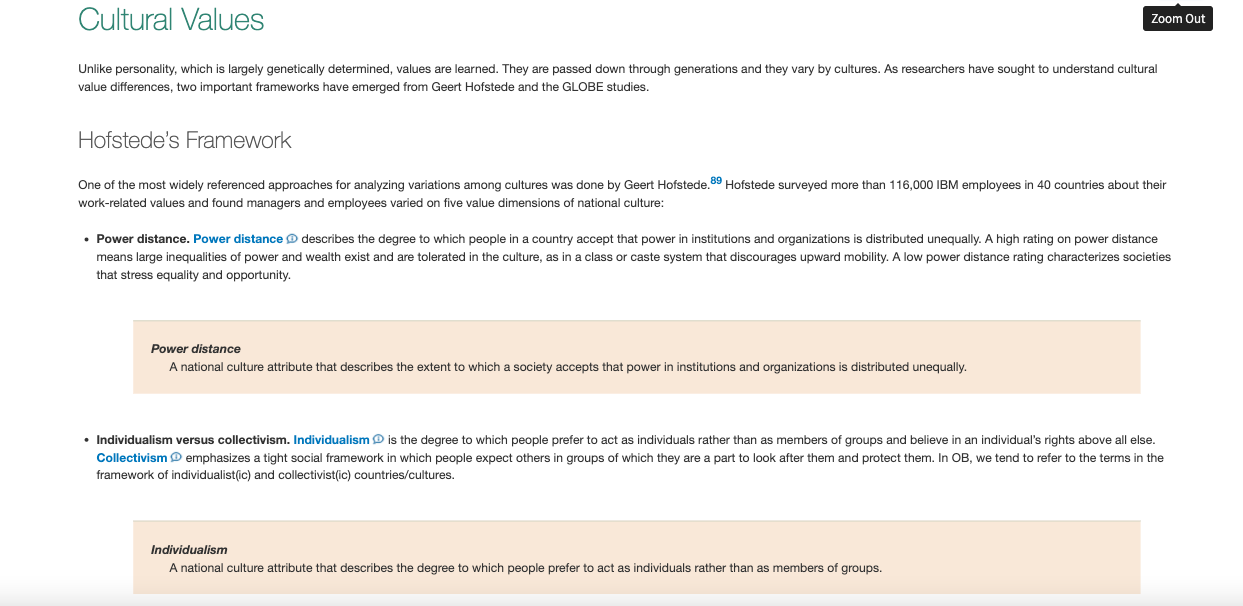
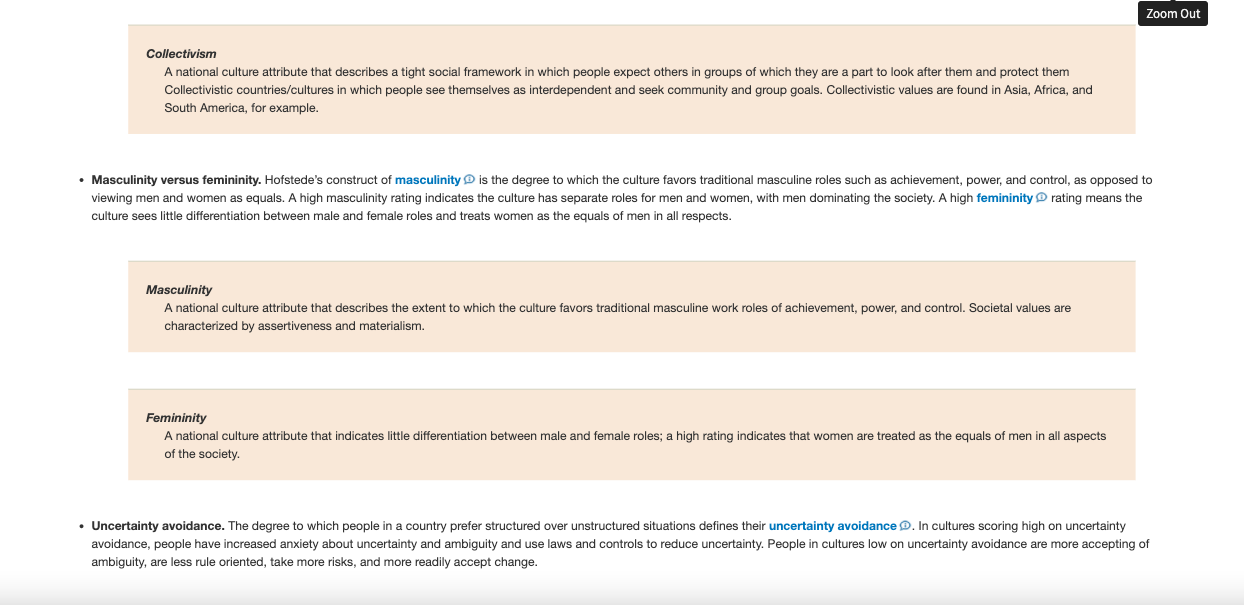
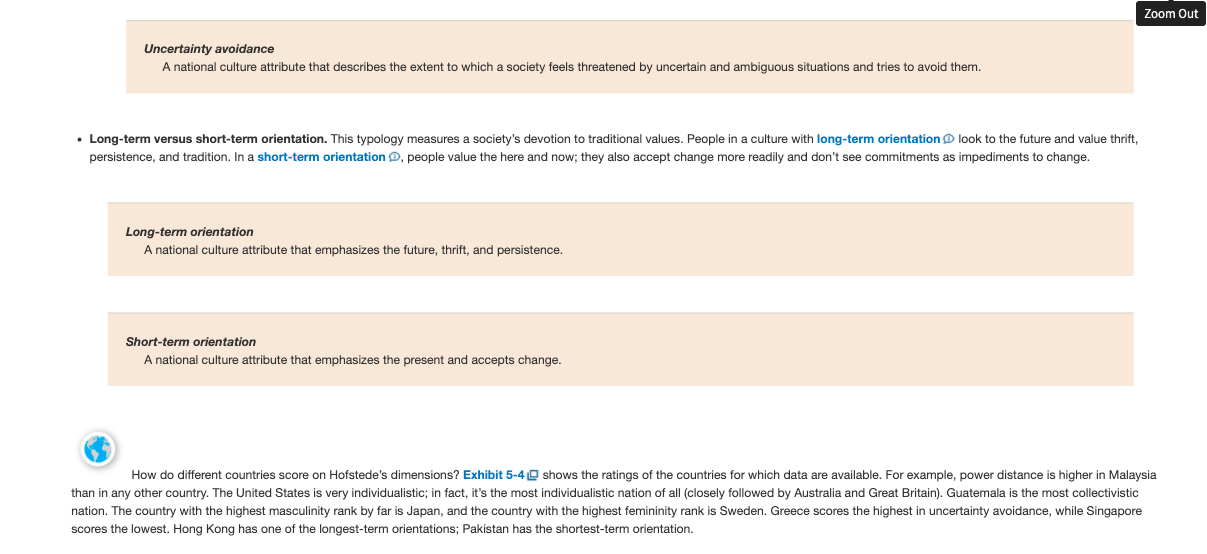
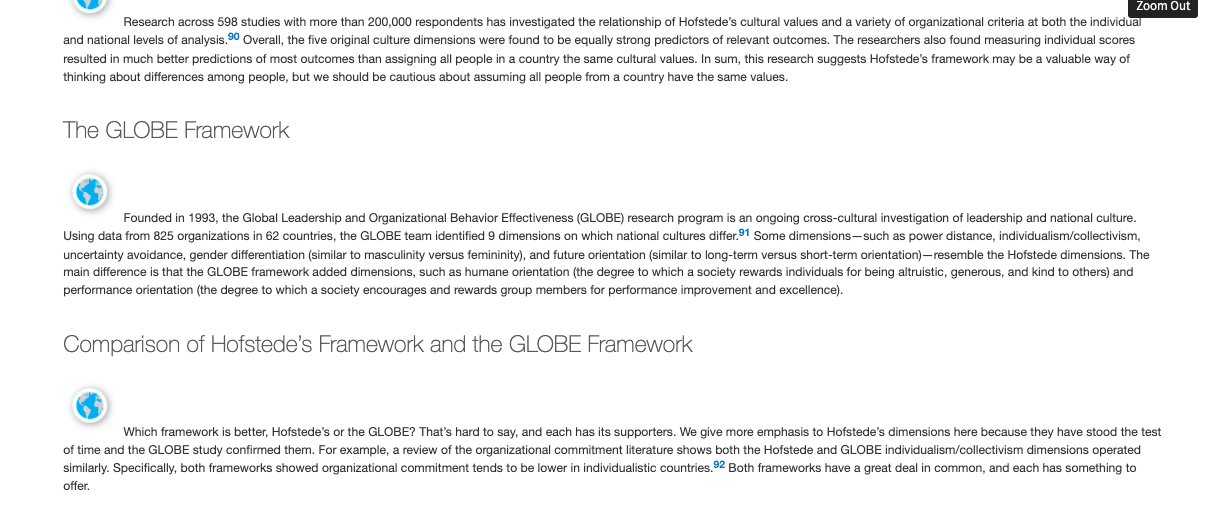
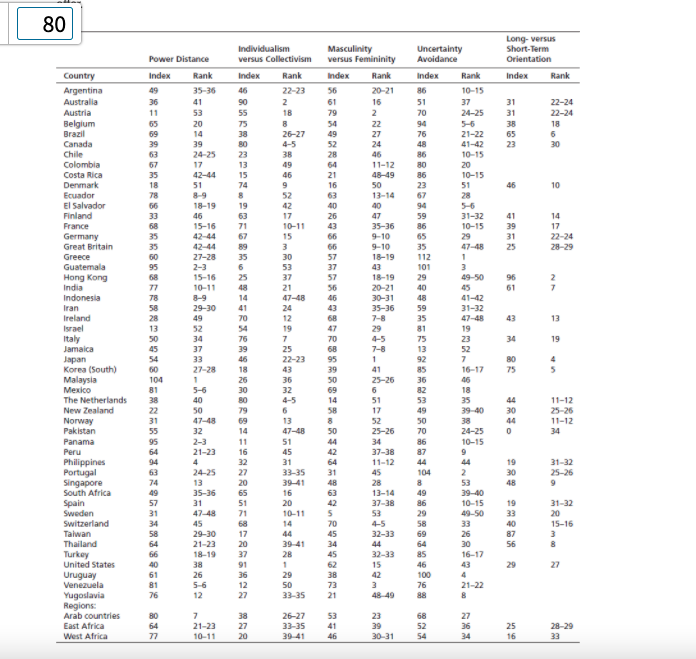
Cultural Values Zoom Out Unlike personality, which is largely genetically determined, values are learned. They are passed down through generations and they vary by cultures. As researchers have sought to understand cultural value differences, two important frameworks have emerged from Geert Hofstede and the GLOBE studies. Hofstede's Framework One of the most widely referenced approaches for analyzing variations among cultures was done by Geert Hofstede." Hofstede surveyed more than 116,000 IBM employees in 40 countries about their work-related values and found managers and employees varied on five value dimensions of national culture: . Power distance. Power distance @ describes the degree to which people in a country accept that power in institutions and organizations is distributed unequally. A high rating on power distance means large inequalities of power and wealth exist and are tolerated in the culture, as in a class or caste system that discourages upward mobility. A low power distance rating characterizes societies that stress equality and opportunity. Power distance A national culture attribute that describes the extent to which a society accepts that power in institutions and organizations is distributed unequally. . Individualism versus collectivism. Individualism is the degree to which people prefer to act as individuals rather than as members of groups and believe in an individual's rights above all else. Collectivism emphasizes a tight social framework in which people expect others in groups of which they are a part to look after them and protect them. In OB, we tend to refer to the terms in the framework of individualist(ic) and collectivist(ic) countries/cultures. Individualism A national culture attribute that describes the degree to which people prefer to act as individuals rather than as members of groups.Zoom Out Collectivism A national culture attribute that describes a tight social framework in which people expect others in groups of which they are a part to look after them and protect them Collectivistic countries/cultures in which people see themselves as interdependent and seek community and group goals. Collectivistic values are found in Asia, Africa, and South America, for example. . Masculinity versus femininity. Hofstede's construct of masculinity @ is the degree to which the culture favors traditional masculine roles such as achievement, power, and control, as opposed to viewing men and women as equals. A high masculinity rating indicates the culture has separate roles for men and women, with men dominating the society. A high femininity @ rating means the culture sees little differentiation between male and female roles and treats women as the equals of men in all respects. Masculinity A national culture attribute that describes the extent to which the culture favors traditional masculine work roles of achievement, power, and control. Societal values are characterized by assertiveness and materialism. Femininity A national culture attribute that indicates little differentiation between male and female roles; a high rating indicates that women are treated as the equals of men in all aspects of the society. . Uncertainty avoidance. The degree to which people in a country prefer structured over unstructured situations defines their uncertainty avoidance @. In cultures scoring high on uncertainty avoidance, people have increased anxiety about uncertainty and ambiguity and use laws and controls to reduce uncertainty. People in cultures low on uncertainty avoidance are more accepting of ambiguity, are less rule oriented, take more risks, and more readily accept change.Zoom Out Uncertainty avoidance A national culture attribute that describes the extent to which a society feels threatened by uncertain and ambiguous situations and tries to avoid them. . Long-term versus short-term orientation. This typology measures a society's devotion to traditional values. People in a culture with long-term orientation @ look to the future and value thrift, persistence, and tradition. In a short-term orientation , people value the here and now; they also accept change more readily and don't see commitments as impediments to change. Long-term orientation A national culture attribute that emphasizes the future, thrift, and persistence. Short-term orientation A national culture attribute that emphasizes the present and accepts change. How do different countries score on Hofstede's dimensions? Exhibit 5-4 D shows the ratings of the countries for which data are available. For example, power distance is higher in Malaysia than in any other country. The United States is very individualistic; in fact, it's the most individualistic nation of all (closely followed by Australia and Great Britain). Guatemala is the most collectivistic nation. The country with the highest masculinity rank by far is Japan, and the country with the highest femininity rank is Sweden. Greece scores the highest in uncertainty avoidance, while Singapore scores the lowest. Hong Kong has one of the longest-term orientations; Pakistan has the shortest-term orientation.Zoom Out Research across 598 studies with more than 200,000 respondents has investigated the relationship of Hofstede's cultural values and a variety of organizational criteria at both the individual and national levels of analysis." Overall, the five original culture dimensions were found to be equally strong predictors of relevant outcomes. The researchers also found measuring individual scores resulted in much better predictions of most outcomes than assigning all people in a country the same cultural values. In sum, this research suggests Hofstede's framework may be a valuable way of thinking about differences among people, but we should be cautious about assuming all people from a country have the same values. The GLOBE Framework Founded in 1993, the Global Leadership and Organizational Behavior Effectiveness (GLOBE) research program is an ongoing cross-cultural investigation of leadership and national culture. Using data from 825 organizations in 62 countries, the GLOBE team identified 9 dimensions on which national cultures differ." Some dimensions-such as power distance, individualism/collectivism, uncertainty avoidance, gender differentiation (similar to masculinity versus femininity), and future orientation (similar to long-term versus short-term orientation)-resemble the Hofstede dimensions. The main difference is that the GLOBE framework added dimensions, such as humane orientation (the degree to which a society rewards individuals for being altruistic, generous, and kind to others) and performance orientation (the degree to which a society encourages and rewards group members for performance improvement and excellence). Comparison of Hofstede's Framework and the GLOBE Framework Which framework is better, Hofstede's or the GLOBE? That's hard to say, and each has its supporters. We give more emphasis to Hofstede's dimensions here because they have stood the test of time and the GLOBE study confirmed them. For example, a review of the organizational commitment literature shows both the Hofstede and GLOBE individualism/collectivism dimensions operated similarly. Specifically, both frameworks showed organizational commitment tends to be lower in individualistic countries. Both frameworks have a great deal in common, and each has something to offer.80 Long- verein Individualism Masculinity Uncertainty Short-Term Orientation Power Distance versus Collectivism versus Femininity Avoidance Index Rank Country Index Rank Index Rank Index Rank Index Rank Argentina 16 22-23 20-21 10-15 90 2 61 16 51 37 22-24 Australia 41 55 79 2 70 24-2! 22-24 Austria 11 53 20 94 18 Belgium 65 75 54 22 Brazil 69 14 38 26-27 76 21-22 6 Canada 39 GE 4-5 52 48 41-4 46 86 10-15 Chile 63 24 2 38 Colombia 67 17 13 49 11-12 20 35 42-44 15 46 48-49 10-15 Costa Rica 50 51 46 Denmark 18 51 28 Ecuador 8-9 5-6 El Salvador 18-19 14 33 46 31-32 Finland 10-15 17 France 15-16 29 22-24 Germany 42-44 28-29 Great Britain 42-44 Greece 27-28 Guatemala 2 - 3 49-50 Hong Kong 15-16 India 77 10-11 Indonesia 78 8-9 1-42 29-30 31-32 Iran 58 47-48 43 13 Ireland 49 Israel 52 19 34 34 19 Italy 50 Jamaica 45 37 52 Japan 54 EE 22-23 41 16-17 Korea (South) 60 27-2 Malaysia 104 25-26 46 18 Mexico 81 5-6 11-12 The Netherlands 38 40 4-5 35 25-26 22 39-4 New Zealand 50 31 47-48 38 11-12 Norway Pakistan 55 32 47-48 25-20 24-25 51 34 10-15 Panama 95 2-3 64 21-23 45 37-36 Peru 94 4 31 19 31-32 Philippines 25-26 Portugal 24-25 33-35 9 Singapore 74 13 39-41 19- South Africa 49 35-36 16 31-32 57 31 20 10-15 Spain 10-11 20 Sweden 31 47-48 15-16 Switzerland 34 45 14 Taiwan 58 29-30 44 32-33 Thailand 64 21-23 39-41 18-19 28 32-3 16-17 Turkey 66 37 United States 40 38 Uruguay 61 26 29 81 5 6 50 21-22 Venezuela Yugoslavia 76 12 33-35 48-49 Regions Arab countries BO 26-27 23 64 21-23 33-35 39 25 28-29 East Africa 33 39-41 30-31 West Africa 10-11
Step by Step Solution
There are 3 Steps involved in it

Get step-by-step solutions from verified subject matter experts