







Question: 1. Question 1 (purchasing power parity ). Please refer to lecture 9 for background. (a) Price levels are defined as the cost of a representative
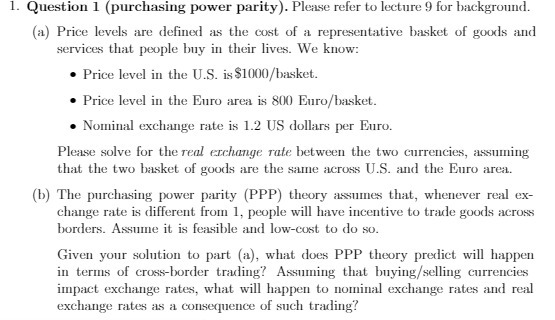
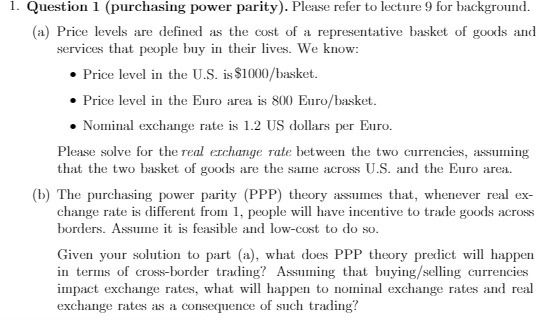
1. Question 1 (purchasing power parity ). Please refer to lecture 9 for background. (a) Price levels are defined as the cost of a representative basket of goods and services that people buy in their lives. We know: . Price level in the U.S. is $1000/basket. . Price level in the Euro area is 800 Euro/basket. . Nominal exchange rate is 1.2 US dollars per Euro. Please solve for the real exchange rate between the two currencies, assuming that the two basket of goods are the same across U.S. and the Euro area. (b) The purchasing power parity (PPP) theory assumes that, whenever real ex- change rate is different from 1, people will have incentive to trade goods across borders. Assume it is feasible and low-cost to do so. Given your solution to part (a), what does PPP theory predict will happen in terms of cross-border trading? Assuming that buying/selling currencies impact exchange rates, what will happen to nominal exchange rates and real exchange rates as a consequence of such trading
Step by Step Solution
There are 3 Steps involved in it

Get step-by-step solutions from verified subject matter experts
 Study Help