Question: 1) Question: Write a small paragraph based on their understanding of the reading. I do not want the facts but what you felt after reading
 1) Question: Write a small paragraph based on their understanding of the reading. I do not want the facts but what you felt after reading the chapter.
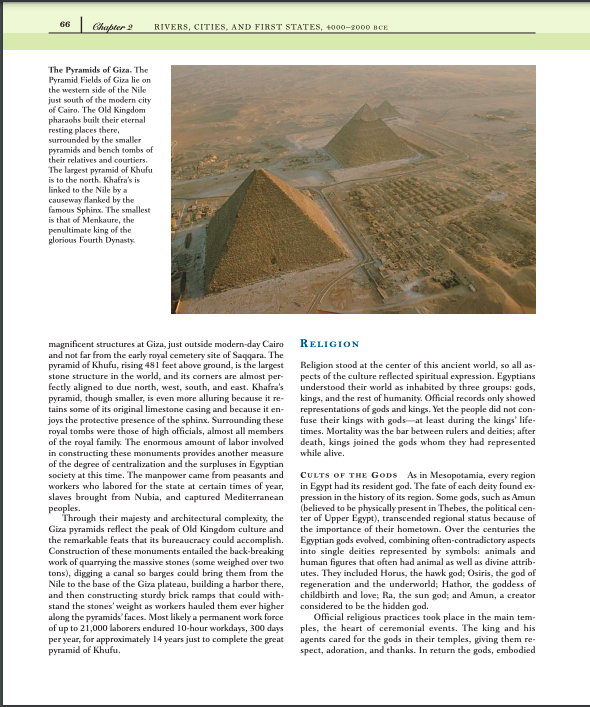
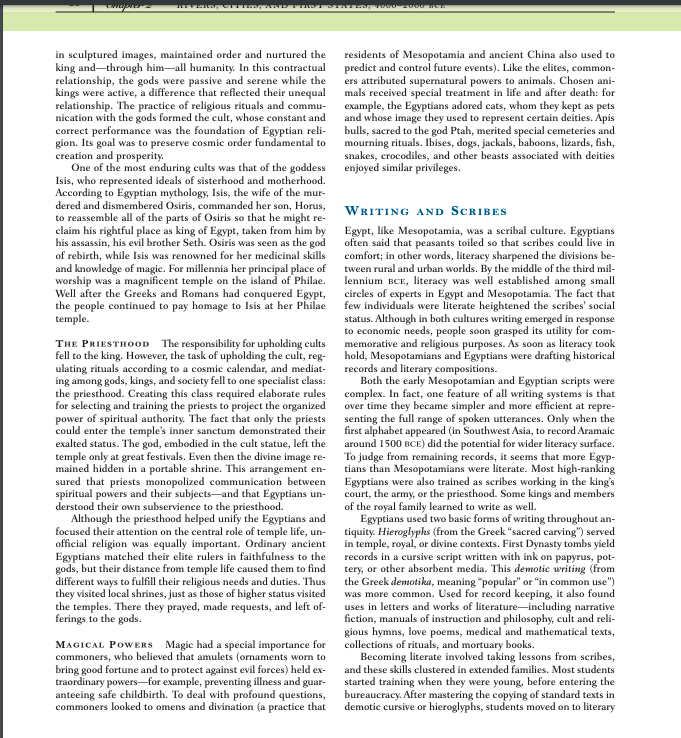
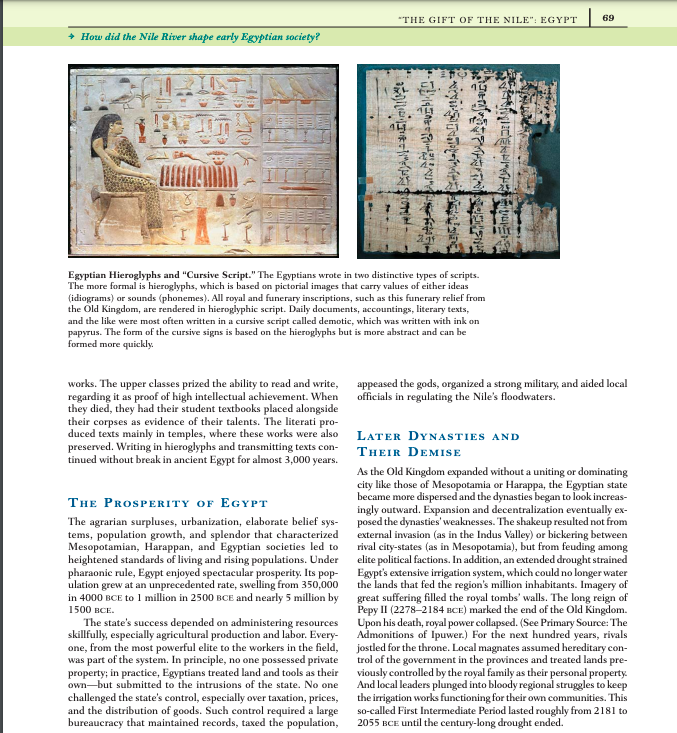
66 Chapter 9 RIVERS, CITIES, AND FIRST STATES, +000-2000 BCE The Pyramids of Giza. The Pyramid Fields of Giza lie on the western side of the Nile just south of the modern city of Cairo. The Old Kingdom pharaohs built their eternal resting places there, surrounded by the smaller pyramids and bench tombs of their relatives and courtiers. The largest pyramid of Khufu is to the north. Khafra's is linked to the Nile by a causeway flanked by the famous Sphinx. The smallest is that of Menkaure, the penultimate king of the glorious Fourth Dynasty RELIGION Religion stood at the center of this ancient world, so all as- pects of the culture reflected spiritual expression. Egyptians understood their world as inhabited by three groups: gods, kings, and the rest of humanity. Official records only showed representations of gods and kings. Yet the people did not con fuse their kings with gods at least during the kings' life- times. Mortality was the bar between rulers and deities, after death, kings joined the gods whom they had represented while alive. magnificent structures at Giza, just outside modern-day Cairo and not far from the early royal cemetery site of Saqqara. The pyramid of Khufu, rising 481 feet above ground, is the largest stone structure in the world, and its corners are almost per fectly aligned to due north, west, south, and east. Khafra's pyramid, though smaller, is even more alluring because it re- tains some of its original limestone casing and because it en joys the protective presence of the sphinx. Surrounding these royal tombs were those of high officials, almost all members of the royal family. The enormous amount of labor involved in constructing these monuments provides another measure of the degree of centralization and the surpluses in Egyptian society at this time. The manpower came from peasants and workers who labored for the state at certain times of year, slaves brought from Nubia, and captured Mediterranean peoples. Through their majesty and architectural complexity, the Giza pyramids reflect the peak of Old Kingdom culture and the remarkable feats that its bureaucracy could accomplish. Construction of these monuments entailed the back-breaking work of quarrying the massive stones (some weighed over two tons), digging a canal so barges could bring them from the Nile to the base of the Giza plateau, building a harbor there, and then constructing sturdy brick ramps that could with stand the stones' weight as workers hauled them ever higher along the pyramids' faces. Most likely a permanent work force of up to 21,000 laborers endured 10 hour workdays, 300 days per year, for approximately 14 years just to complete the great Pyramid of Khufu. CULTS OF THE GODS As in Mesopotamia, every region in Egypt had its resident god. The fate of each deity found ex- pression in the history of its region. Some gods, such as Amun (believed to be physically present in Thebes, the political cen. ter of Upper Egypt), transcended regional status because of the importance of their hometown. Over the centuries the Egyptian gods evolved, combining often contradictory aspects into single deities represented by symbols animals and human figures that often had animal as well as divine attrib- utes. They included Horus, the hawk god; Osiris, the god of regeneration and the underworld; Hathor, the goddess of childbirth and love, Ra, the sun god, and Amun, a creator considered to be the hidden god. Official religious practices took place in the main tem- ples, the heart of ceremonial events. The king and his agents cared for the gods in their temples, giving them re- spect, adoration, and thanks. In return the gods, embodied , in sculptured images, maintained order and nurtured the residents of Mesopotamia and ancient China also used to king andthrough him-all humanity. In this contractual predict and control future events). Like the elites, common- relationship, the gods were passive and serene while the ers attributed supernatural powers to animals. Chosen ani- kings were active, a difference that reflected their unequal mals received special treatment in life and after death: for relationship. The practice of religious rituals and commu- example, the Egyptians adored cats, whom they kept as pets nication with the gods formed the cult, whose constant and and whose image they used to represent certain deities. Apis correct performance was the foundation of Egyptian reli- bulls, sacred to the god Ptah, merited special cemeteries and gion. Its goal was to preserve cosmic order fundamental to mourning rituals. Ibises, dogs, jackals, baboons, lizards, fish, creation and prosperity snakes, crocodiles, and other beasts associated with deities One of the most enduring cults was that of the goddess enjoyed similar privileges. Isis, who represented ideals of sisterhood and motherhood. According to Egyptian mythology, Isis, the wife of the mur- dered and dismembered Osiris, commanded her son, Horus, to reassemble all of the parts of Osiris so that he might re- WRITING AND SCRIBES claim his rightful place as king of Egypt, taken from him by Egypt, like Mesopotamia, was a scribal culture. Egyptians his assassin, his evil brother Seth. Osiris was seen as the god often said that peasants toiled so that scribes could live in of rebirth, while Isis was renowned for her medicinal skills comfort; in other words, literacy sharpened the divisions be- and knowledge of magic. For millennia her principal place of tween rural and urban worlds. By the middle of the third mil- worship was a magnificent temple on the island of Philae. lennium BCE, literacy was well established among small Well after the Greeks and Romans had conquered Egypt, circles of experts in Egypt and Mesopotamia. The fact that the people continued to pay homage to Isis at her Philae few individuals were literate heightened the scribes' social temple. status. Although in both cultures writing emerged in response to economic needs, people soon grasped its utility for com- THE PRIESTHOOD The responsibility for upholding cults memorative and religious purposes. As soon as literacy took fell to the king. However, the task of upholding the cult, reg- hold, Mesopotamians and Egyptians were drafting historical ulating rituals according to a cosmic calendar, and mediat- records and literary compositions. ing among gods, kings, and society fell to one specialist class: Both the early Mesopotamian and Egyptian scripts were the priesthood. Creating this class required elaborate rules complex. In fact, one feature of all writing systems is that for selecting and training the priests to project the organized over time they became simpler and more efficient at repre- power of spiritual authority. The fact that only the priests senting the full range of spoken utterances. Only when the could enter the temple's inner sanctum demonstrated their first alphabet appeared (in Southwest Asia, to record Aramaie exalted status. The god, embodied in the cult statue, left the around 1500 BCE) did the potential for wider literacy surface. temple only at great festivals. Even then the divine image re- To judge from remaining records, it seems that more Egyp- mained hidden in a portable shrine. This arrangement en- tians than Mesopotamians were literate. Most high-ranking sured that priests monopolized communication between Egyptians were also trained as scribes working in the king's spiritual powers and their subjectsand that Egyptians un- court, the army, or the priesthood. Some kings and members derstood their own subservience to the priesthood. of the royal family learned to write as well. Although the priesthood helped unify the Egyptians and Egyptians used two basic forms of writing throughout an- focused their attention on the central role of temple life, un- tiquity. Hieroglyphs (from the Greek "sacred carving") served official religion was equally important. Ordinary ancient in temple, royal, or divine contexts. First Dynasty tombs yield Egyptians matched their elite rulers in faithfulness to the records in a cursive script written with ink on papyrus, pot- gods, but their distance from temple life caused them to find tery, or other absorbent media. This demotic writing (from different ways to fulfill their religious needs and duties. Thus the Greek demotika, meaning "popular" or "in common use") they visited local shrines, just as those of higher status visited was more common. Used for record keeping, it also found the temples. There they prayed, made requests, and left of- uses in letters and works of literatureincluding narrative ferings to the gods. fiction, manuals of instruction and philosophy, cult and reli- gious hymns, love poems, medical and mathematical texts, MAGICAL POWERS Magic had a special importance for collections of rituals, and mortuary books. commoners, who believed that amulets (ornaments wom to Becoming literate involved taking lessons from scribes, bring good fortune and to protect against evil forces) held ex- and these skills clustered in extended families. Most students traordinary powers-for example, preventing illness and guar- started training when they were young, before entering the anteeing safe childbirth. To deal with profound questions, bureaucracy. After mastering the copying of standard texts in commoners looked to omens and divination (a practice that demotic cursive or hieroglyphs, students moved on to literary "THE GIFT OF THE NILE": EGYPT 69 How did the Nile River shape early Egyptian society? Egyptian Hieroglyphs and "Cursive Script." The Egyptians wrote in two distinctive types of scripts. The more formal is hieroglyphs, which is based on pictorial images that carry values of either ideas (idiograms) or sounds (phonemes). All royal and funerary inscriptions, such as this funerary relief from the Old Kingdom, are rendered in hieroglyphic script. Daily documents, accountings, literary texts, and the like were most often written in a cursive script called demotic, which was written with ink on papyrus. The form of the cursive signs is based on the hieroglyphs but is more abstract and can be formed more quickly works. The upper classes prized the ability to read and write, appeased the gods, organized a strong military, and aided local regarding it as proof of high intellectual achievement. When officials in regulating the Nile's floodwaters. they died, they had their student textbooks placed alongside their corpses as evidence of their talents. The literati pro- duced texts mainly in temples, where these works were also LATER DYNASTIES AND preserved. Writing in hieroglyphs and transmitting texts con- THEIR DEMISE tinued without break in ancient Egypt for almost 3,000 years. As the Old Kingdom expanded without a uniting or dominating city like those of Mesopotamia or Harappa, the Egyptian state THE PROSPERITY OF EGYPT became more dispersed and the dynasties began to look increas- ingly outward. Expansion and decentralization eventually ex- The agrarian surpluses, urbanization, elaborate belief sys- posed the dynasties' weaknesses. The shakeup resulted not from tems, population growth, and splendor that characterized external invasion (as in the Indus Valley) or bickering between Mesopotamian, Harappan, and Egyptian societies led to rival city-states (as in Mesopotamia), but from feuding among heightened standards of living and rising populations. Under elite political factions. In addition, an extended drought strained pharaonic rule, Egypt enjoyed spectacular prosperity. Its pop- Egypt's extensive irrigation system, which could no longer water ulation grew at an unprecedented rate, swelling from 350,000 the lands that fed the region's million inhabitants. Imagery of in 4000 BCE to 1 million in 2500 BCE and nearly 5 million by great suffering filled the royal tombs' walls. The long reign of 1500 BCE Pepy II (2278-2184 BCE) marked the end of the Old Kingdom. The state's success depended on administering resources Upon his death, royal power collapsed. (See Primary Source: The skillfully, especially agricultural production and labor. Every- Admonitions of Ipuwer.) For the next hundred years, rivals one, from the most powerful elite to the workers in the field, jostled for the throne. Local magnates assumed hereditary con- was part of the system. In principle, no one possessed private trol of the government in the provinces and treated lands pre- property; in practice, Egyptians treated land and tools as their viously controlled by the royal family as their personal property. ownbut submitted to the intrusions of the state. No one And local leaders plunged into bloody regional struggles to keep challenged the state's control, especially over taxation, prices, the irrigation works functioning for their own communities. This and the distribution of goods. Such control required a large so-called First Intermediate Period lasted roughly from 2181 to bureaucracy that maintained records, taxed the population, 2055 BCE until the century-long drought ended









 Study Help