







Question: 1) Question: Write a small paragraph based on their understanding of the reading. I do not want the facts but what you felt after reading
 1) Question: Write a small paragraph based on their understanding of the reading. I do not want the facts but what you felt after reading the chapter.
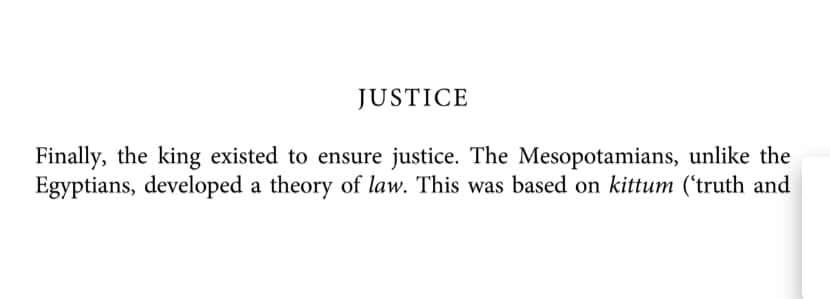
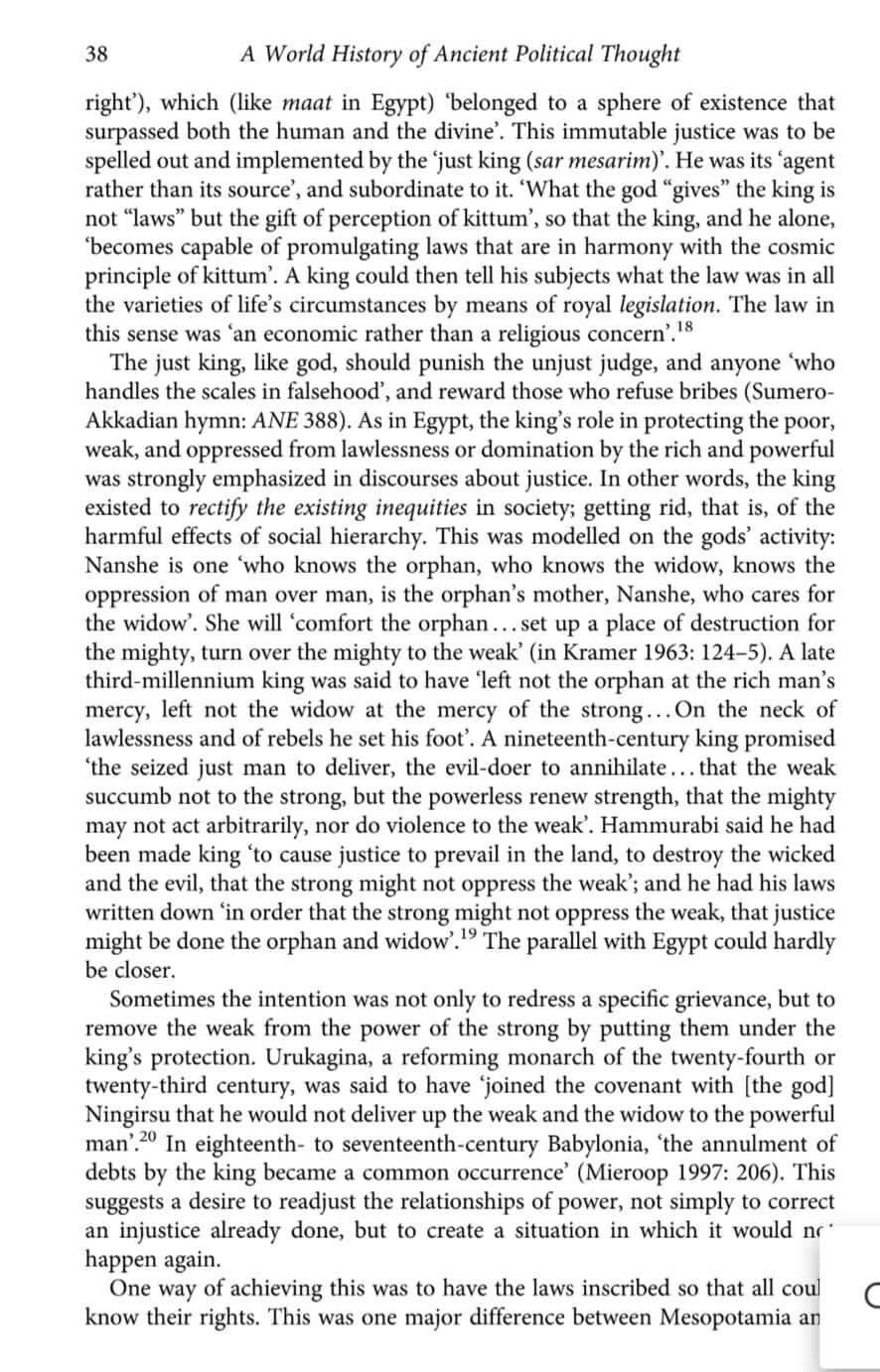
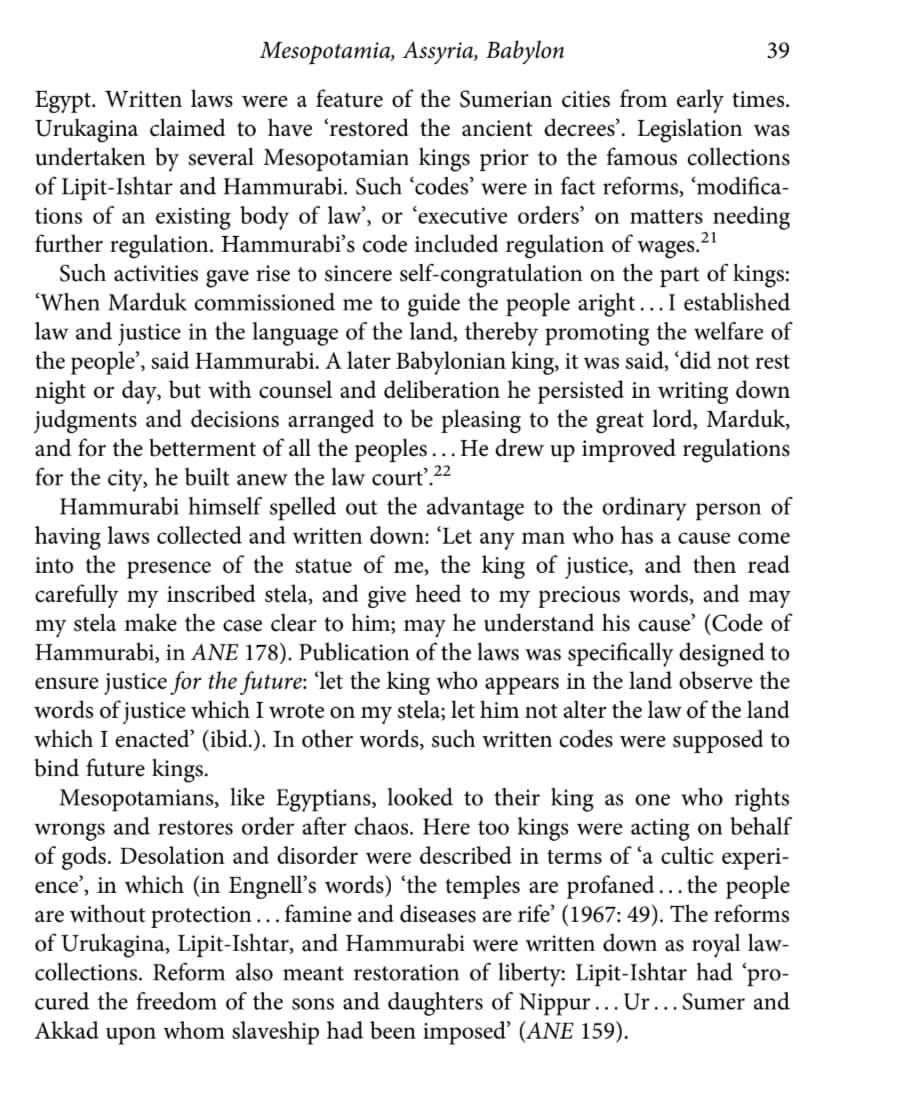
JUSTICE Finally, the king existed to ensure justice. The Mesopotamians, unlike the Egyptians, developed a theory of law. This was based on kittum ("truth and 38 A World History of Ancient Political Thought right), which (like maat in Egypt) 'belonged to a sphere of existence that surpassed both the human and the divine'. This immutable justice was to be spelled out and implemented by the just king (sar mesarim)'. He was its agent rather than its source', and subordinate to it. What the god "gives the king is not laws" but the gift of perception of kittum', so that the king, and he alone, becomes capable of promulgating laws that are in harmony with the cosmic principle of kittum'. A king could then tell his subjects what the law was in all the varieties of life's circumstances by means of royal legislation. The law in this sense was an economic rather than a religious concern'.18 The just king, like god, should punish the unjust judge, and anyone 'who handles the scales in falsehood, and reward those who refuse bribes (Sumero- Akkadian hymn: ANE 388). As in Egypt, the king's role in protecting the poor, weak, and oppressed from lawlessness or domination by the rich and powerful was strongly emphasized in discourses about justice. In other words, the king existed to rectify the existing inequities in society; getting rid, that is, of the harmful effects of social hierarchy. This was modelled on the gods' activity: Nanshe is one who knows the orphan, who knows the widow, knows the oppression of man over man, is the orphan's mother, Nanshe, who cares for the widow'. She will comfort the orphan... set up a place of destruction for the mighty, turn over the mighty to the weak' (in Kramer 1963: 1245). A late third-millennium king was said to have left not the orphan at the rich man's mercy, left not the widow at the mercy of the strong... On the neck of lawlessness and of rebels he set his foot'. A nineteenth-century king promised *the seized just man to deliver, the evil-doer to annihilate... that the weak succumb not to the strong, but the powerless renew strength, that the mighty may not act arbitrarily, nor do violence to the weak. Hammurabi said he had been made king 'to cause justice to prevail in the land, to destroy the wicked and the evil, that the strong might not oppress the weak'; and he had his laws written down in order that the strong might not oppress the weak, that justice might be done the orphan and widow'. '9 The parallel with Egypt could hardly be closer. Sometimes the intention was not only to redress a specific grievance, but to remove the weak from the power of the strong by putting them under the king's protection. Urukagina, a reforming monarch of the twenty-fourth or twenty-third century, was said to have 'joined the covenant with (the god] Ningirsu that he would not deliver up the weak and the widow to the powerful man.20 In eighteenth- to seventeenth-century Babylonia, 'the annulment of debts by the king became a common occurrence' (Mieroop 1997: 206). This suggests a desire to readjust the relationships of power, not simply to correct an injustice already done, but to create a situation in which it would nr happen again. One way of achieving this was to have the laws inscribed so that all coul know their rights. This was one major difference between Mesopotamia an C Mesopotamia, Assyria, Babylon 39 Egypt. Written laws were a feature of the Sumerian cities from early times. Urukagina claimed to have restored the ancient decrees'. Legislation was undertaken by several Mesopotamian kings prior to the famous collections of Lipit-Ishtar and Hammurabi. Such codes' were in fact reforms, modifica- tions of an existing body of law', or executive orders' on matters needing further regulation. Hammurabi's code included regulation of wages.21 Such activities gave rise to sincere self-congratulation on the part of kings: 'When Marduk commissioned me to guide the people aright... I established law and justice in the language of the land, thereby promoting the welfare of the people', said Hammurabi. A later Babylonian king, it was said, 'did not rest night or day, but with counsel and deliberation he persisted in writing down judgments and decisions arranged to be pleasing to the great lord, Marduk, and for the betterment of all the peoples ... He drew up improved regulations for the city, he built anew the law court.22 Hammurabi himself spelled out the advantage to the ordinary person of having laws collected and written down: 'Let any man who has a cause come into the presence of the statue of me, the king of justice, and then read carefully my inscribed stela, and give heed to my precious words, and may my stela make the case clear to him; may he understand his cause' (Code of Hammurabi, in ANE 178). Publication of the laws was specifically designed to ensure justice for the future: let the king who appears in the land observe the words of justice which I wrote on my stela; let him not alter the law of the land which I enacted (ibid.). In other words, such written codes were supposed to bind future kings. Mesopotamians, like Egyptians, looked to their king as one who rights wrongs and restores order after chaos. Here too kings were acting on behalf of gods. Desolation and disorder were described in terms of a cultic experi- ence', in which (in Engnell's words) 'the temples are profaned ... the people are without protection ... famine and diseases are rife' (1967: 49). The reforms of Urukagina, Lipit-Ishtar, and Hammurabi were written down as royal law- collections. Reform also meant restoration of liberty: Lipit-Ishtar had 'pro- cured the freedom of the sons and daughters of Nippur... Ur... Sumer and Akkad upon whom slaveship had been imposed' (ANE 159)
Step by Step Solution
There are 3 Steps involved in it
1 Expert Approved Answer
Step: 1 Unlock

Question Has Been Solved by an Expert!
Get step-by-step solutions from verified subject matter experts
Step: 2 Unlock
Step: 3 Unlock
 Study Help