Question: 1. Read and reflect (think about how each point relates to you) on pages 13-14, #1-7 . Type your personal thoughts in a minimum of
1. Read and reflect (think about how each point relates to you) on pages 13-14, #1-7. Type your personal thoughts in a minimum of two (2) sentences for each number.
- #1 Understanding the baseline for success in the course (write 2 reflective thoughts):
- #2 Establishing an overview of the field (write 2 reflective thoughts):
- #3 Overlearn until you discover what is expected (write 2 reflective thoughts):
- #4 Use several different methods to learn the same information (write 2 reflective thoughts)
- #5 Look for similarities between the new subject matter and other academic fields that are more familiar to you (write 2 reflective thoughts):
- #6 Develop a support network (write 2 reflective thoughts):
- #7 Think in new ways (write 2 reflective thoughts):
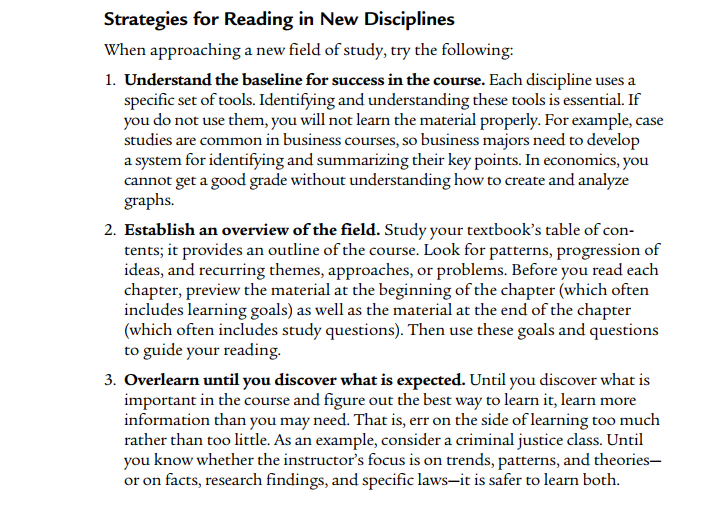
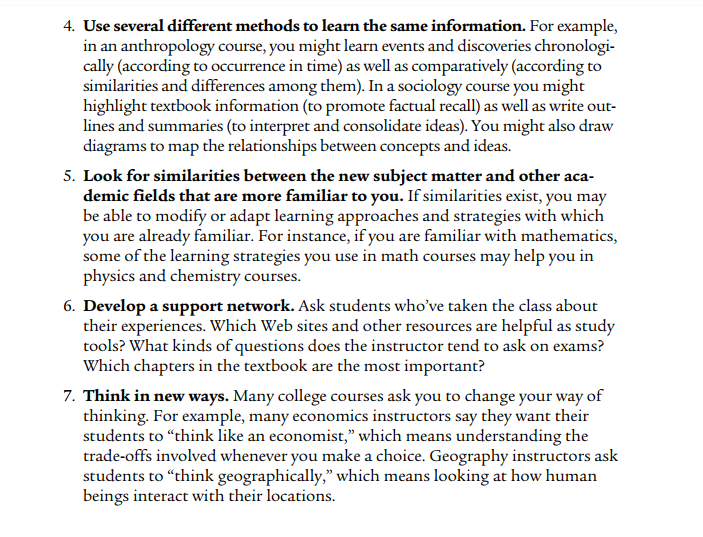
Strategies for Reading in New Disciplines When approaching a new field of study, try the following: 1. Understand the baseline for success in the course. Each discipline uses a specific set of tools. Identifying and understanding these tools is essential. If you do not use them, you will not learn the material properly. For example, case studies are common in business courses, so business majors need to develop a system for identifying and summarizing their key points. In economics, you cannot get a good grade without understanding how to create and analyze graphs. 2. Establish an overview of the field. Study your textbook's table of con- tents; it provides an outline of the course. Look for patterns, progression of ideas, and recurring themes, approaches, or problems. Before you read each chapter, preview the material at the beginning of the chapter (which often includes learning goals) as well as the material at the end of the chapter (which often includes study questions). Then use these goals and questions to guide your reading. 3. Overlearn until you discover what is expected. Until you discover what is important in the course and figure out the best way to learn it, learn more information than you may need. That is, err on the side of learning too much rather than too little. As an example, consider a criminal justice class. Until you know whether the instructor's focus is on trends, patterns, and theories, or on facts, research findings, and specific laws-it is safer to learn both. 4. Use several different methods to learn the same information. For example, in an anthropology course, you might learn events and discoveries chronologi- cally (according to occurrence in time) as well as comparatively (according to similarities and differences among them). In a sociology course you might highlight textbook information to promote factual recall) as well as write out- lines and summaries (to interpret and consolidate ideas). You might also draw diagrams to map the relationships between concepts and ideas. 5. Look for similarities between the new subject matter and other aca- demic fields that are more familiar to you. If similarities exist, you may be able to modify or adapt learning approaches and strategies with which you are already familiar. For instance, if you are familiar with mathematics, some of the learning strategies you use in math courses may help you in physics and chemistry courses. 6. Develop a support network. Ask students who've taken the class about their experiences. Which Web sites and other resources are helpful as study tools? What kinds of questions does the instructor tend to ask on exams? Which chapters in the textbook are the most important? 7. Think in new ways. Many college courses ask you to change your way of thinking. For example, many economics instructors say they want their students to "think like an economist, which means understanding the trade-offs involved whenever you make a choice. Geography instructors ask students to "think geographically," which means looking at how human beings interact with their locations









 Study Help