Question: 1. Read Communicating with Classmates and Communicating with Instructors, p. 18-19 and select 3 tips you intend to use and explain how you have or
1. Read Communicating with Classmates and Communicating with Instructors, p. 18-19 and select 3 tips you intend to use and explain how you have or will obtain the necessary information in order to communicate.
- Tip #1 I intend to use:
- Tip #2 I intend to use:
- Tip #3 I intend to use:
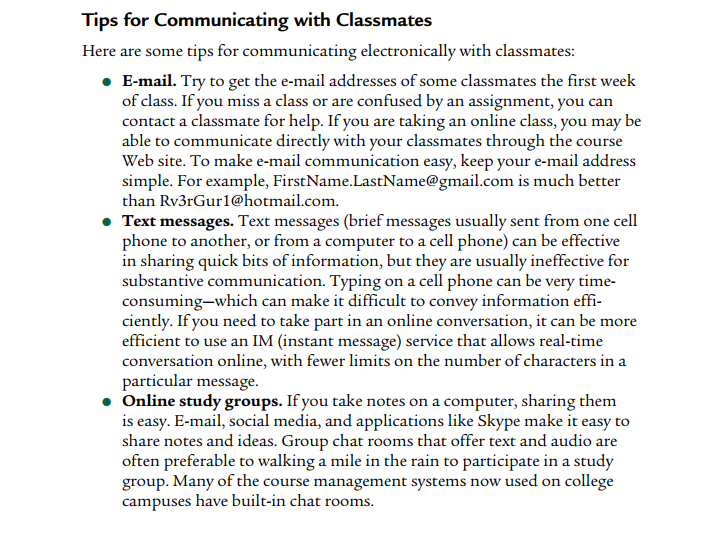
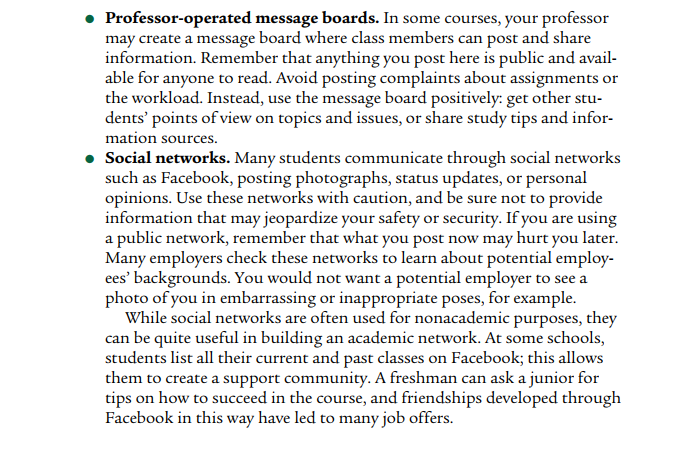
Tips for Communicating with Classmates Here are some tips for communicating electronically with classmates: E-mail. Try to get the e-mail addresses of some classmates the first week of class. If you miss a class or are confused by an assignment, you can contact a classmate for help. If you are taking an online class, you may be able to communicate directly with your classmates through the course Web site. To make e-mail communication easy, keep your e-mail address simple. For example, First Name.LastName@gmail.com is much better than Rv3rGur1@hotmail.com. Text messages. Text messages (brief messages usually sent from one cell phone to another, or from a computer to a cell phone) can be effective in sharing quick bits of information, but they are usually ineffective for substantive communication. Typing on a cell phone can be very time- consuming-which can make it difficult to convey information effi- ciently. If you need to take part in an online conversation, it can be more efficient to use an IM instant message) service that allows real-time conversation online, with fewer limits on the number of characters in a particular message. Online study groups. If you take notes on a computer, sharing them is easy. E-mail, social media, and applications like Skype make it easy to share notes and ideas. Group chat rooms that offer text and audio are often preferable to walking a mile in the rain to participate in a study group. Many of the course management systems now used on college campuses have built-in chat rooms. Professor-operated message boards. In some courses, your professor may create a message board where class members can post and share information. Remember that anything you post here is public and avail- able for anyone to read. Avoid posting complaints about assignments or the workload. Instead, use the message board positively: get other stu- dents' points of view on topics and issues, or share study tips and infor- mation sources. Social networks. Many students communicate through social networks such as Facebook, posting photographs, status updates, or personal opinions. Use these networks with caution, and be sure not to provide information that may jeopardize your safety or security. If you are using a public network, remember that what you post now may hurt you later. Many employers check these networks to learn about potential employ- ees' backgrounds. You would not want a potential employer to see a photo of you in embarrassing or inappropriate poses, for example. While social networks are often used for nonacademic purposes, they can be quite useful in building an academic network. At some schools, students list all their current and past classes on Facebook; this allows them to create a support community. A freshman can ask a junior for tips on how to succeed in the course, and friendships developed through Facebook in this way have led to many job offers




