







Question: 1. Read the attached case study, thoroughly. 2. Write 23 paragraphs per question. 3. Questions to address: - How did the owner of Malden Mills
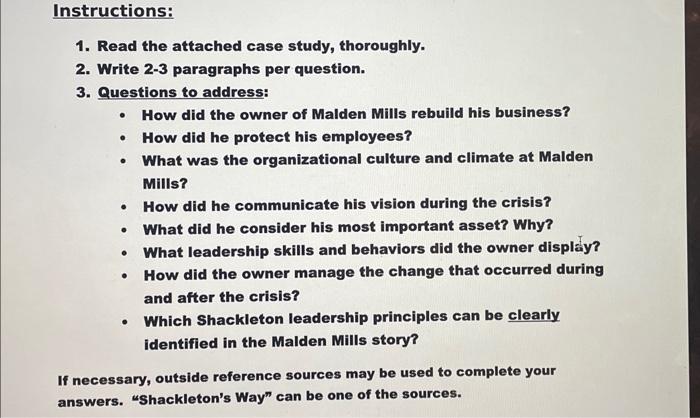
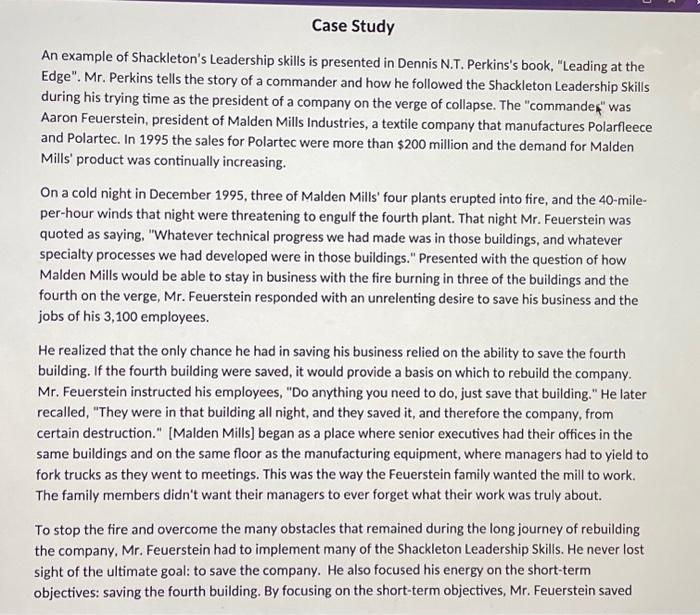
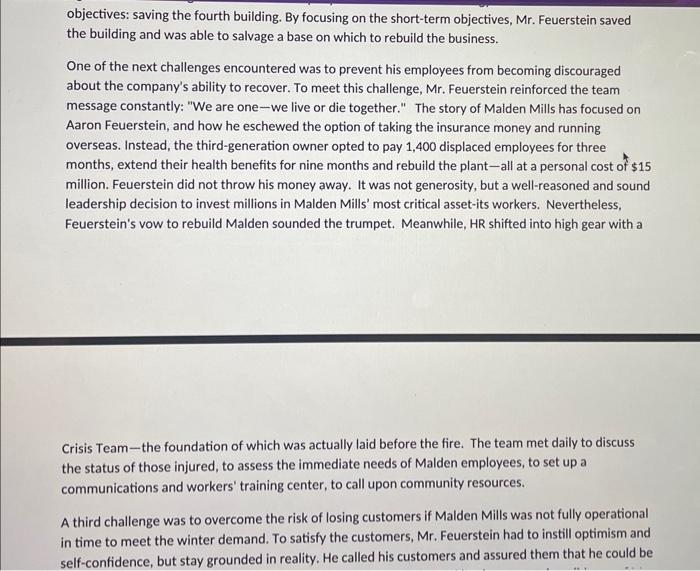
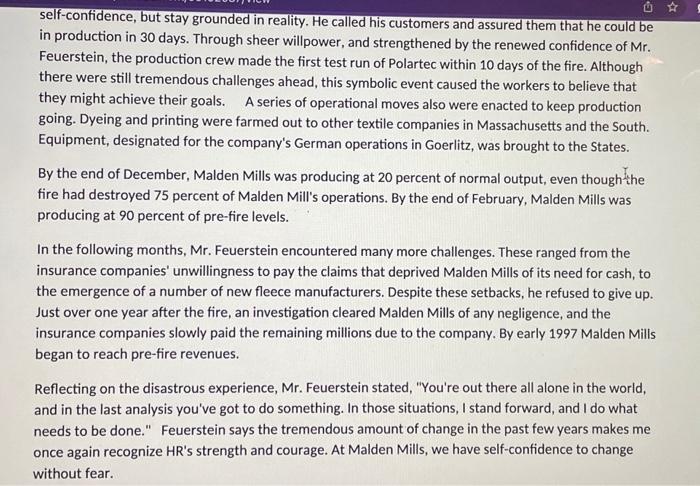
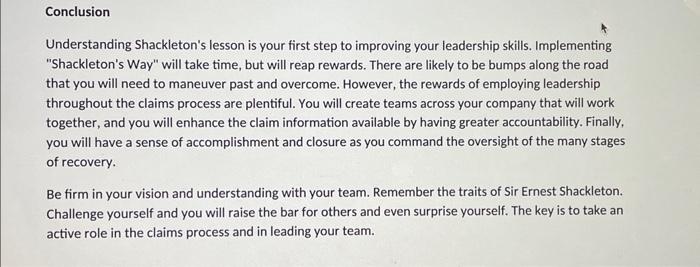
1. Read the attached case study, thoroughly. 2. Write 23 paragraphs per question. 3. Questions to address: - How did the owner of Malden Mills rebuild his business? - How did he protect his employees? - What was the organizational culture and climate at Malden Mills? - How did he communicate his vision during the crisis? - What did he consider his most important asset? Why? - What leadership skills and behaviors did the owner displajy? - How did the owner manage the change that occurred during and after the crisis? - Which Shackleton leadership principles can be clearly identified in the Malden Mills story? If necessary, outside reference sources may be used to complete your answers. "Shackleton's Way" can be one of the sources. An example of Shackleton's Leadership skills is presented in Dennis N.T. Perkins's book, "Leading at the Edge". Mr. Perkins tells the story of a commander and how he followed the Shackleton Leadership Skills during his trying time as the president of a company on the verge of collapse. The "commande" was Aaron Feuerstein, president of Malden Mills Industries, a textile company that manufactures Polarfleece and Polartec. In 1995 the sales for Polartec were more than $200 million and the demand for Malden Mills' product was continually increasing. On a cold night in December 1995, three of Malden Mills' four plants erupted into fire, and the 40-mileper-hour winds that night were threatening to engulf the fourth plant. That night Mr. Feuerstein was quoted as saying, "Whatever technical progress we had made was in those buildings, and whatever specialty processes we had developed were in those buildings." Presented with the question of how Malden Mills would be able to stay in business with the fire burning in three of the buildings and the fourth on the verge, Mr. Feuerstein responded with an unrelenting desire to save his business and the jobs of his 3,100 employees. He realized that the only chance he had in saving his business relied on the ability to save the fourth building. If the fourth building were saved, it would provide a basis on which to rebuild the company. Mr. Feuerstein instructed his employees, "Do anything you need to do, just save that building." He later recalled, "They were in that building all night, and they saved it, and therefore the company, from certain destruction." [Malden Mills] began as a place where senior executives had their offices in the same buildings and on the same floor as the manufacturing equipment, where managers had to yield to fork trucks as they went to meetings. This was the way the Feuerstein family wanted the mill to work. The family members didn't want their managers to ever forget what their work was truly about. To stop the fire and overcome the many obstacles that remained during the long journey of rebuilding the company, Mr. Feuerstein had to implement many of the Shackleton Leadership Skills. He never lost sight of the ultimate goal: to save the company. He also focused his energy on the short-term objectives: saving the fourth building. By focusing on the short-term objectives, Mr. Feuerstein saved objectives: saving the fourth building. By focusing on the short-term objectives, Mr. Feuerstein saved the building and was able to salvage a base on which to rebuild the business. One of the next challenges encountered was to prevent his employees from becoming discouraged about the company's ability to recover. To meet this challenge, Mr. Feuerstein reinforced the team message constantly: "We are one-we live or die together." The story of Malden Mills has focused on Aaron Feuerstein, and how he eschewed the option of taking the insurance money and running overseas. Instead, the third-generation owner opted to pay 1,400 displaced employees for three months, extend their health benefits for nine months and rebuild the plant-all at a personal cost of $15 million. Feuerstein did not throw his money away. It was not generosity, but a well-reasoned and sound leadership decision to invest millions in Malden Mills' most critical asset-its workers. Nevertheless, Feuerstein's vow to rebuild Malden sounded the trumpet. Meanwhile, HR shifted into high gear with a Crisis Team - the foundation of which was actually laid before the fire. The team met daily to discuss the status of those injured, to assess the immediate needs of Malden employees, to set up a communications and workers' training center, to call upon community resources. A third challenge was to overcome the risk of losing customers if Malden Mills was not fully operational in time to meet the winter demand. To satisfy the customers, Mr. Feuerstein had to instill optimism and self-confidence, but stay grounded in reality. He called his customers and assured them that he could be in production in 30 days. Through sheer willpower, and strengthened by the renewed confidence of Mr. Feuerstein, the production crew made the first test run of Polartec within 10 days of the fire. Although there were still tremendous challenges ahead, this symbolic event caused the workers to believe that they might achieve their goals. A series of operational moves also were enacted to keep production going. Dyeing and printing were farmed out to other textile companies in Massachusetts and the South. Equipment, designated for the company's German operations in Goerlitz, was brought to the States. By the end of December, Malden Mills was producing at 20 percent of normal output, even though the fire had destroyed 75 percent of Malden Mill's operations. By the end of February, Malden Mills was producing at 90 percent of pre-fire levels. In the following months, Mr. Feuerstein encountered many more challenges. These ranged from the insurance companies' unwillingness to pay the claims that deprived Malden Mills of its need for cash, to the emergence of a number of new fleece manufacturers. Despite these setbacks, he refused to give up. Just over one year after the fire, an investigation cleared Malden Mills of any negligence, and the insurance companies slowly paid the remaining millions due to the company. By early 1997 Malden Mills began to reach pre-fire revenues. Reflecting on the disastrous experience, Mr. Feuerstein stated, "You're out there all alone in the world, and in the last analysis you've got to do something. In those situations, I stand forward, and I do what needs to be done." Feuerstein says the tremendous amount of change in the past few years makes me once again recognize HR's strength and courage. At Malden Mills, we have self-confidence to change Understanding Shackleton's lesson is your first step to improving your leadership skills. Implementing "Shackleton's Way" will take time, but will reap rewards. There are likely to be bumps along the road that you will need to maneuver past and overcome. However, the rewards of employing leadership throughout the claims process are plentiful. You will create teams across your company that will work together, and you will enhance the claim information available by having greater accountability. Finally, you will have a sense of accomplishment and closure as you command the oversight of the many stages of recovery. Be firm in your vision and understanding with your team. Remember the traits of Sir Ernest Shackleton. Challenge yourself and you will raise the bar for others and even surprise yourself. The key is to take an active role in the claims process and in leading your team. 1. Read the attached case study, thoroughly. 2. Write 23 paragraphs per question. 3. Questions to address: - How did the owner of Malden Mills rebuild his business? - How did he protect his employees? - What was the organizational culture and climate at Malden Mills? - How did he communicate his vision during the crisis? - What did he consider his most important asset? Why? - What leadership skills and behaviors did the owner displajy? - How did the owner manage the change that occurred during and after the crisis? - Which Shackleton leadership principles can be clearly identified in the Malden Mills story? If necessary, outside reference sources may be used to complete your answers. "Shackleton's Way" can be one of the sources. An example of Shackleton's Leadership skills is presented in Dennis N.T. Perkins's book, "Leading at the Edge". Mr. Perkins tells the story of a commander and how he followed the Shackleton Leadership Skills during his trying time as the president of a company on the verge of collapse. The "commande" was Aaron Feuerstein, president of Malden Mills Industries, a textile company that manufactures Polarfleece and Polartec. In 1995 the sales for Polartec were more than $200 million and the demand for Malden Mills' product was continually increasing. On a cold night in December 1995, three of Malden Mills' four plants erupted into fire, and the 40-mileper-hour winds that night were threatening to engulf the fourth plant. That night Mr. Feuerstein was quoted as saying, "Whatever technical progress we had made was in those buildings, and whatever specialty processes we had developed were in those buildings." Presented with the question of how Malden Mills would be able to stay in business with the fire burning in three of the buildings and the fourth on the verge, Mr. Feuerstein responded with an unrelenting desire to save his business and the jobs of his 3,100 employees. He realized that the only chance he had in saving his business relied on the ability to save the fourth building. If the fourth building were saved, it would provide a basis on which to rebuild the company. Mr. Feuerstein instructed his employees, "Do anything you need to do, just save that building." He later recalled, "They were in that building all night, and they saved it, and therefore the company, from certain destruction." [Malden Mills] began as a place where senior executives had their offices in the same buildings and on the same floor as the manufacturing equipment, where managers had to yield to fork trucks as they went to meetings. This was the way the Feuerstein family wanted the mill to work. The family members didn't want their managers to ever forget what their work was truly about. To stop the fire and overcome the many obstacles that remained during the long journey of rebuilding the company, Mr. Feuerstein had to implement many of the Shackleton Leadership Skills. He never lost sight of the ultimate goal: to save the company. He also focused his energy on the short-term objectives: saving the fourth building. By focusing on the short-term objectives, Mr. Feuerstein saved objectives: saving the fourth building. By focusing on the short-term objectives, Mr. Feuerstein saved the building and was able to salvage a base on which to rebuild the business. One of the next challenges encountered was to prevent his employees from becoming discouraged about the company's ability to recover. To meet this challenge, Mr. Feuerstein reinforced the team message constantly: "We are one-we live or die together." The story of Malden Mills has focused on Aaron Feuerstein, and how he eschewed the option of taking the insurance money and running overseas. Instead, the third-generation owner opted to pay 1,400 displaced employees for three months, extend their health benefits for nine months and rebuild the plant-all at a personal cost of $15 million. Feuerstein did not throw his money away. It was not generosity, but a well-reasoned and sound leadership decision to invest millions in Malden Mills' most critical asset-its workers. Nevertheless, Feuerstein's vow to rebuild Malden sounded the trumpet. Meanwhile, HR shifted into high gear with a Crisis Team - the foundation of which was actually laid before the fire. The team met daily to discuss the status of those injured, to assess the immediate needs of Malden employees, to set up a communications and workers' training center, to call upon community resources. A third challenge was to overcome the risk of losing customers if Malden Mills was not fully operational in time to meet the winter demand. To satisfy the customers, Mr. Feuerstein had to instill optimism and self-confidence, but stay grounded in reality. He called his customers and assured them that he could be in production in 30 days. Through sheer willpower, and strengthened by the renewed confidence of Mr. Feuerstein, the production crew made the first test run of Polartec within 10 days of the fire. Although there were still tremendous challenges ahead, this symbolic event caused the workers to believe that they might achieve their goals. A series of operational moves also were enacted to keep production going. Dyeing and printing were farmed out to other textile companies in Massachusetts and the South. Equipment, designated for the company's German operations in Goerlitz, was brought to the States. By the end of December, Malden Mills was producing at 20 percent of normal output, even though the fire had destroyed 75 percent of Malden Mill's operations. By the end of February, Malden Mills was producing at 90 percent of pre-fire levels. In the following months, Mr. Feuerstein encountered many more challenges. These ranged from the insurance companies' unwillingness to pay the claims that deprived Malden Mills of its need for cash, to the emergence of a number of new fleece manufacturers. Despite these setbacks, he refused to give up. Just over one year after the fire, an investigation cleared Malden Mills of any negligence, and the insurance companies slowly paid the remaining millions due to the company. By early 1997 Malden Mills began to reach pre-fire revenues. Reflecting on the disastrous experience, Mr. Feuerstein stated, "You're out there all alone in the world, and in the last analysis you've got to do something. In those situations, I stand forward, and I do what needs to be done." Feuerstein says the tremendous amount of change in the past few years makes me once again recognize HR's strength and courage. At Malden Mills, we have self-confidence to change Understanding Shackleton's lesson is your first step to improving your leadership skills. Implementing "Shackleton's Way" will take time, but will reap rewards. There are likely to be bumps along the road that you will need to maneuver past and overcome. However, the rewards of employing leadership throughout the claims process are plentiful. You will create teams across your company that will work together, and you will enhance the claim information available by having greater accountability. Finally, you will have a sense of accomplishment and closure as you command the oversight of the many stages of recovery. Be firm in your vision and understanding with your team. Remember the traits of Sir Ernest Shackleton. Challenge yourself and you will raise the bar for others and even surprise yourself. The key is to take an active role in the claims process and in leading your team
Step by Step Solution
There are 3 Steps involved in it

Get step-by-step solutions from verified subject matter experts
 Study Help