



Question: Please read the attached case study (POSCO's Journey: Building Employee Trust Through Communication) and produce a 3-4 page analysis using your past experience, and/or your
Please read the attached case study (POSCO's Journey: Building Employee Trust Through Communication) and produce a 3-4 page analysis using your past experience, and/or your own informed opinion.The follow questions should be addressed in your analysis:
- Why is trust important to companies such as POSCO that hope to attain sustainability?
- How is communication important to trust-building efforts?
- Was there anything else POSCO could have done to build employee trust through communication?
- While the trust communication initiative produced some early positive results, employees continued to perceive POSCOs culture in a negative light (i.e. it is like army culture). Why did this discrepancy exist? What could POSCO do to address this troubling perception?
- Despite having one of the top three employee engagement scores among companies in South Korea in 2010, the perception that POSCO had an army culture persisted. What could have accounted for this discrepancy?
- Was POSCO successful in establishing trust through communication?
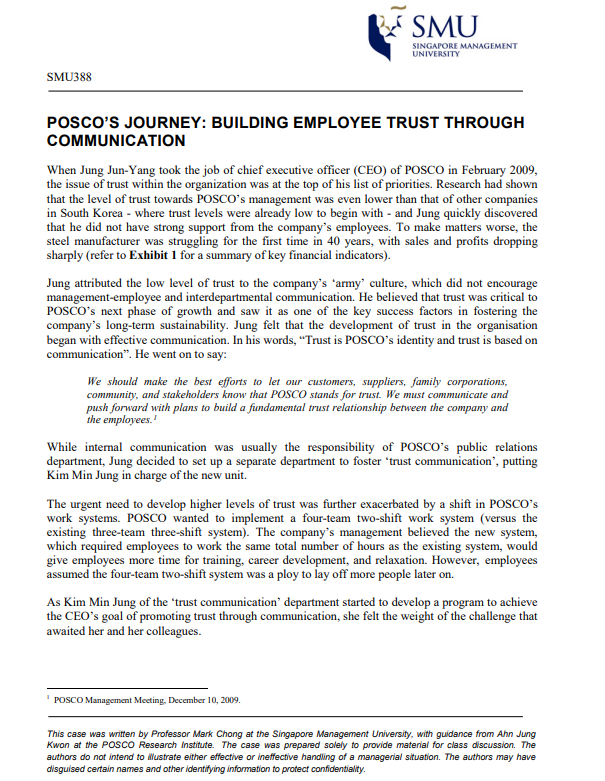
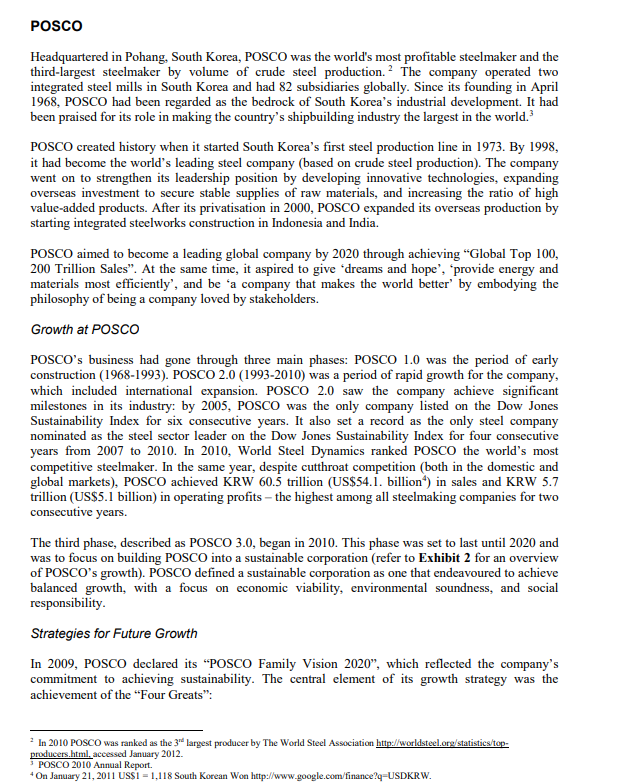
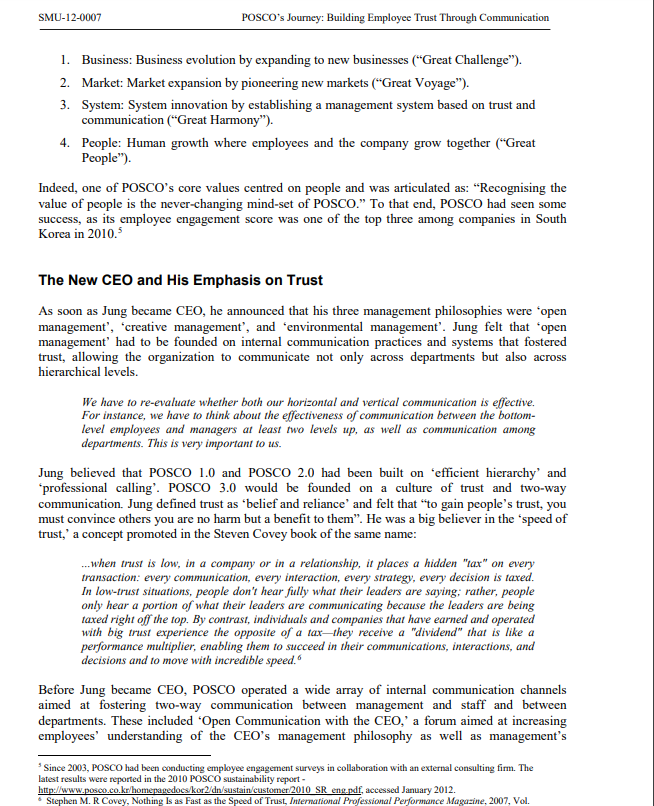
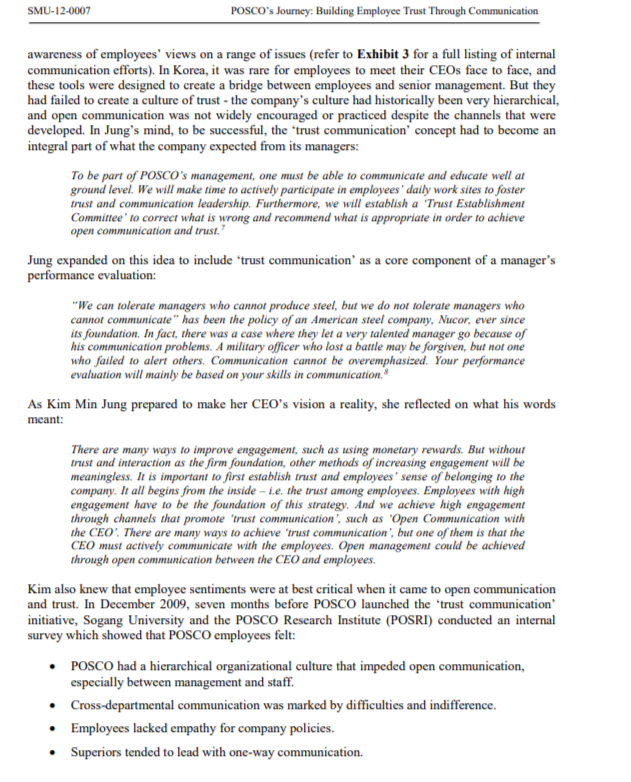
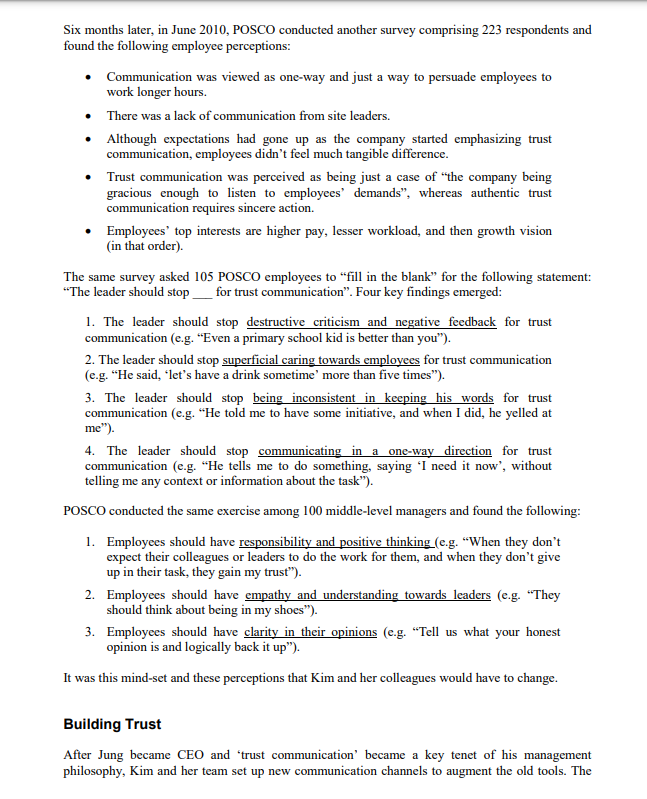
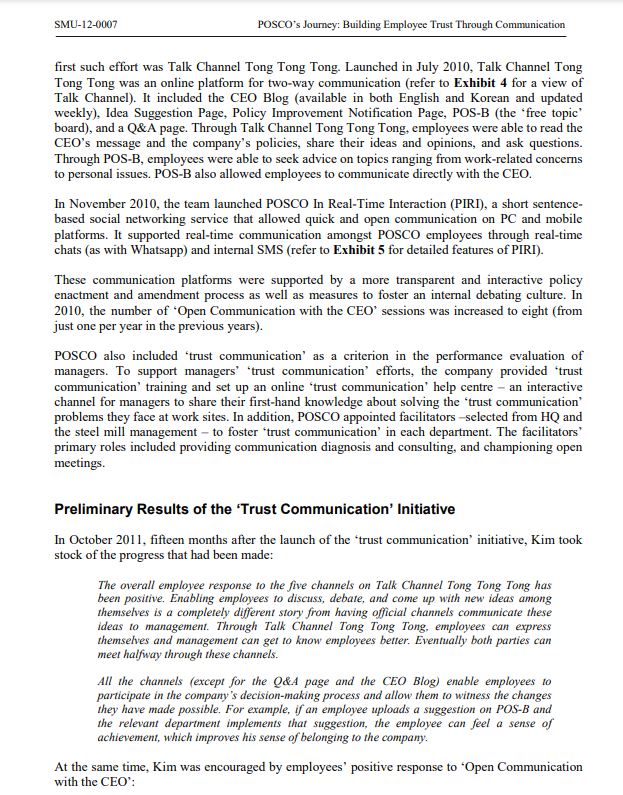
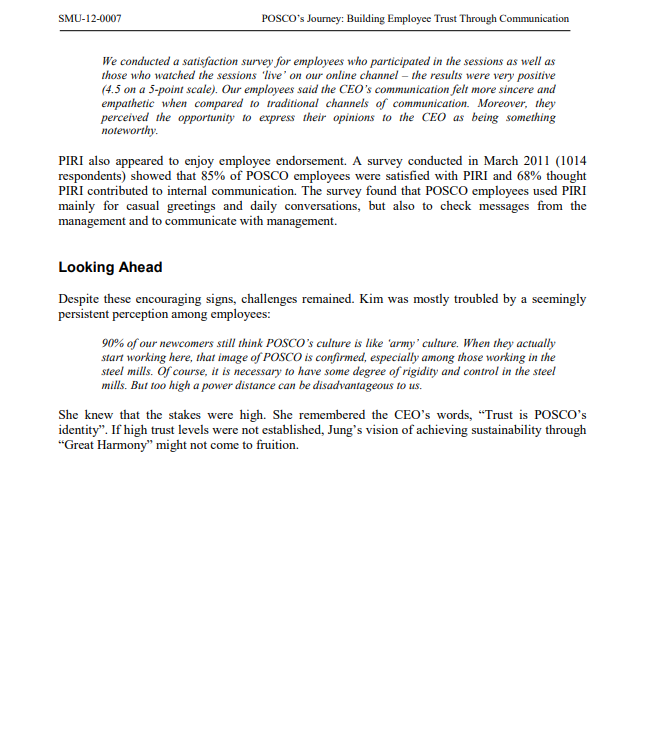
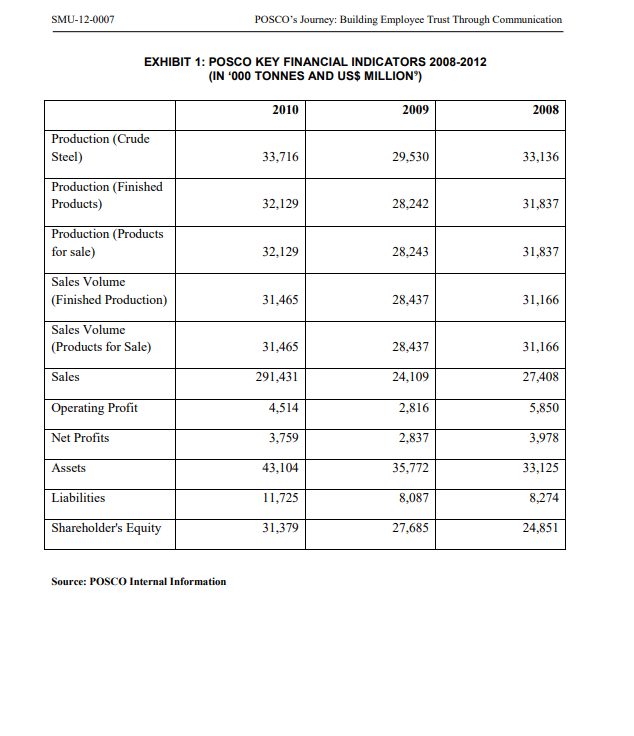
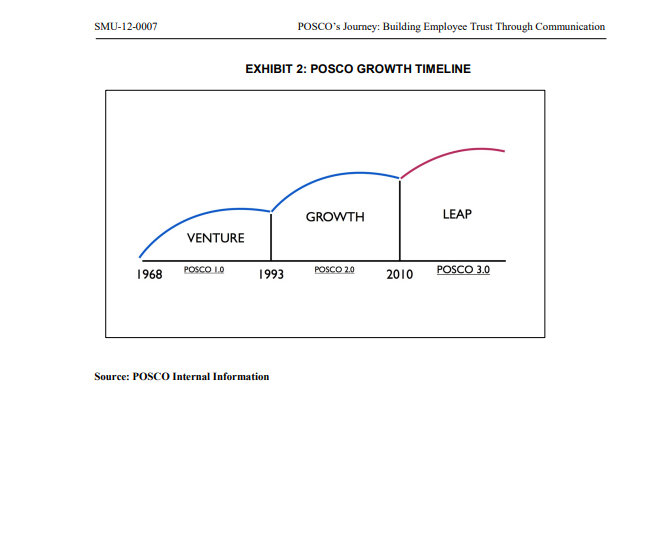
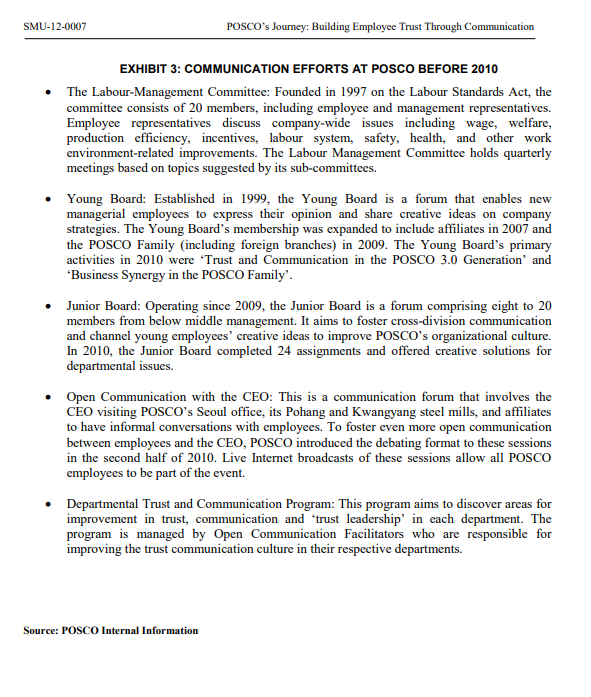
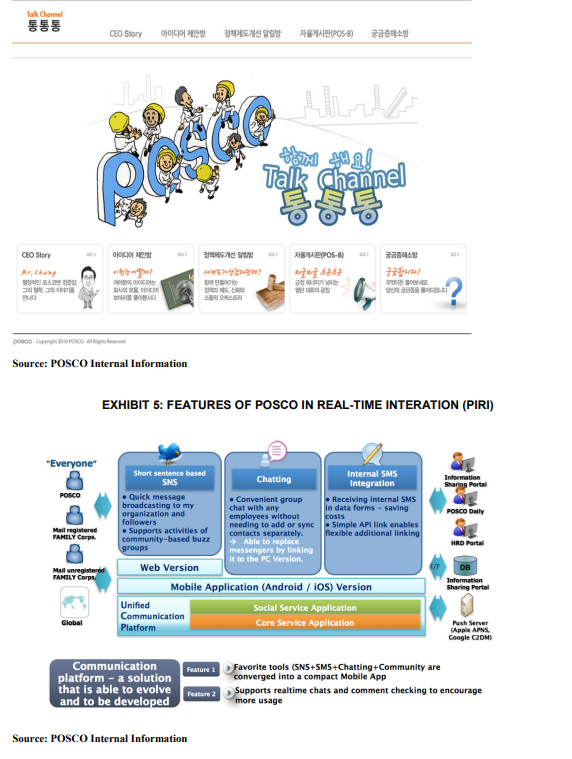
When Jung Jun-Yang took the job of chief executive officer (CEO) of POSCO in February 2009, the issue of trust within the organization was at the top of his list of priorities. Research had shown that the level of trust towards POSCO's management was even lower than that of other companies in South Korea - where trust levels were already low to begin with - and Jung quickly discovered that he did not have strong support from the company's employees. To make matters worse, the steel manufacturer was struggling for the first time in 40 years, with sales and profits dropping sharply (refer to Exhibit 1 for a summary of key financial indicators). Jung attributed the low level of trust to the company's 'army' culture, which did not encourage management-employee and interdepartmental communication. He believed that trust was critical to POSCO's next phase of growth and saw it as one of the key success factors in fostering the company's long-term sustainability. Jung felt that the development of trust in the organisation began with effective communication. In his words, "Trust is POSCO's identity and trust is based on communication". He went on to say: We should make the best efforts to let our customers, suppliers, family corporations, community, and stakeholders know that POSCO stands for trust. We must communicate and push forward with plans to build a fundamental trust relationship between the company and the employees. I While internal communication was usually the responsibility of POSCO's public relations department, Jung decided to set up a separate department to foster 'trust communication', putting Kim Min Jung in charge of the new unit. The urgent need to develop higher levels of trust was further exacerbated by a shift in POSCO's work systems. POSCO wanted to implement a four-team two-shift work system (versus the existing three-team three-shift system). The company's management believed the new system, which required employees to work the same total number of hours as the existing system, would give employees more time for training, career development, and relaxation. However, employees assumed the four-team two-shift system was a ploy to lay off more people later on. As Kim Min Jung of the 'trust communication' department started to develop a program to achieve the CEO's goal of promoting trust through communication, she felt the weight of the challenge that awaited her and her colleagues. POSCO Management Mecting. December 10, 2009. This case was written by Professor Mark Chong at the Singapore Management University, with guidance from Ahn Jung Kwon at the POSCO Research Institute. The case was prepared solely to provide material for class discussion. The authors do not intend to Wilustrate either effective or ineffective handing of a managerial situation. The authors may have disguised certain names and other identifying information to protect confidentiality. POSCO Headquartered in Pohang, South Korea, POSCO was the world's most profitable steelmaker and the third-largest steelmaker by volume of crude steel production. 2 The company operated two integrated steel mills in South Korea and had 82 subsidiaries globally. Since its founding in April 1968 , POSCO had been regarded as the bedrock of South Korea's industrial development. It had been praised for its role in making the country's shipbuilding industry the largest in the world. 3 POSCO created history when it started South Korea's first steel production line in 1973. By 1998, it had become the world's leading steel company (based on crude steel production). The company went on to strengthen its leadership position by developing innovative technologies, expanding overseas investment to secure stable supplies of raw materials, and increasing the ratio of high value-added products. After its privatisation in 2000, POSCO expanded its overseas production by starting integrated steelworks construction in Indonesia and India. POSCO aimed to become a leading global company by 2020 through achieving "Global Top 100 , 200 Trillion Sales". At the same time, it aspired to give 'dreams and hope', 'provide energy and materials most efficiently', and be 'a company that makes the world better' by embodying the philosophy of being a company loved by stakeholders. Growth at POSCO POSCO's business had gone through three main phases: POSCO 1.0 was the period of early construction (1968-1993). POSCO 2.0 (1993-2010) was a period of rapid growth for the company, which included international expansion. POSCO2.0 saw the company achieve significant milestones in its industry: by 2005, POSCO was the only company listed on the Dow Jones Sustainability Index for six consecutive years. It also set a record as the only steel company nominated as the steel sector leader on the Dow Jones Sustainability Index for four consecutive years from 2007 to 2010 . In 2010, World Steel Dynamics ranked POSCO the world's most competitive steelmaker. In the same year, despite cutthroat competition (both in the domestic and global markets), POSCO achieved KRW 60.5 trillion (US\$54.1. billion 4 ) in sales and KRW 5.7 trillion (US\$5.1 billion) in operating profits - the highest among all steelmaking companies for two consecutive years. The third phase, described as POSCO 3.0, began in 2010. This phase was set to last until 2020 and was to focus on building POSCO into a sustainable corporation (refer to Exhibit 2 for an overview of POSCO's growth). POSCO defined a sustainable corporation as one that endeavoured to achieve balanced growth, with a focus on economic viability, environmental soundness, and social responsibility. Strategies for Future Growth In 2009, POSCO declared its "POSCO Family Vision 2020", which reflected the company's commitment to achieving sustainability. The central element of its growth strategy was the achievement of the "Four Greats": 2 In 2010 POSCO was ranked as the 3ra largest producer by The World Steel Association hatho//worldsteel.org/statistics/topproducers. html, accessed January 2012 . 3 POSCO 2010 Annual Report. "On January 21, 2011 USS 1=1,118 South Korean Won http://www.google.com/finance?q=USDKRW. SMU-12-0007 POSCO's Journey: Building Employee Trust Through Communication 1. Business: Business evolution by expanding to new businesses ("Great Challenge"). 2. Market: Market expansion by pioneering new markets ("Great Voyage"). 3. System: System innovation by establishing a management system based on trust and communication ("Great Harmony"). 4. People: Human growth where employees and the company grow together ("Great People"). Indeed, one of POSCO's core values centred on people and was articulated as: "Recognising the value of people is the never-changing mind-set of POSCO." To that end, POSCO had seen some success, as its employee engagement score was one of the top three among companies in South Korea in 2010.5 The New CEO and His Emphasis on Trust As soon as Jung became CEO, he announced that his three management philosophies were 'open management', 'creative management', and 'environmental management'. Jung felt that 'open management' had to be founded on internal communication practices and systems that fostered trust, allowing the organization to communicate not only across departments but also across hierarchical levels. We have to re-evaluate whether both our horizontal and vertical communication is effective. For instance, we have to think about the effectiveness of communication between the bottomlevel employees and managers at least two levels up, as well as communication among departments. This is very important to us. Jung believed that POSCO 1.0 and POSCO 2.0 had been built on 'efficient hierarchy' and 'professional calling'. POSCO 3.0 would be founded on a culture of trust and two-way communication. Jung defined trust as 'belief and reliance' and felt that "to gain people's trust, you must convince others you are no harm but a benefit to them". He was a big believer in the 'speed of trust,' a concept promoted in the Steven Covey book of the same name: ... When trust is low, in a company or in a relationship, it places a hidden "tax" on every transaction: every communication, every interaction, every strategy, every decision is taxed. In low-trust situations, people don't hear fully what their leaders are saying; rather, people only hear a portion of what their leaders are communicating because the leaders are being taxed right off the top. By contrast, individuals and companies that have earned and operated with big trust experience the opposite of a tax-they receive a "dividend" that is like a performance multiplier, enabling them to succeed in their communications, interactions, and decisions and to move with incredible speed. 6 Before Jung became CEO, POSCO operated a wide array of internal communication channels aimed at fostering two-way communication between management and staff and between departments. These included 'Open Communication with the CEO,' a forum aimed at increasing employees' understanding of the CEO's management philosophy as well as management's 'Since 2003, POSCO had been conducting employee engagement surveys in collaboration with an external consulting firm. The latest results were reported in the 2010 POSCO sustainability report - http // www.posco.co.kr/homepagedocs/kor 2/dn/sustain/ customer 2010SR eng.pdf, accessed January 2012. Stephen M. R. Covey, Nothing Is as Fast as the Speed of Trust, Intemational Prafessional Performance Magazine, 2007, Vol. awareness of employees' views on a range of issues (refer to Exhibit 3 for a full listing of internal communication efforts). In Korea, it was rare for employees to meet their CEOs face to face, and these tools were designed to create a bridge between employees and senior management. But they had failed to create a culture of trust - the company's culture had historically been very hierarchical, and open communication was not widely encouraged or practiced despite the channels that were developed. In Jung's mind, to be successful, the 'trust communication' concept had to become an integral part of what the company expected from its managers: To be part of POSCO's management, one must be able to communicate and educate well at ground level. We will make time to actively participate in employees' daily work sites to foster trust and communication leadership. Furthermore, we will establish a 'Trust Establishment Committee " to correct what is wrong and recommend what is appropriate in order to achieve open communication and trust. ? Jung expanded on this idea to include 'trust communication' as a core component of a manager's performance evaluation: "We can tolerate managers who cannot produce steel, but we do not tolerate managers who cannot communicate" has been the policy of an American steel company, Nucor, ever since its foundation. In fact, there was a case where they let a very talented manager go because of his communication problems. A military officer who lost a battle may be forgiven, but not one who failed to alert others. Communication cannot be overemphasized. Your performance evaluation will mainly be based on your skills in communication. 8 As Kim Min Jung prepared to make her CEO's vision a reality, she reflected on what his words meant: There are many ways to improve engagement, such as using monetary rewards. But without trust and interaction as the firm foundation, other methods of increasing engagement will be meaningless. It is important to first establish trust and employees' sense of belonging to the company. It all begins from the inside-i.e. the trust among employees. Employees with high engagement have to be the foundation of this strategy. And we achieve high engagement through channels that promote 'trust communication', such as 'Open Communication with the CEO'. There are many ways to achieve 'trust communication', but one of them is that the CEO must actively communicate with the employees. Open management could be achieved through open communication between the CEO and employees. Kim also knew that employee sentiments were at best critical when it came to open communication and trust. In December 2009, seven months before POSCO launched the 'trust communication' initiative, Sogang University and the POSCO Research Institute (POSRI) conducted an internal survey which showed that POSCO employees felt: - POSCO had a hierarchical organizational culture that impeded open communication, especially between management and staff. - Cross-departmental communication was marked by difficulties and indifference. - Employees lacked empathy for company policies. - Superiors tended to lead with one-way communication. Six months later, in June 2010 , POSCO conducted another survey comprising 223 respondents and found the following employee perceptions: - Communication was viewed as one-way and just a way to persuade employees to work longer hours. - There was a lack of communication from site leaders. - Although expectations had gone up as the company started emphasizing trust communication, employees didn't feel much tangible difference. - Trust communication was perceived as being just a case of "the company being gracious enough to listen to employees' demands", whereas authentic trust communication requires sincere action. - Employees' top interests are higher pay, lesser workload, and then growth vision (in that order). The same survey asked 105 POSCO employees to "fill in the blank" for the following statement: "The leader should stop for trust communication". Four key findings emerged: 1. The leader should stop destructive criticism and negative feedback for trust communication (e.g. "Even a primary school kid is better than you"). 2. The leader should stop superficial caring towards employees for trust communication (e.g. "He said, 'let's have a drink sometime' more than five times"). 3. The leader should stop being inconsistent in keeping his words for trust communication (e.g. "He told me to have some initiative, and when I did, he yelled at me"). 4. The leader should stop communicating in a one-way direction for trust communication (e.g. "He tells me to do something, saying 'I need it now', without telling me any context or information about the task"). POSCO conducted the same exercise among 100 middle-level managers and found the following: 1. Employees should have responsibility and positive thinking_(e.g. "When they don't expect their colleagues or leaders to do the work for them, and when they don't give up in their task, they gain my trust"). 2. Employees should have empathy and understanding towards leaders (e.g. "They should think about being in my shoes"). 3. Employees should have clarity in their opinions (e.g. "Tell us what your honest opinion is and logically back it up"). It was this mind-set and these perceptions that Kim and her colleagues would have to change. Building Trust After Jung became CEO and 'trust communication' became a key tenet of his management philosophy, Kim and her team set up new communication channels to augment the old tools. The first such effort was Talk Channel Tong Tong Tong. Launched in July 2010, Talk Channel Tong Tong Tong was an online platform for two-way communication (refer to Exhibit 4 for a view of Talk Channel). It included the CEO Blog (available in both English and Korean and updated weekly), Idea Suggestion Page, Policy Improvement Notification Page, POS-B (the 'free topic' board), and a Q\&A page. Through Talk Channel Tong Tong Tong, employees were able to read the CEO's message and the company's policies, share their ideas and opinions, and ask questions. Through POS-B, employees were able to seek advice on topics ranging from work-related concerns to personal issues. POS-B also allowed employees to communicate directly with the CEO. In November 2010, the team launched POSCO In Real-Time Interaction (PIRI), a short sentencebased social networking service that allowed quick and open communication on PC and mobile platforms. It supported real-time communication amongst POSCO employees through real-time chats (as with Whatsapp) and internal SMS (refer to Exhibit 5 for detailed features of PIRI). These communication platforms were supported by a more transparent and interactive policy enactment and amendment process as well as measures to foster an internal debating culture. In 2010, the number of 'Open Communication with the CEO' sessions was increased to eight (from just one per year in the previous years). POSCO also included 'trust communication' as a criterion in the performance evaluation of managers. To support managers' 'trust communication' efforts, the company provided 'trust communication' training and set up an online 'trust communication' help centre - an interactive channel for managers to share their first-hand knowledge about solving the 'trust communication' problems they face at work sites. In addition, POSCO appointed facilitators -selected from HQ and the steel mill management - to foster 'trust communication' in each department. The facilitators' primary roles included providing communication diagnosis and consulting, and championing open meetings. Preliminary Results of the 'Trust Communication' Initiative In October 2011, fifteen months after the launch of the 'trust communication' initiative, Kim took stock of the progress that had been made: The overall employee response to the five channels on Talk Channel Tong Tong Tong has been positive. Enabling employees to discuss, debate, and come up with new ideas among themselves is a completely different story from having official channels communicate these ideas to management. Through Talk Channel Tong Tong Tong, employees can express themselves and management can get to know employees better. Eventually both parties can meet halfway through these channels. All the channels (except for the Q\&A page and the CEO Blog) enable employees to participate in the company's decision-making process and allow them to witness the changes they have made possible. For example, if an employee uploads a suggestion on POS-B and the relevant department implements that suggestion, the employee can feel a sense of achievement, which improves his sense of belonging to the company. At the same time, Kim was encouraged by employees' positive response to 'Open Communication with the CEO': We conducted a satisfaction survey for employees who participated in the sessions as well as those who watched the sessions 'live' on our online channel - the results were very positive (4.5 on a 5-point scale). Our employees said the CEO's communication felt more sincere and empathetic when compared to traditional channels of communication. Moreover, they perceived the opportunity to express their opinions to the CEO as being something noteworthy. PIRI also appeared to enjoy employee endorsement. A survey conducted in March 2011(1014 respondents) showed that 85% of POSCO employees were satisfied with PIRI and 68% thought PIRI contributed to internal communication. The survey found that POSCO employees used PIRI mainly for casual greetings and daily conversations, but also to check messages from the management and to communicate with management. Looking Ahead Despite these encouraging signs, challenges remained. Kim was mostly troubled by a seemingly persistent perception among employees: 90% of our newcomers still think POSCO's culture is like 'army' culture. When they actually start working here, that image of POSCO is confirmed, especially among those working in the steel mills. Of course, it is necessary to have some degree of rigidity and control in the steel mills. But too high a power distance can be disadvantageous to us. She knew that the stakes were high. She remembered the CEO's words, "Trust is POSCO's identity". If high trust levels were not established, Jung's vision of achieving sustainability through "Great Harmony" might not come to fruition. EXHIBIT 1: POSCO KEY FINANCIAL INDICATORS 2008-2012 IN 'OAN TONNFS N IISS MII I ION') Source: POSCO Internal Information Source: POSCO Internal Information EXHIBIT 3: COMMUNICATION EFFORTS AT POSCO BEFORE 2010 - The Labour-Management Committee: Founded in 1997 on the Labour Standards Act, the committee consists of 20 members, including employee and management representatives. Employee representatives discuss company-wide issues including wage, welfare, production efficiency, incentives, labour system, safety, health, and other work environment-related improvements. The Labour Management Committee holds quarterly meetings based on topics suggested by its sub-committees. - Young Board: Established in 1999, the Young Board is a forum that enables new managerial employees to express their opinion and share creative ideas on company strategies. The Young Board's membership was expanded to include affiliates in 2007 and the POSCO Family (including foreign branches) in 2009. The Young Board's primary activities in 2010 were 'Trust and Communication in the POSCO 3.0 Generation' and 'Business Synergy in the POSCO Family'. - Junior Board: Operating since 2009, the Junior Board is a forum comprising eight to 20 members from below middle management. It aims to foster cross-division communication and channel young employees' creative ideas to improve POSCO's organizational culture. In 2010, the Junior Board completed 24 assignments and offered creative solutions for departmental issues. - Open Communication with the CEO: This is a communication forum that involves the CEO visiting POSCO's Seoul office, its Pohang and Kwangyang steel mills, and affiliates to have informal conversations with employees. To foster even more open communication between employees and the CEO, POSCO introduced the debating format to these sessions in the second half of 2010. Live Internet broadcasts of these sessions allow all POSCO employees to be part of the event. - Departmental Trust and Communication Program: This program aims to discover areas for improvement in trust, communication and 'trust leadership' in each department. The program is managed by Open Communication Facilitators who are responsible for improving the trust communication culture in their respective departments. Source: POSCO Internal Information Source: POSCO Internal Information EXHIBIT 5: FEATURES OF POSCO IN REAL-TIME INTERATION (PIRI) 3) Favorite tools (SNS+SMS+Chatting+Community are converged into a compact Mobile App ? Supports realtime chats and comment checking to encourage more usage more usage Source: POSCO Internal Information
Step by Step Solution
There are 3 Steps involved in it
1 Expert Approved Answer
Step: 1 Unlock

Question Has Been Solved by an Expert!
Get step-by-step solutions from verified subject matter experts
Step: 2 Unlock
Step: 3 Unlock