



Question: 1. Read the lab, then complete this pre-lab. Turn in this copy of the pre-lab. Make a copy of it for your use in lab.
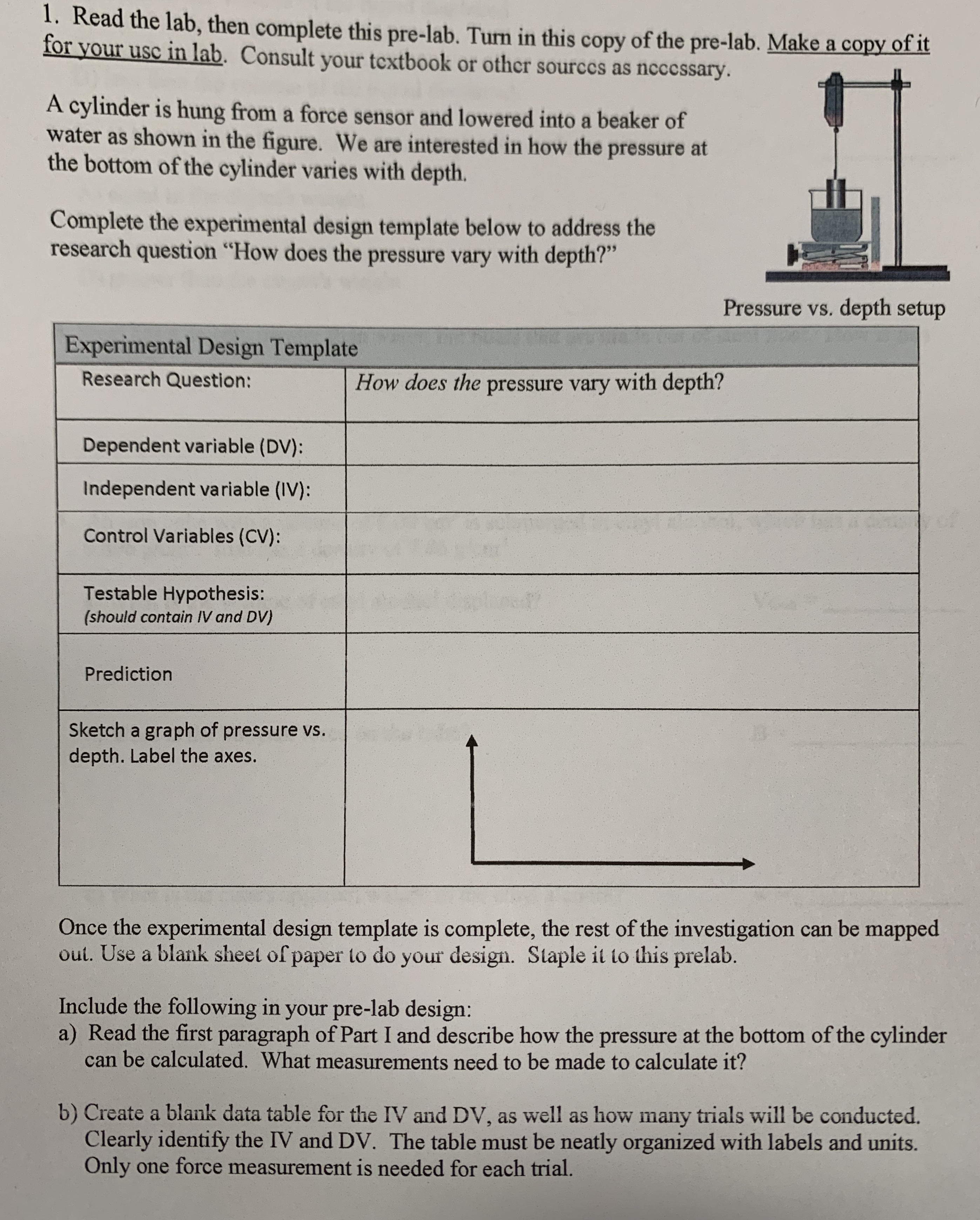
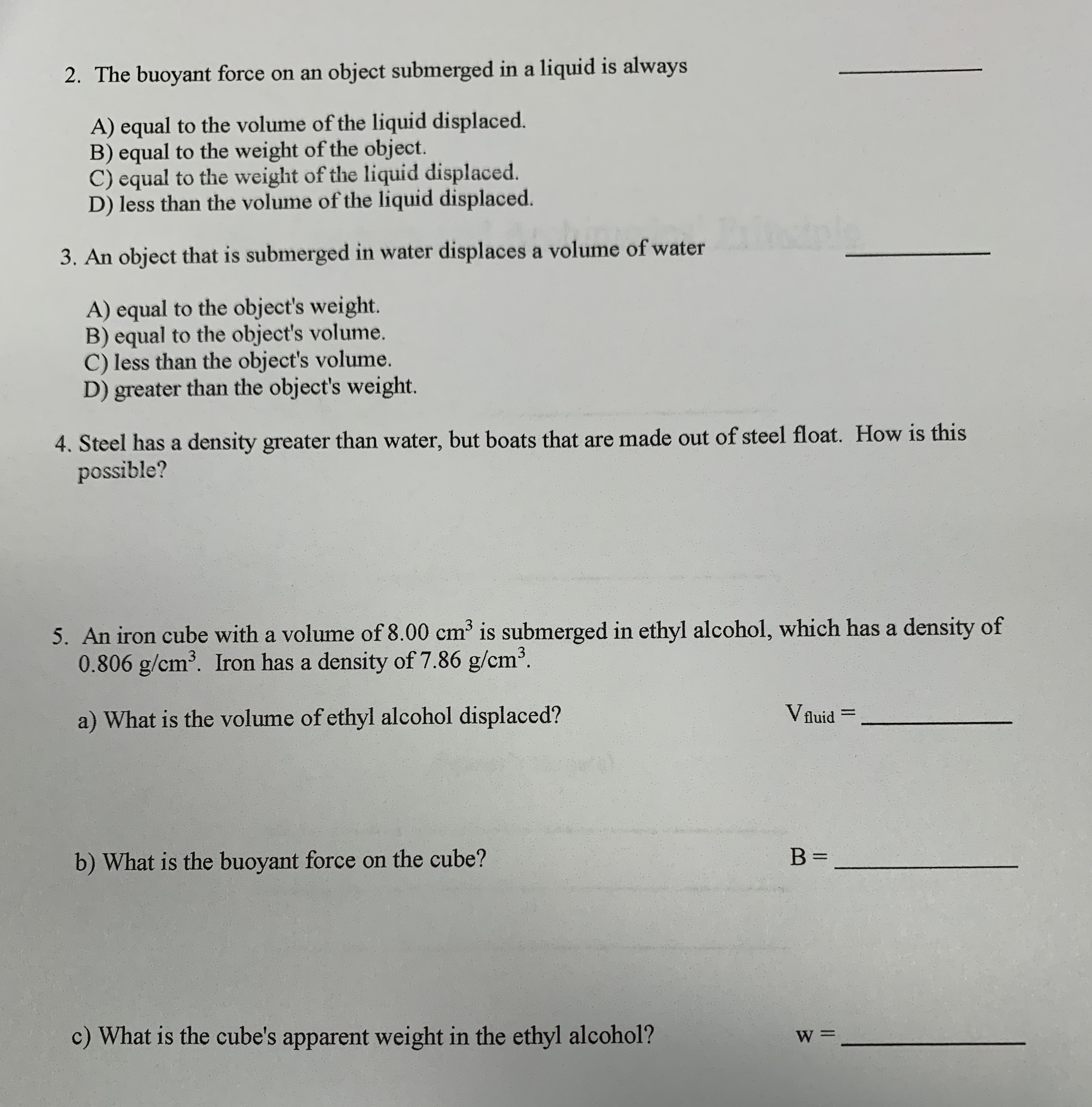
1. Read the lab, then complete this pre-lab. Turn in this copy of the pre-lab. Make a copy of it for your use in lab. Consult your textbook or other sources as necessary. A cylinder is hung from a force sensor and lowered into a beaker of water as shown in the figure. We are interested in how the pressure at the bottom of the cylinder varies with depth. Complete the experimental design template below to address the research question "How does the pressure vary with depth?" Pressure vs. depth setup Experimental Design Template Research Question: How does the pressure vary with depth? Dependent variable (DV): Independent variable (IV): Control Variables (CV): Testable Hypothesis: (should contain IV and DV) Prediction Sketch a graph of pressure vs. depth. Label the axes. Once the experimental design template is complete, the rest of the investigation can be mapped out. Use a blank sheet of paper to do your design. Staple it to this prelab. Include the following in your pre-lab design: a) Read the first paragraph of Part I and describe how the pressure at the bottom of the cylinder can be calculated. What measurements need to be made to calculate it? b) Create a blank data table for the IV and DV, as well as how many trials will be conducted. Clearly identify the IV and DV. The table must be neatly organized with labels and units. Only one force measurement is needed for each trial.2. The buoyant force on an object submerged in a liquid is always A) equal to the volume of the liquid displaced. B) equal to the weight of the object. C) equal to the weight of the liquid displaced. D) less than the volume of the liquid displaced. 3. An object that is submerged in water displaces a volume of water A) equal to the object's weight. B) equal to the object's volume. C) less than the object's volume. D) greater than the object's weight. 4. Steel has a density greater than water, but boats that are made out of steel float. How is this possible? 5. An iron cube with a volume of 8.00 cm' is submerged in ethyl alcohol, which has a density of 0.806 g/cm'. Iron has a density of 7.86 g/cm3 a) What is the volume of ethyl alcohol displaced? Vfluid = b) What is the buoyant force on the cube? B = c) What is the cube's apparent weight in the ethyl alcohol? W =
Step by Step Solution
There are 3 Steps involved in it

Get step-by-step solutions from verified subject matter experts