







Question: 1. Recall the coin changing problem: Given denominations d = (d,d2, ..., dn) and an amount N to be paid, determine the number of coins
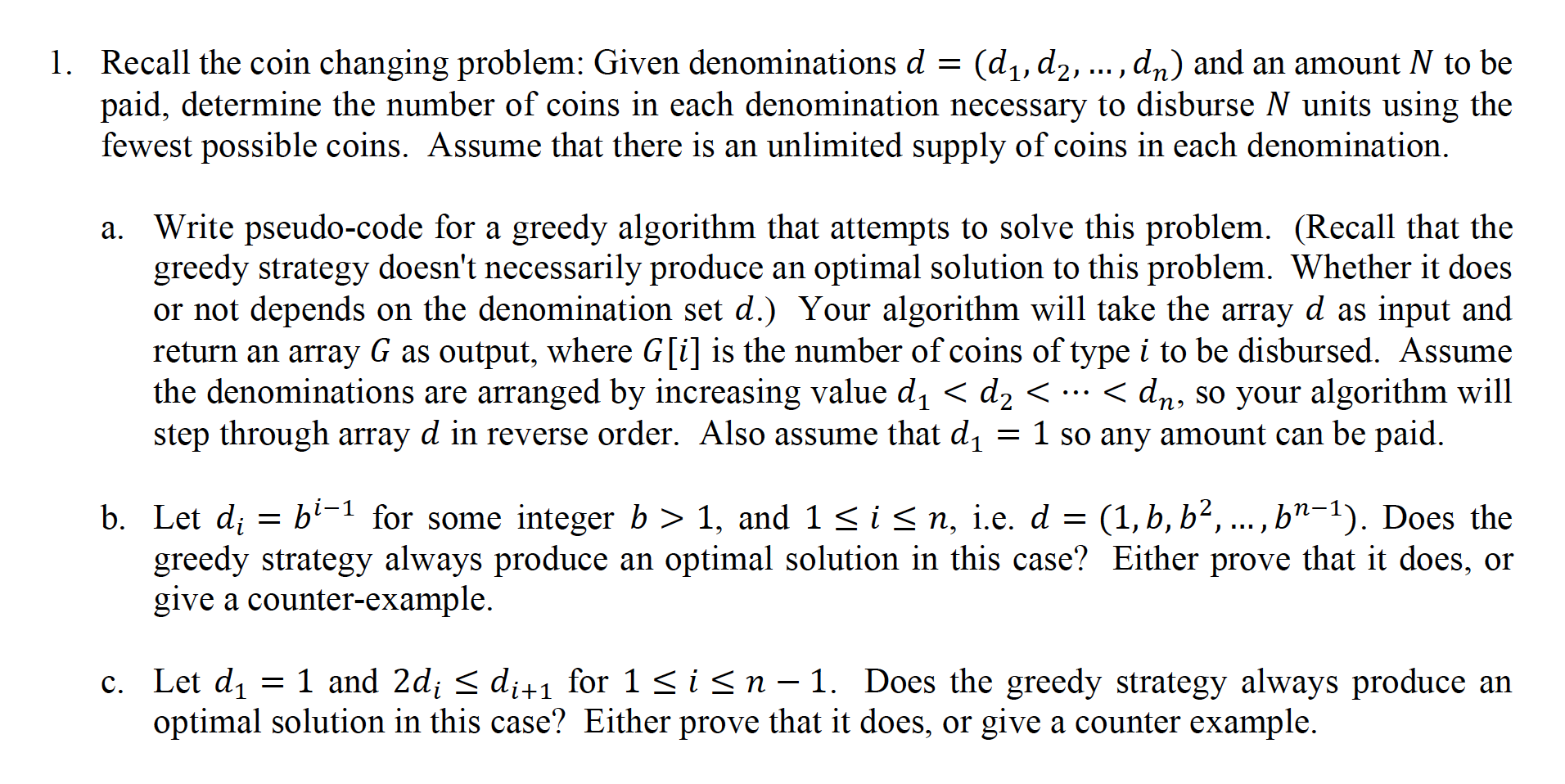
1. Recall the coin changing problem: Given denominations d = (d,d2, ..., dn) and an amount N to be paid, determine the number of coins in each denomination necessary to disburse N units using the fewest possible coins. Assume that there is an unlimited supply of coins in each denomination. Write pseudo-code for a greedy algorithm that attempts to solve this problem. (Recall that the greedy strategy doesn't necessarily produce an optimal solution to this problem. Whether it does or not depends on the denomination set d.) Your algorithm will take the array d as input and return an array G as output, where G[i] is the number of coins of type i to be disbursed. Assume the denominations are arranged by increasing value dy
Step by Step Solution
There are 3 Steps involved in it

Get step-by-step solutions from verified subject matter experts
 Study Help