



Question: 1 (Related to Checkpoint 12.1) (Calculating changes in net operating working capital) Tetious Dimensions is introducing a new product and has an expected change in
1
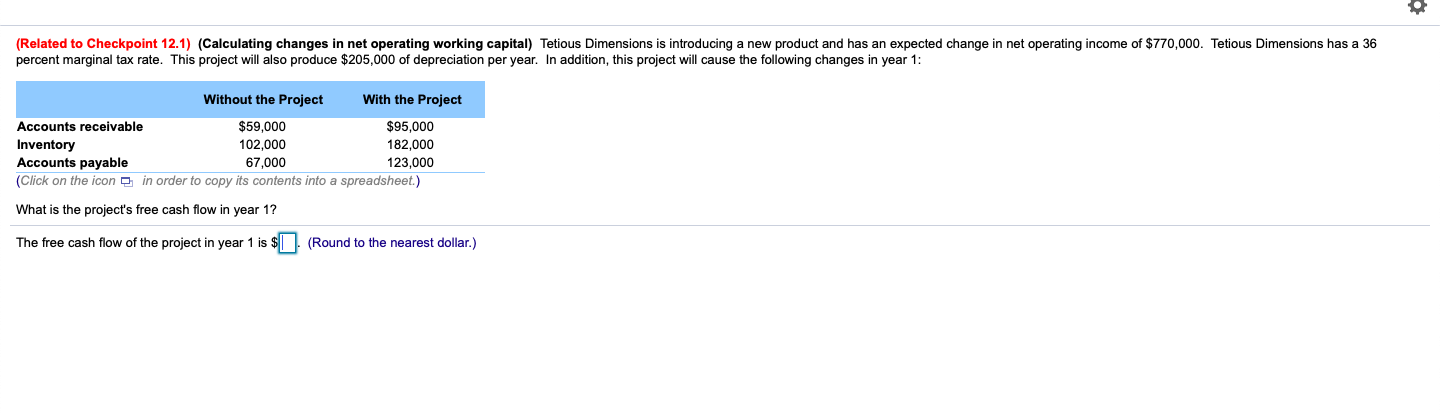
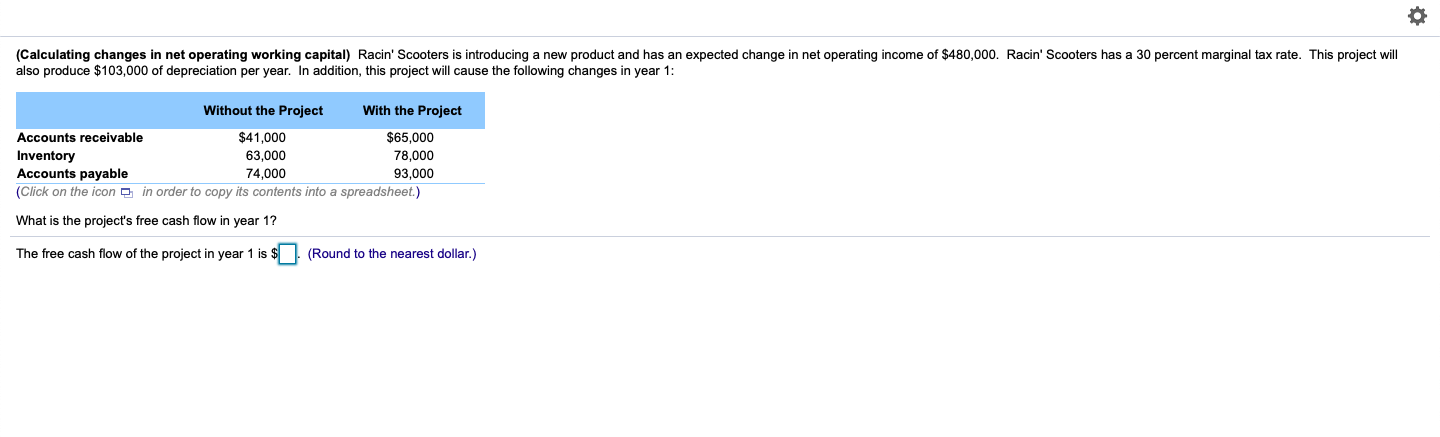
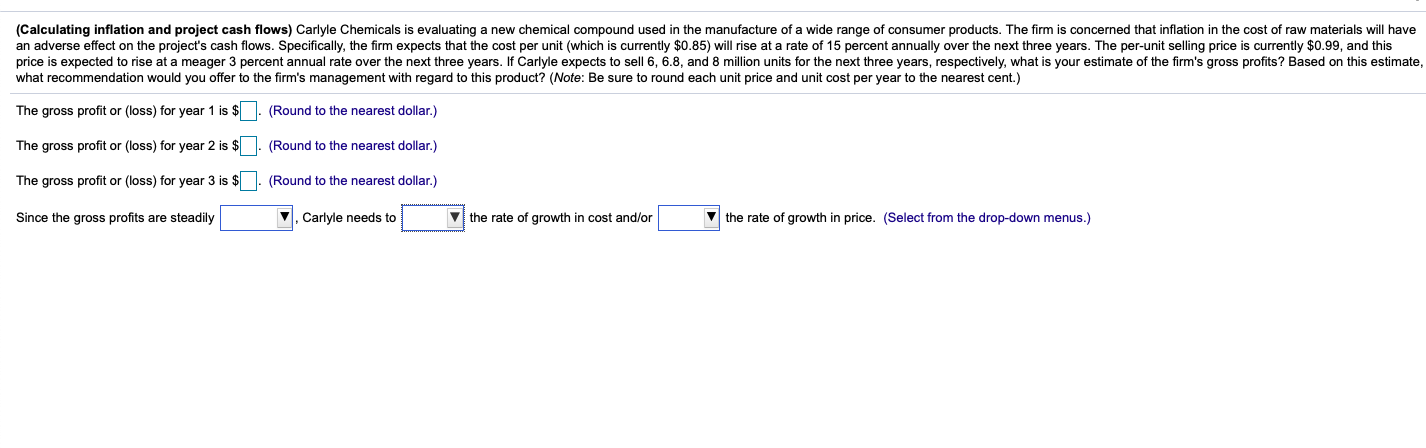
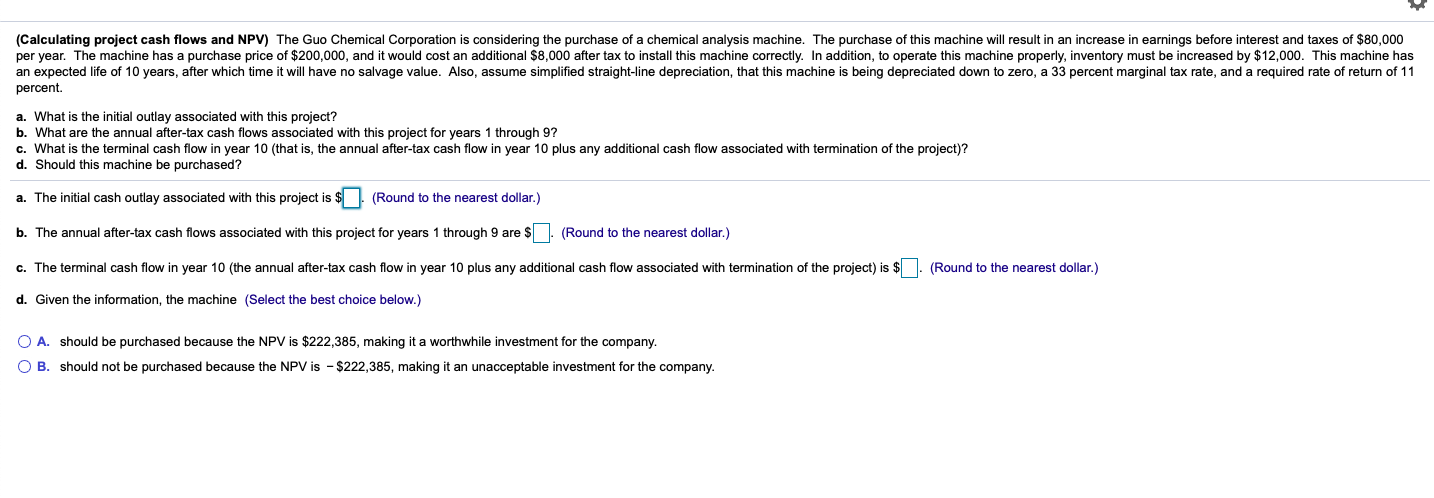
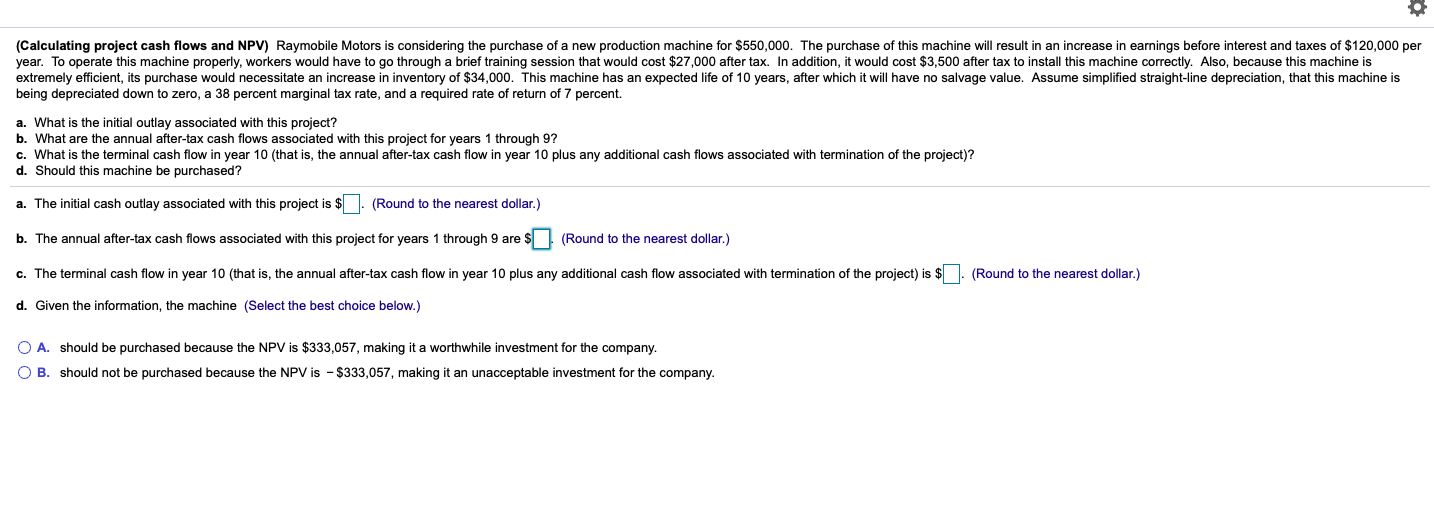
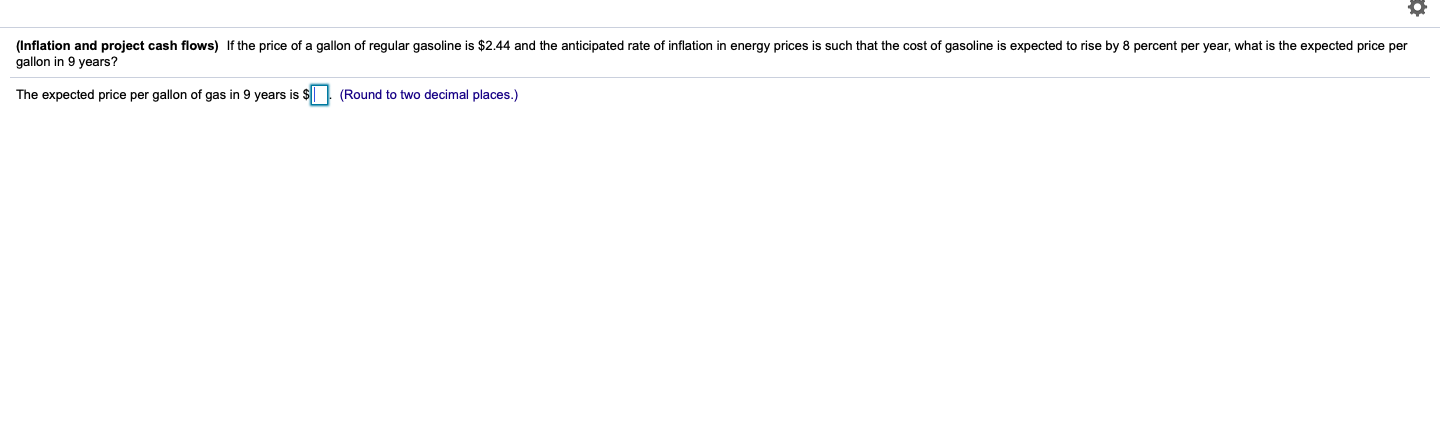
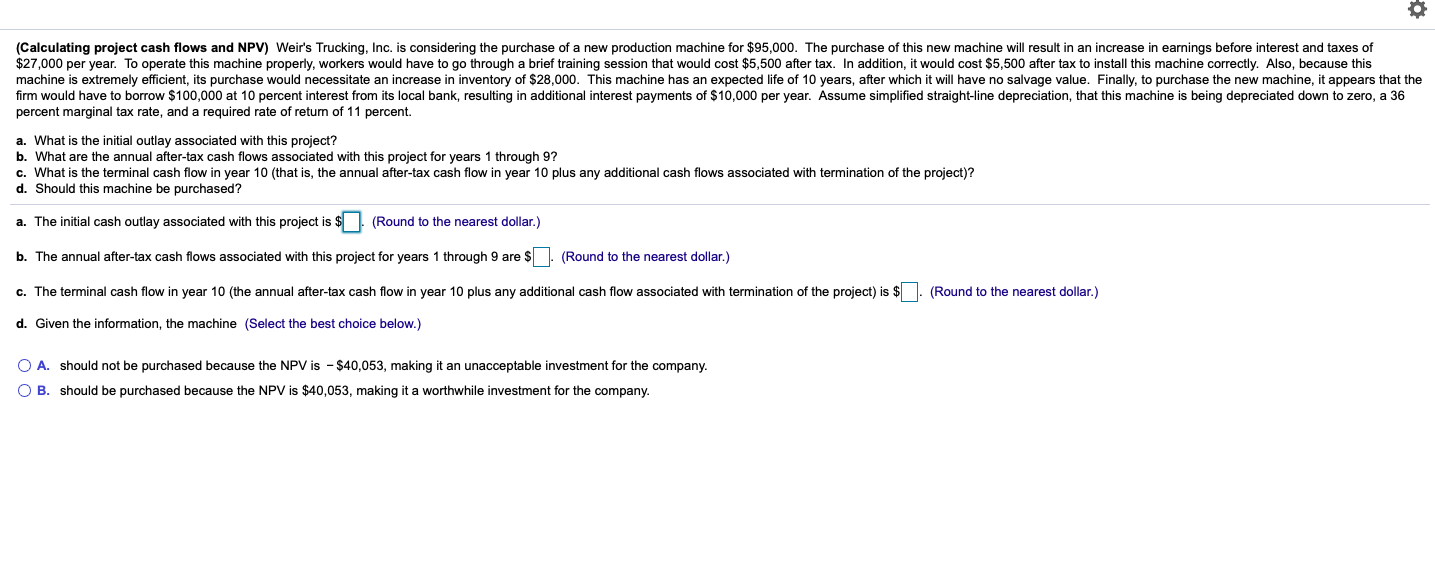
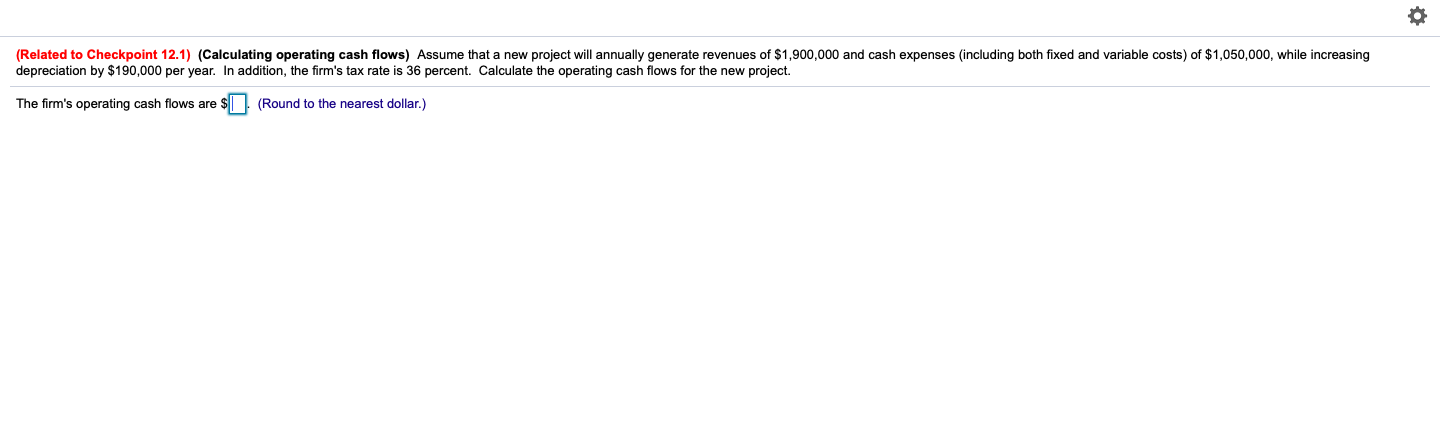
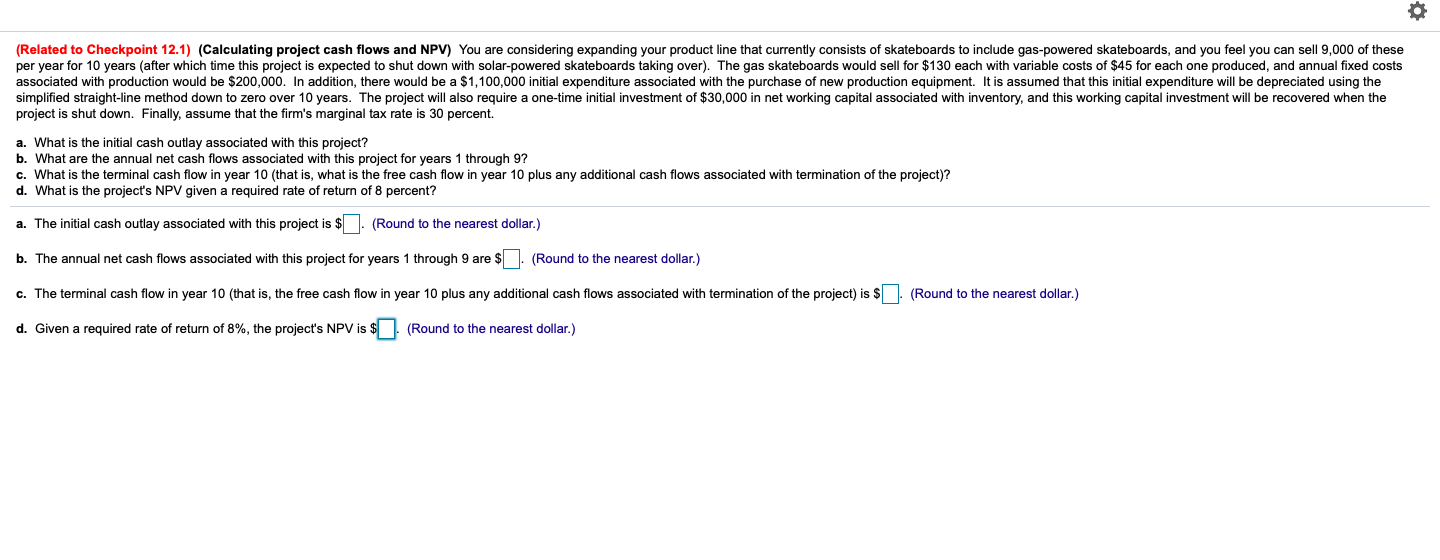
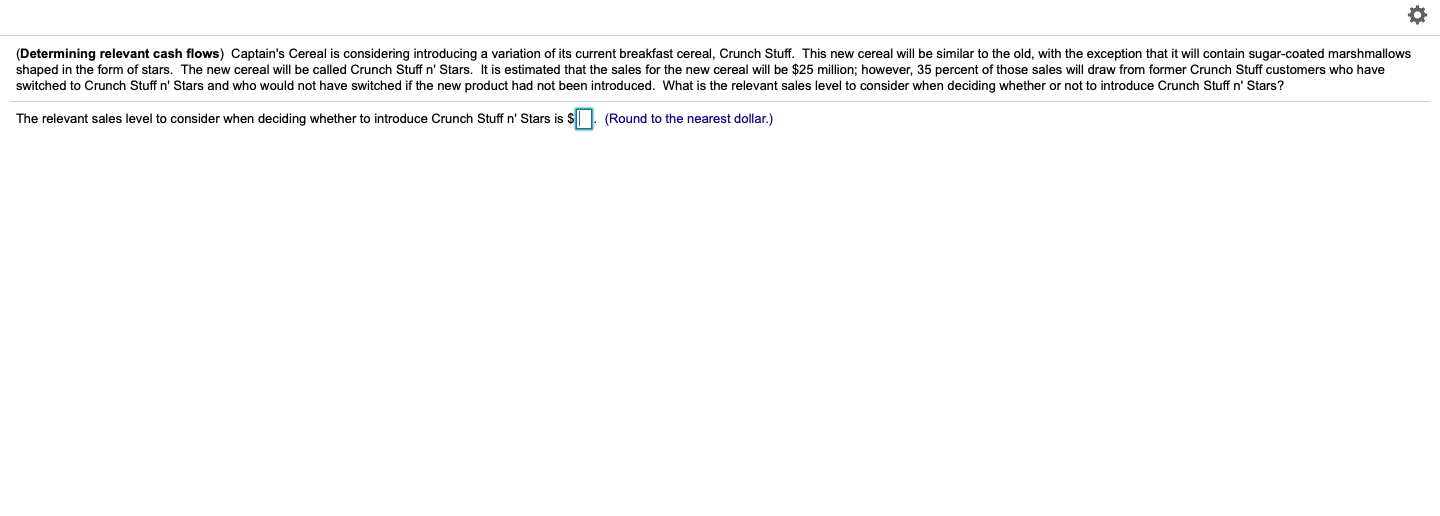
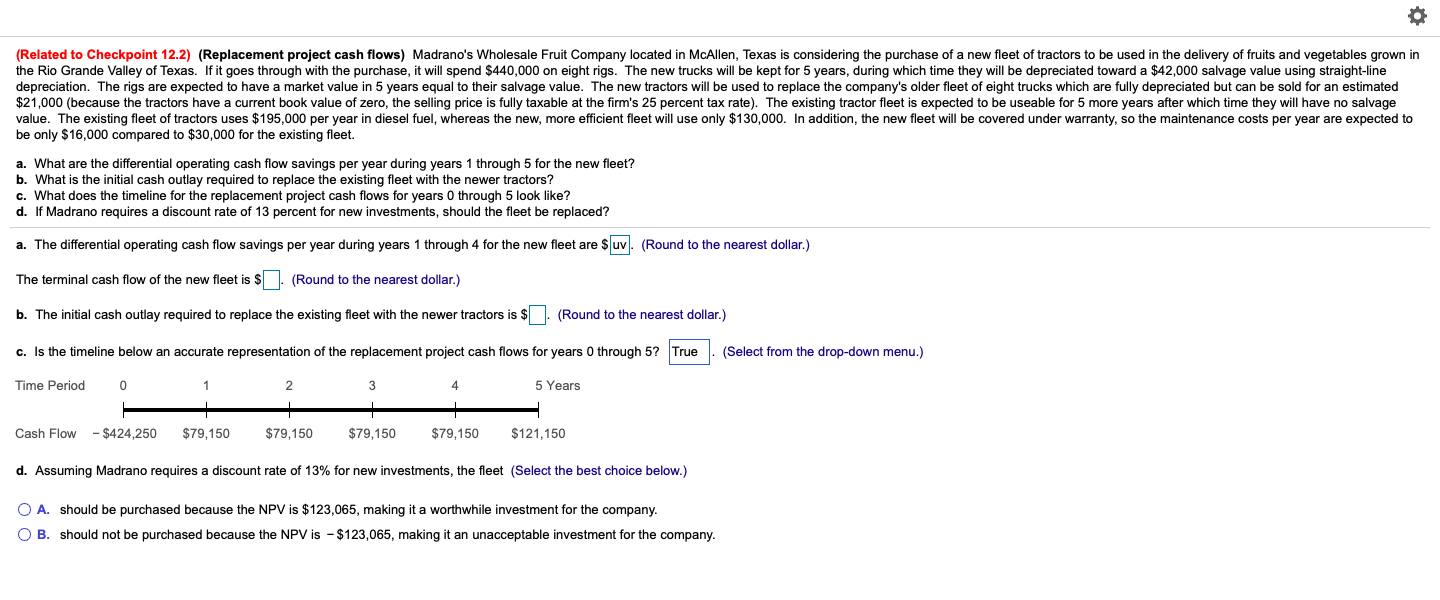
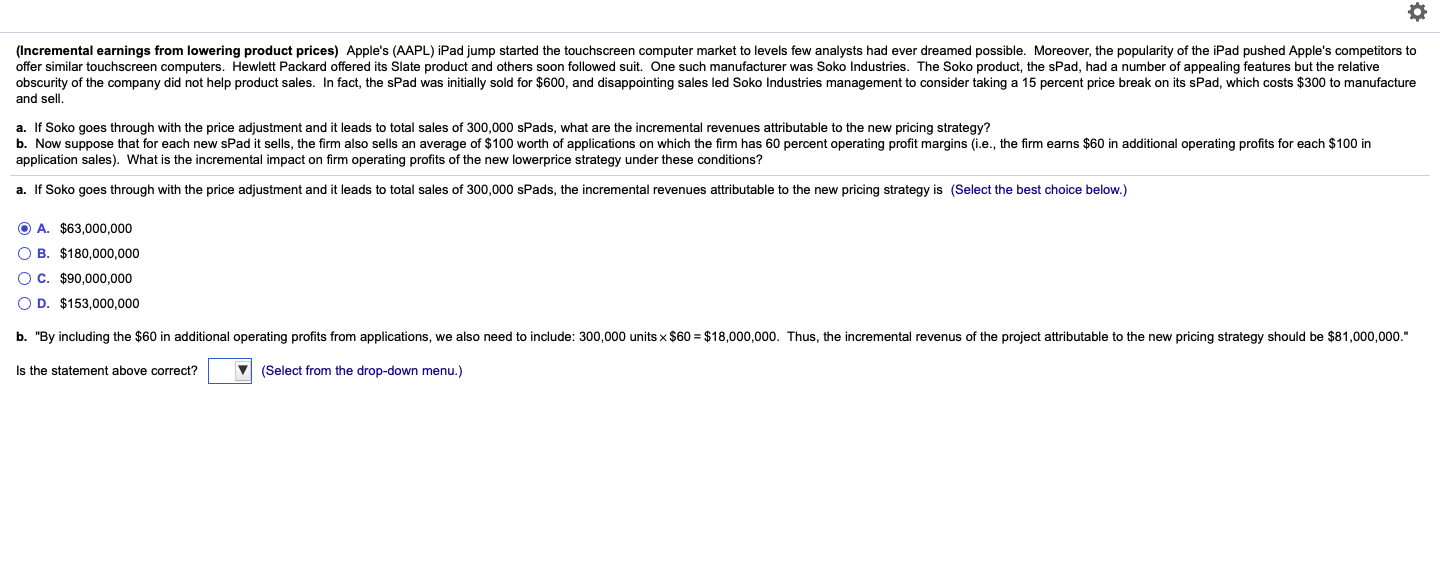
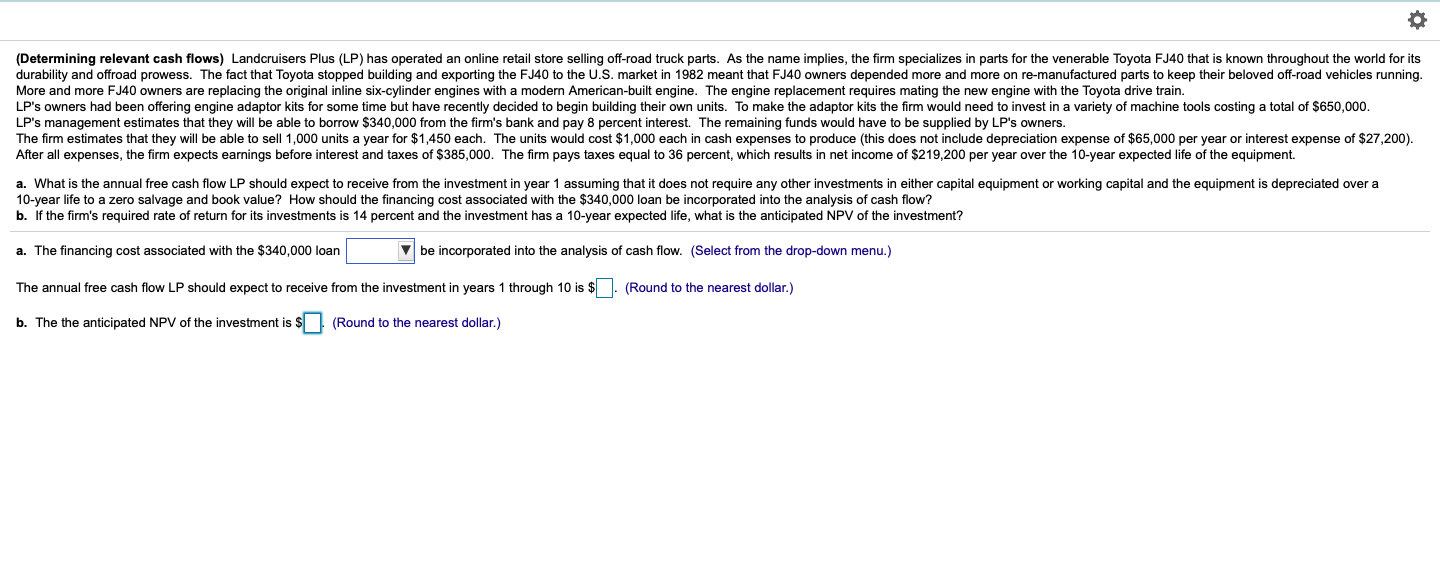
(Related to Checkpoint 12.1) (Calculating changes in net operating working capital) Tetious Dimensions is introducing a new product and has an expected change in net operating income of $770,000. Tetious Dimensions has a 36 percent marginal tax rate. This project will also produce $205,000 of depreciation per year. In addition, this project will cause the following changes in year 1: Without the Project With the Project Accounts receivable $59,000 $95,000 Inventory 102,000 182,000 Accounts payable 67,000 123,000 (Click on the icon [ in order to copy its contents into a spreadsheet.) What is the project's free cash flow in year 1? The free cash flow of the project in year 1 is $ | . (Round to the nearest dollar.)(Calculating changes in net operating working capital) Racin' Scooters is introducing a new product and has an expected change in net operating income of $480,000. Racin' Scooters has a 30 percent marginal tax rate. This project will also produce $103,000 of depreciation per year. In addition, this project will cause the following changes in year 1: Without the Project With the Project Accounts receivable $41,000 $65,000 Inventory 63,000 78,000 Accounts payable 74,000 93,000 (Click on the icon [ in order to copy its contents into a spreadsheet.) What is the project's free cash flow in year 1? The free cash flow of the project in year 1 is $ . (Round to the nearest dollar.)(Calculating inflation and project cash flows) Carlyle Chemicals is evaluating a new chemical compound used in the manufacture of a wide range of consumer products. The firm is concerned that inflation in the cost of raw materials will have an adverse effect on the project's cash flows. Specifically, the firm expects that the cost per unit (which is currently $0.85) will rise at a rate of 15 percent annually over the next three years. The per-unit selling price is currently $0.99, and this price is expected to rise at a meager 3 percent annual rate over the next three years. If Carlyle expects to sell 6, 6.8, and 8 million units for the next three years, respectively, what is your estimate of the firm's gross profits? Based on this estimate, what recommendation would you offer to the firm's management with regard to this product? (Note: Be sure to round each unit price and unit cost per year to the nearest cent.) The gross profit or (loss) for year 1 is $ . (Round to the nearest dollar.) The gross profit or (loss) for year 2 is $ . (Round to the nearest dollar.) The gross profit or (loss) for year 3 is $ . (Round to the nearest dollar.) Since the gross profits are steadily , Carlyle needs to the rate of growth in cost and/or the rate of growth in price. (Select from the drop-down menus.)(Calculating project cash flows and NPV) The Guo Chemical Corporation is considering the purchase of a chemical analysis machine. The purchase of this machine will result in an increase in earnings before interest and taxes of $80,000 per year. The machine has a purchase price of $200,000, and it would cost an additional $8,000 after tax to install this machine correctly. In addition, to operate this machine properly, inventory must be increased by $12,000. This machine has an expected life of 10 years, after which time it will have no salvage value. Also, assume simplified straight-line depreciation, that this machine is being depreciated down to zero, a 33 percent marginal tax rate, and a required rate of return of 11 percent. a. What is the initial outlay associated with this project? b. What are the annual after-tax cash flows associated with this project for years 1 through 9? c. What is the terminal cash flow in year 10 (that is, the annual after-tax cash flow in year 10 plus any additional cash flow associated with termination of the project)? d. Should this machine be purchased? a. The initial cash outlay associated with this project is $|. (Round to the nearest dollar.) b. The annual after-tax cash flows associated with this project for years 1 through 9 are $ . (Round to the nearest dollar.) c. The terminal cash flow in year 10 (the annual after-tax cash flow in year 10 plus any additional cash flow associated with termination of the project) is $ . (Round to the nearest dollar.) d. Given the information, the machine (Select the best choice below.) O A. should be purchased because the NPV is $222,385, making it a worthwhile investment for the company. O B. should not be purchased because the NPV is - $222,385, making it an unacceptable investment for the company.(Calculating project cash flows and NPV) Raymobile Motors is considering the purchase of a new production machine for $550,000. The purchase of this machine will result in an increase in earnings before interest and taxes of $120,000 per year. To operate this machine properly, workers would have to go through a brief training session that would cost $27,000 after tax. In addition, it would cost $3,500 after tax to install this machine correctly. Also, because this machine is extremely efficient, its purchase would necessitate an increase in inventory of $34,000. This machine has an expected life of 10 years, after which it will have no salvage value. Assume simplified straight-line depreciation, that this machine is being depreciated down to zero, a 38 percent marginal tax rate, and a required rate of return of 7 percent. a. What is the initial outlay associated with this project? b. What are the annual after-tax cash flows associated with this project for years 1 through 9? c. What is the terminal cash flow in year 10 (that is, the annual after-tax cash flow in year 10 plus any additional cash flows associated with termination of the project)? d. Should this machine be purchased? a. The initial cash outlay associated with this project is $ . (Round to the nearest dollar.) b. The annual after-tax cash flows associated with this project for years 1 through 9 are $ (Round to the nearest dollar.) c. The terminal cash flow in year 10 (that is, the annual after-tax cash flow in year 10 plus any additional cash flow associated with termination of the project) is $ . (Round to the nearest dollar.) d. Given the information, the machine (Select the best choice below.) O A. should be purchased because the NPV is $333,057, making it a worthwhile investment for the company. O B. should not be purchased because the NPV is - $333,057, making it an unacceptable investment for the company.(Inflation and project cash flows) If the price of a gallon of regular gasoline is $2.44 and the anticipated rate of inflation in energy prices is such that the cost of gasoline is expected to rise by 8 percent per year, what is the expected price per gallon in 9 years? The expected price per gallon of gas in 9 years is $| . (Round to two decimal places.)(Calculating project cash flows and NPV) Weir's Trucking, Inc. is considering the purchase of a new production machine for $95,000. The purchase of this new machine will result in an increase in earnings before interest and taxes of $27,000 per year. To operate this machine properly, workers would have to go through a brief training session that would cost $5,500 after tax. In addition, it would cost $5,500 after tax to install this machine correctly. Also, because this machine is extremely efficient, its purchase would necessitate an increase in inventory of $28,000. This machine has an expected life of 10 years, after which it will have no salvage value. Finally, to purchase the new machine, it appears that the firm would have to borrow $100,000 at 10 percent interest from its local bank, resulting in additional interest payments of $10,000 per year. Assume simplified straight-line depreciation, that this machine is being depreciated down to zero, a 36 percent marginal tax rate, and a required rate of return of 11 percent. a. What is the initial outlay associated with this project? b. What are the annual after-tax cash flows associated with this project for years 1 through 9? c. What is the terminal cash flow in year 10 (that is, the annual after-tax cash flow in year 10 plus any additional cash flows associated with termination of the project)? d. Should this machine be purchased? a. The initial cash outlay associated with this project is $ . (Round to the nearest dollar.) b. The annual after-tax cash flows associated with this project for years 1 through 9 are $ . (Round to the nearest dollar.) c. The terminal cash flow in year 10 (the annual after-tax cash flow in year 10 plus any additional cash flow associated with termination of the project) is $ . (Round to the nearest dollar.) d. Given the information, the machine (Select the best choice below.) O A. should not be purchased because the NPV is - $40,053, making it an unacceptable investment for the company. O B. should be purchased because the NPV is $40,053, making it a worthwhile investment for the company.(Related to Checkpoint 12.1) (Calculating operating cash flows) Assume that a new project will annually generate revenues of $1,900,000 and cash expenses (including both fixed and variable costs) of $1,050,000, while increasing depreciation by $190,000 per year. In addition, the firm's tax rate is 36 percent. Calculate the operating cash flows for the new project. The firm's operating cash flows are $ | | (Round to the nearest dollar.)(Related to Checkpoint 12.1) (Calculating project cash flows and NPV) You are considering expanding your product line that currently consists of skateboards to include gas-powered skateboards, and you feel you can sell 9,000 of these per year for 10 years (after which time this project is expected to shut down with solar-powered skateboards taking over). The gas skateboards would sell for $130 each with variable costs of $45 for each one produced, and annual fixed costs associated with production would be $200,000. In addition, there would be a $1,100,000 initial expenditure associated with the purchase of new production equipment. It is assumed that this initial expenditure will be depreciated using the simplified straight-line method down to zero over 10 years. The project will also require a one-time initial investment of $30,000 in net working capital associated with inventory, and this working capital investment will be recovered when the project is shut down. Finally, assume that the firm's marginal tax rate is 30 percent. a. What is the initial cash outlay associated with this project? b. What are the annual net cash flows associated with this project for years 1 through 9? c. What is the terminal cash flow in year 10 (that is, what is the free cash flow in year 10 plus any additional cash flows associated with termination of the project)? d. What is the project's NPV given a required rate of return of 8 percent? a. The initial cash outlay associated with this project is $ . (Round to the nearest dollar.) b. The annual net cash flows associated with this project for years 1 through 9 are $ . (Round to the nearest dollar.) c. The terminal cash flow in year 10 (that is, the free cash flow in year 10 plus any additional cash flows associated with termination of the project) is $ . (Round to the nearest dollar.) d. Given a required rate of return of 8%, the project's NPV is $ . (Round to the nearest dollar.)(Determining relevant cash flows) Captain's Cereal is considering introducing a variation of its current breakfast cereal, Crunch Stuff. This new cereal will be similar to the old, with the exception that it will contain sugar-coated marshmallows shaped in the form of stars. The new cereal will be called Crunch Stuff n' Stars. It is estimated that the sales for the new cereal will be $25 million; however, 35 percent of those sales will draw from former Crunch Stuff customers who have switched to Crunch Stuff n' Stars and who would not have switched if the new product had not been introduced. What is the relevant sales level to consider when deciding whether or not to introduce Crunch Stuff n' Stars? The relevant sales level to consider when deciding whether to introduce Crunch Stuff n' Stars is $| . (Round to the nearest dollar.)(Related to Checkpoint 12.2) (Replacement project cash flows) Madrano's Wholesale Fruit Company located in McAllen, Texas is considering the purchase of a new fleet of tractors to be used in the delivery of fruits and vegetables grown in the Rio Grande Valley of Texas. If it goes through with the purchase, it will spend $440,000 on eight rigs. The new trucks will be kept for 5 years, during which time they will be depreciated toward a $42,000 salvage value using straight-line depreciation. The rigs are expected to have a market value in 5 years equal to their salvage value. The new tractors will be used to replace the company's older fleet of eight trucks which are fully depreciated but can be sold for an estimated $21,000 (because the tractors have a current book value of zero, the selling price is fully taxable at the firm's 25 percent tax rate). The existing tractor fleet is expected to be useable for 5 more years after which time they will have no salvage value. The existing fleet of tractors uses $195,000 per year in diesel fuel, whereas the new, more efficient fleet will use only $130,000. In addition, the new fleet will be covered under warranty, so the maintenance costs per year are expected to be only $16,000 compared to $30,000 for the existing fleet. a. What are the differential operating cash flow savings per year during years 1 through 5 for the new fleet? b. What is the initial cash outlay required to replace the existing fleet with the newer tractors? c. What does the timeline for the replacement project cash flows for years 0 through 5 look like? d. If Madrano requires a discount rate of 13 percent for new investments, should the fleet be replaced? a. The differential operating cash flow savings per year during years 1 through 4 for the new fleet are $ uv . (Round to the nearest dollar.) The terminal cash flow of the new fleet is $ . (Round to the nearest dollar.) b. The initial cash outlay required to replace the existing fleet with the newer tractors is $ . (Round to the nearest dollar.) c. Is the timeline below an accurate representation of the replacement project cash flows for years 0 through 5? True (Select from the drop-down menu.) Time Period 5 Years Cash Flow - $424,250 $79,150 $79,150 $79,150 $79,150 $121, 150 d. Assuming Madrano requires a discount rate of 13% for new investments, the fleet (Select the best choice below.) O A. should be purchased because the NPV is $123,065, making it a worthwhile investment for the company. O B. should not be purchased because the NPV is - $123,065, making it an unacceptable investment for the company.(Incremental earnings from lowering product prices) Apple's (AAPL) iPad jump started the touchscreen computer market to levels few analysts had ever dreamed possible. Moreover, the popularity of the iPad pushed Apple's competitors to offer similar touchscreen computers. Hewlett Packard offered its Slate product and others soon followed suit. One such manufacturer was Soko Industries. The Soko product, the sPad, had a number of appealing features but the relative obscurity of the company did not help product sales. In fact, the sPad was initially sold for $600, and disappointing sales led Soko Industries management to consider taking a 15 percent price break on its sPad, which costs $300 to manufacture and sell. a. If Soko goes through with the price adjustment and it leads to total sales of 300,000 sPads, what are the incremental revenues attributable to the new pricing strategy? b. Now suppose that for each new sPad it sells, the firm also sells an average of $100 worth of applications on which the firm has 60 percent operating profit margins (i.e., the firm earns $60 in additional operating profits for each $100 in application sales). What is the incremental impact on firm operating profits of the new lowerprice strategy under these conditions? a. If Soko goes through with the price adjustment and it leads to total sales of 300,000 sPads, the incremental revenues attributable to the new pricing strategy is (Select the best choice below.) O A. $63,000,000 O B. $180,000,000 O C. $90,000,000 O D. $153,000,000 b. "By including the $60 in additional operating profits from applications, we also need to include: 300,000 units x $60 =$18,000,000. Thus, the incremental revenus of the project attributable to the new pricing strategy should be $81,000,000." Is the statement above correct? (Select from the drop-down menu.)(Determining relevant cash flows) Landcruisers Plus (LP) has operated an online retail store selling off-road truck parts. As the name implies, the firm specializes in parts for the venerable Toyota FJ40 that is known throughout the world for its durability and offroad prowess. The fact that Toyota stopped building and exporting the FJ40 to the U.S. market in 1982 meant that FJ40 owners depended more and more on re-manufactured parts to keep their beloved off-road vehicles running. More and more FJ40 owners are replacing the original inline six-cylinder engines with a modern American-built engine. The engine replacement requires mating the new engine with the Toyota drive train. LP's owners had been offering engine adaptor kits for some time but have recently decided to begin building their own units. To make the adaptor kits the firm would need to invest in a variety of machine tools costing a total of $650,000. LP's management estimates that they will be able to borrow $340,000 from the firm's bank and pay 8 percent interest. The remaining funds would have to be supplied by LP's owners. The firm estimates that they will be able to sell 1,000 units a year for $1,450 each. The units would cost $1,000 each in cash expenses to produce (this does not include depreciation expense of $65,000 per year or interest expense of $27,200). After all expenses, the firm expects earnings before interest and taxes of $385,000. The firm pays taxes equal to 36 percent, which results in net income of $219,200 per year over the 10-year expected life of the equipment. a. What is the annual free cash flow LP should expect to receive from the investment in year 1 assuming that it does not require any other investments in either capital equipment or working capital and the equipment is depreciated over a 10-year life to a zero salvage and book value? How should the financing cost associated with the $340,000 loan be incorporated into the analysis of cash flow? b. If the firm's required rate of return for its investments is 14 percent and the investment has a 10-year expected life, what is the anticipated NPV of the investment? a. The financing cost associated with the $340,000 loan be incorporated into the analysis of cash flow. (Select from the drop-down menu.) The annual free cash flow LP should expect to receive from the investment in years 1 through 10 is $ . (Round to the nearest dollar.) b. The the anticipated NPV of the investment is $ (Round to the nearest dollar.)
Step by Step Solution
There are 3 Steps involved in it

Get step-by-step solutions from verified subject matter experts