







Question: 1. Review Chapter 15 in the attachment - Global Issues in Organization Development: Utilizing the Tenets of Ubuntu: A Global Organization Development Case Study and
1. Review Chapter 15 in the attachment - Global Issues in Organization Development: Utilizing the Tenets of Ubuntu: A Global Organization Development Case Study and answer the following questions:
a. What steps should global OD consultants undertake to prepare themselves for a cross cultural engagement?
b. Why is culture so important in global OD?
c. What other elements should global OD consultants consider besides culture when working abroad?
d. Pick a country where you would like to do some OD work. How would you integrate that country's indigenous practices with a particular OD application?
e. How would you ensure that the values of OD (democratic, humanistic, and optimistic) are sustained in instances where modifications to OD interventions have to be made to fit a particular setting?
Please include references. Thank you!
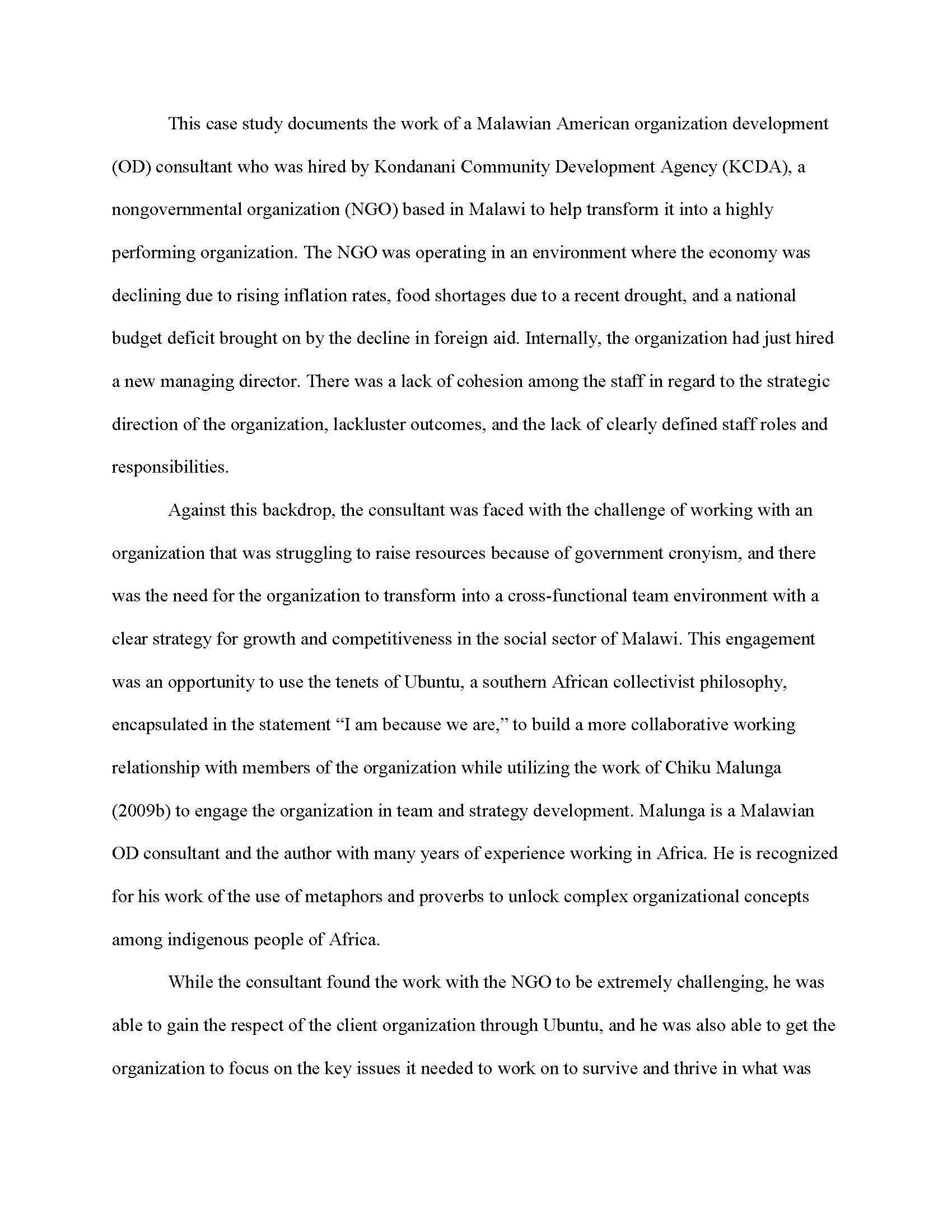
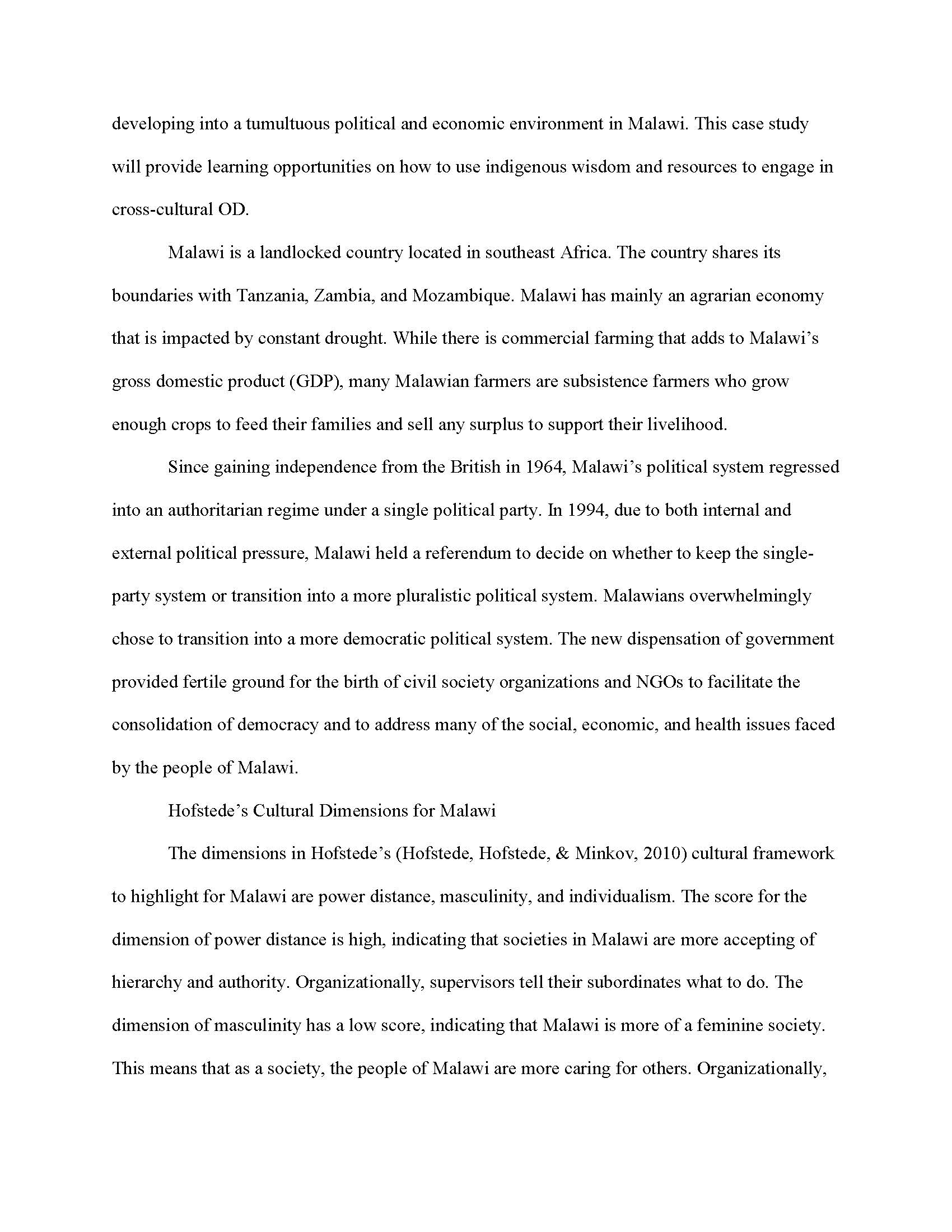
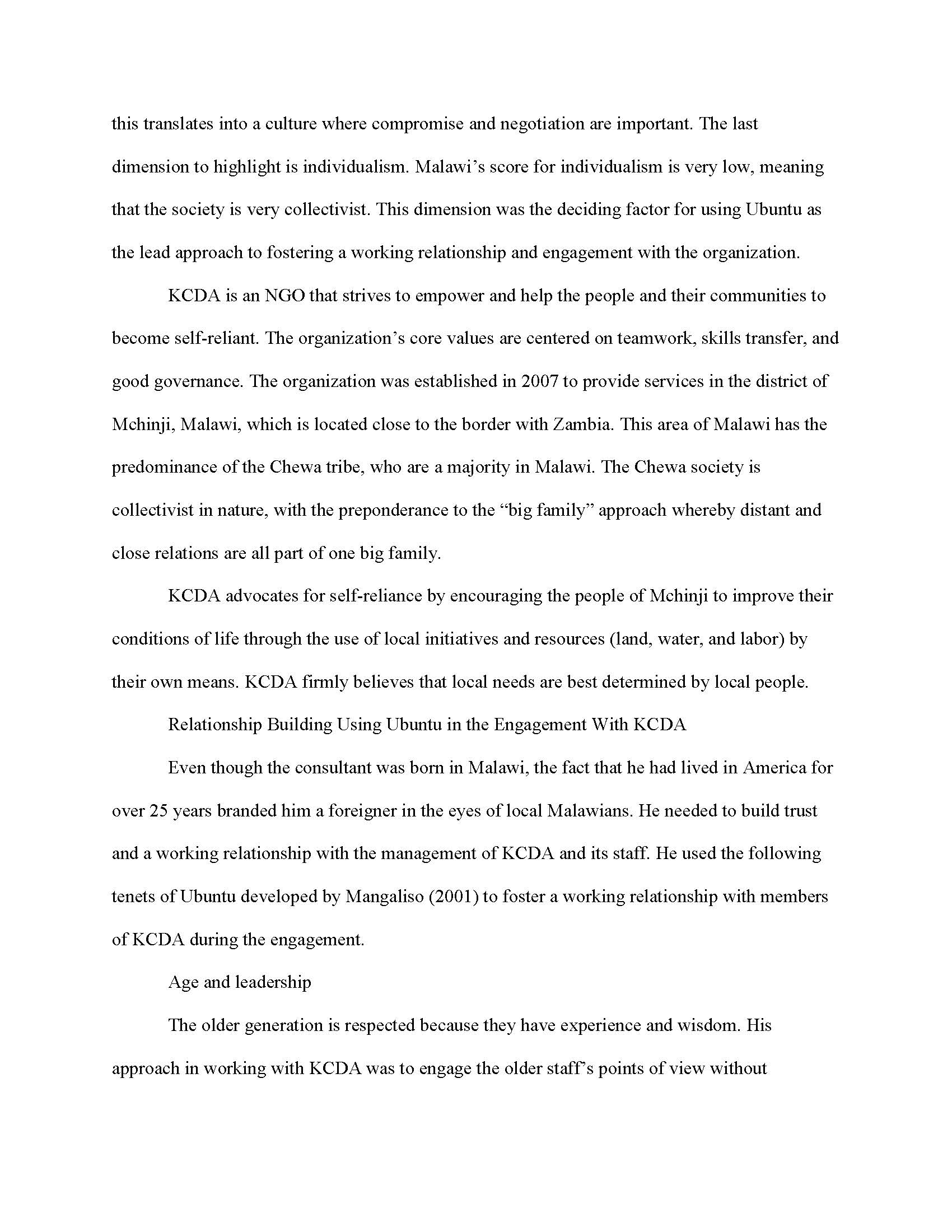
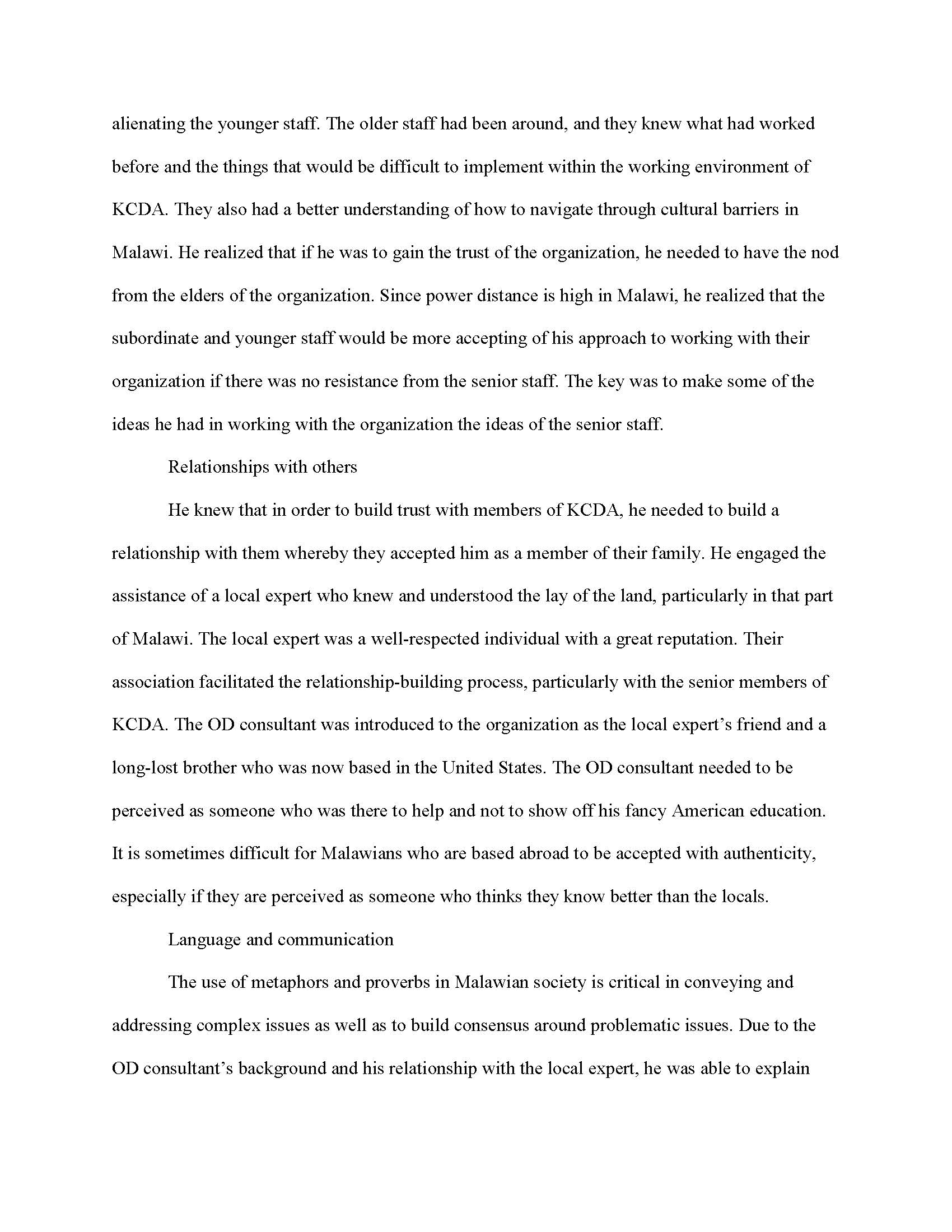
This case study documents the work of a Malawian American organization development (OD) consultant who was hired by Kondanani Community Development Agency (KCDA), a nongovernmental organization (NGO) based in Malawi to help transform it into a highly performing organization. The NGO was operating in an environment where the economy was declining due to rising ination rates, food shortages due to a recent drought, and a national budget decit brought on by the decline in foreign aid. Internally, the organization had just hired a new managing director. There was a lack of cohesion among the staff in regard to the strategic direction of the organization, lackluster outcomes, and the lack of clearly defined staff roles and responsibilities. Against this backdrop, the consultant was faced with the challenge of working with an organization that was struggling to raise resources because of government cronyism, and there was the need for the organization to transform into a cross-functional team environment with a clear strategy for growth and competitiveness in the social sector of Malawi. This engagement was an opportunity to use the tenets of Ubuntu, a southern African collectivist philosophy, encapsulated in the statement \"I am because we are,\" to build a more collaborative working relationship with members of the organization while utilizing the work of Chiku Malunga (2009b) to engage the organization in team and strategy development. Malunga is a Malawian OD consultant and the author with many years of experience working in Africa. He is recognized for his work of the use of metaphors and proverbs to unlock complex organizational concepts among indigenous people of Africa. While the consultant found the work with the NGO to be extremely challenging, he was able to gain the respect of the client organization through Ubuntu, and he was also able to get the organization to focus on the key issues it needed to work on to survive and thrive in what was developing into atumultuous political and economic environment in Malawi. This case study will provide learning opportunities on how to use indigenous wisdom and resources to engage in cross-cultural OD. Malawi is a landlocked country located in southeast Africa. The country shares its boundaries with Tanzania, Zambia, and Mozambique. Malawi has mainly an agrarian economy that is impacted by constant drought. While there is commercial farming that adds to Malawi's gross domestic product (GDP), many Malawian farmers are subsistence farmers who grow enough crops to feed their families and sell any surplus to support their livelihood. Since gaining independence from the British in 1964, Malawi's political system regressed into an authoritarian regime under a single political party. In 1994, due to both internal and external political pressure, Malawi held a referendum to decide on whether to keep the single- party system or transition into a more pluralistic political system. Malawians overwhelmingly chose to transition into a more democratic political system. The new dispensation of government provided fertile ground for the birth of civil society organizations and NGOs to facilitate the consolidation of democracy and to address many of the social, economic, and health issues faced by the people of Malawi. Hofstede's Cultural Dimensions for Malawi The dimensions in Hofstede's (Hofstede, Hofstede, & Minkov, 2010) cultural framework to highlight for Malawi are power distance, masculinity, and individualism. The score for the dimension of power distance is high, indicating that societies in Malawi are more accepting of hierarchy and authority. Organizationally, supervisors tell their subordinates what to do. The dimension of masculinity has a low score, indicating that Malawi is more of a feminine society. This means that as a society, the people of Malawi are more caring for others. Organizationally, this translates into a culture where compromise and negotiation are important. The last dimension to highlight is individualism. Malawi's score for individualism is very low, meaning that the society is very collectivist. This dimension was the deciding factor for using Ubuntu as the lead approach to fostering a working relationship and engagement with the organization. KCDA is an NGO that strives to empower and help the people and their communities to become self-reliant. The organization's core values are centered on teamwork, skills transfer, and good governance. The organization was established in 2007 to provide services in the district of Mchinji, Malawi, which is located close to the border with Zambia. This area of Malawi has the predominance of the Chewa tribe, who are a majority in Malawi. The Chewa society is collectivist in nature, with the preponderance to the \"big family\" approach whereby distant and close relations are all part of one big family. KCDA advocates for self-reliance by encouraging the people of Mchinji to improve their conditions of life through the use of local initiatives and resources (land, water, and labor) by their own means. KCDA firmly believes that local needs are best determined by local people. Relationship Building Using Ubuntu in the Engagement With KCDA Even though the consultant was born in Malawi, the fact that he had lived in America for over 25 years branded him a foreigner in the eyes of local Malawians. He needed to build trust and a working relationship with the management of KCDA and its staff. He used the following tenets of Ubuntu developed by Mangaliso (2001) to foster a working relationship with members of KCDA during the engagement. Age and leadership The older generation is respected because they have experience and wisdom. His approach in working with KCDA was to engage the older staffs points of view without alienating the younger staff. The older staff had been around, and they knew what had worked before and the things that would be difficult to implement within the working environment of KCDA. They also had a better understanding of how to navigate through cultural barriers in Malawi. He realized that if he was to gain the trust of the organization, he needed to have the nod from the elders of the organization. Since power distance is high in Malawi, he realized that the subordinate and younger staff would be more accepting of his approach to working with their organization if there was no resistance from the senior staff. The key was to make some of the ideas he had in working with the organization the ideas of the senior staff. Relationships with others He knew that in order to build trust with members of KCDA, he needed to build a relationship with them whereby they accepted him as a member of their family. He engaged the assistance of a local expert who knew and understood the lay of the land, particularly in that part of Malawi. The local expert was a well-respected individual with a great reputation. Their association facilitated the relationship-building process, particularly with the senior members of KCDA. The OD consultant was introduced to the organization as the local expert's friend and a long-lost brother who was now based in the United States. The OD consultant needed to be perceived as someone who was there to help and not to show off his fancy American education. It is sometimes difficult for Malawians who are based abroad to be accepted with authenticity, especially if they are perceived as someone who thinks they know better than the locals. Language and communication The use of metaphors and proverbs in Malawian society is critical in conveying and addressing complex issues as well as to build consensus around problematic issues. Due to the OD consultant's background and his relationship with the local expert, he was able to explain what he needed to do to help the organization through the use of proverbs. For instance, on the need to build a functional team environment, he explained to the organization that a leader cannot shoulder the burden of organizational functions on their own. \"Mutu umodzi siusenza dengaone pillar cannot support the roof structure on its own. Collective ngers theoryA thumb working on its own is useless.\" Since power distance is high in Malawi, explaining the importance of teams was appropriate to do through proverbs. Decision making Consensus building is an approach that is common in the rural areas of Malawi. In the Chewa society, \"pabwalo\" is a large group process whereby issues are heard and discussed with the purpose of building consensus. This was an approach that was considered particularly for strategic planning within the organization. ASSESSMENT AND DIAGNOSIS The approach to assessing and diagnosing some of the issues affecting KCDA involved conducting focus groups with the staff, board, and community members in the area served by KCDA. He also reviewed organizational documents to gain a better understanding as to the alignment between what KCDA had stated within its own documents and what they did in practice. The assessment focused on the structure of the organization, human resources, leadership (which included governance), and the development of a strategic plan. Structure It was critical to assess the structure of the organization so that it could be determined if there was alignment between the various positions within the organization and the actual work done by KCDA. If there was going to be the development of a cross-functional team environment, the structure of the organization needed to be examined to determine opportunities for cross-training. Job descriptions were reviewed against job functions and organizational needs. The structure was also reviewed from the context of reporting relationships and the placement of authority and responsibility within the KCDA. He reviewed the organizational chart, job descriptions, and program functions to determine if they were aligned with KCDA's mission and strategic goals and to determine if the organization's employees had the required skill sets needed to perform their job responsibilities. Summary of observations It appeared that the employees and senior management did not work well together to accomplish the mission of the organization. There were several vacancies that had the potential of impacting program operations. It appeared that job functions were not aligned with the program and service objectives. The organization had not conducted an employee skill assessment to determine if the individual staff, in particular at the leadership levels, had the required skills for their role within the organization. While KCDA's employees seemed to be dedicated to the work of the organization, some were unsure of their roles. Some of the employees were unfamiliar of other employees' roles, and they were also unfamiliar with other programs and services provided by the organization. There was resistance from some of the employees to share everything they did in the eld because they viewed this as a threat to their job security. Interventions The OD consultant worked with the management of KCDA to update the program delivery structure of the organization to ensure that there were linkages between teams that allowed for program and service integration. The goal was for employees to have a working knowledge of all programs and services and to develop a cross-functional team so that any employee could step in to do the work of another employee. The individual employees were asked to document what they did in the eld by developing a step-by-step outline. This was used to train the staff on what each employee did. Management was asked to ll vacancies as soon as possible. An employee skill set analysis was conducted to determine where staff skill sets aligned with the current organizational structure and programs. Even though there was initial resistance to the sharing of job functions, the opportunity to learn other skills and functions was accepted as professional growth. Human Resources The human resources function was key to ensuring that there was a system in place to guide the role and function of the employees within the organization. The managing director, board members, and program staff were interviewed. The OD consultant reviewed the personnel policies, hiring practices, performance evaluations, and job descriptions. These areas were reviewed to ensure employees were qualied to perform certain job functions, provided with the appropriate training and support, and rewarded or recognized for their accomplishments. He worked with a local legal expert to examine the corporate documents and personnel les to ensure compliance with Malawi's labor laws. Summary of observations Upon review of board minutes and interviews that were conducted with the KCDA board and managing director, he learned that the new managing director had not been evaluated by the board of directors. The board of directors consisted of local villagers and members of other community-based organizations. They found it difcult to evaluate the managing director because they thought that she was above them given her role and title. This was an issue which spoke to Malawi's high power distance where positions of authority are highly regarded. There was no one in the organization who was qualied and ofcially designated to perform human resource functions. That role by default fell on the managing director and the accountant. The organization's personnel manual was outdated according to existing agency processes and Malawi labor laws. There was no clear line of responsibility to ensure that employees were informed and understood agency protocol. The organization chart did not contain current job titles. Interventions The OD consultant was able to identify a legal expert who was willing to update KCDA'S personnel policies pro bono so that they were in compliance with current Malawian labor laws. The staff led by the managing director worked as a team to separate the personnel policies from the corporate master le. He worked with the KCDA team to update the organizational chart with the current job titles. It was recommended that KCDA hire a qualied HR ofcer. An employee system was developed to track staff training as well as eldwork. LeadershipBoard Governance The KCDA board of directors is comprised of local villagers and members of community-based organizations in the Mchinji area. Many of these individuals, though committed to developing their region through the various programs offered by KCDA, did not understand their duciary role as members of the board. Their relationship with the managing director was reversed, whereby she was perceived by members of the board as their boss and not the other way around. They not only needed training on their roles and responsibilities, but they
Step by Step Solution
There are 3 Steps involved in it

Get step-by-step solutions from verified subject matter experts
 Study Help