







Question: 1. Say we have a simple linear regression with a single response Y and a single quantitative covariate X. The population model is: Y; =
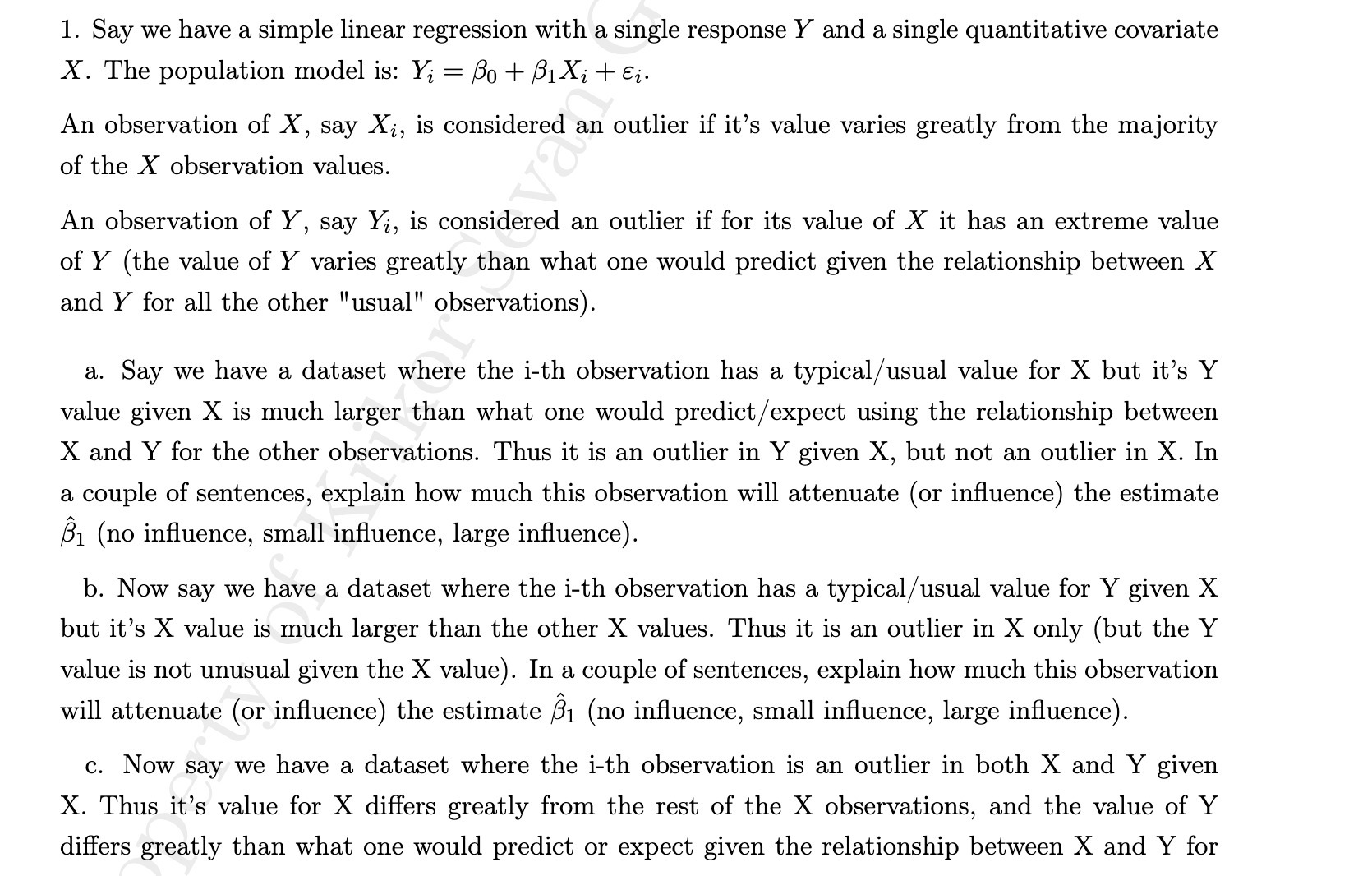
1. Say we have a simple linear regression with a single response Y and a single quantitative covariate X. The population model is: Y; = 60 + 61X\"; + 53-. An observation of X, say X,, is considered an outlier if it's value varies greatly from the majority of the X observation values. An observation of Y, say Y,, is considered an outlier if for its value of X it has an extreme value of Y (the value of Y varies greatly than what one would predict given the relationship between X and Y for all the other "usual" observations). a. Say we have a dataset where the i-th observation has a typical/ usual value for X but it's Y value given X is much larger than what one would predict/ expect using the relationship between X and Y for the other observations. Thus it is an outlier in Y given X, but not an outlier in X. In a couple of sentences, explain how much this observation will attenuate (or inuence) the estimate B1 (no inuence, small inuence, large inuence). b. Now say we have a dataset where the i-th observation has a typical/ usual value for Y given X but it's X value is much larger than the other X values. Thus it is an outlier in X only (but the Y value is not unusual given the X value). In a couple of sentences, explain how much this observation will attenuate (or inuence) the estimate 31 (no inuence, small inuence, large inuence). 0. Now say we have a dataset where the i-th observation is an outlier in both X and Y given X. Thus it's value for X di'ers greatly from the rest of the X observations, and the value of Y differs greatly than what one would predict or expect given the relationship between X and Y for
Step by Step Solution
There are 3 Steps involved in it

Get step-by-step solutions from verified subject matter experts
 Study Help