







Question: 1. Select the Solved Problems. Explain the problem and present the solution also explaining (in detail)each step and why the solution is correct. 13! 7!
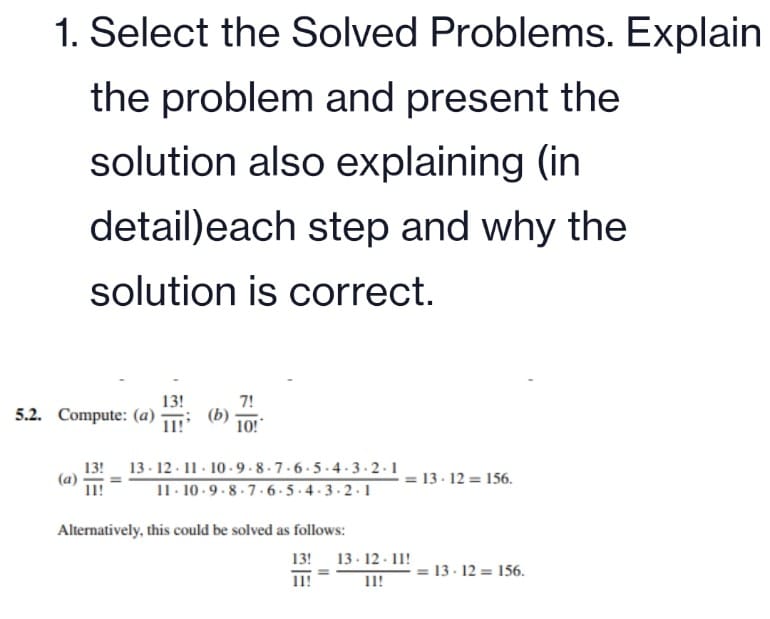
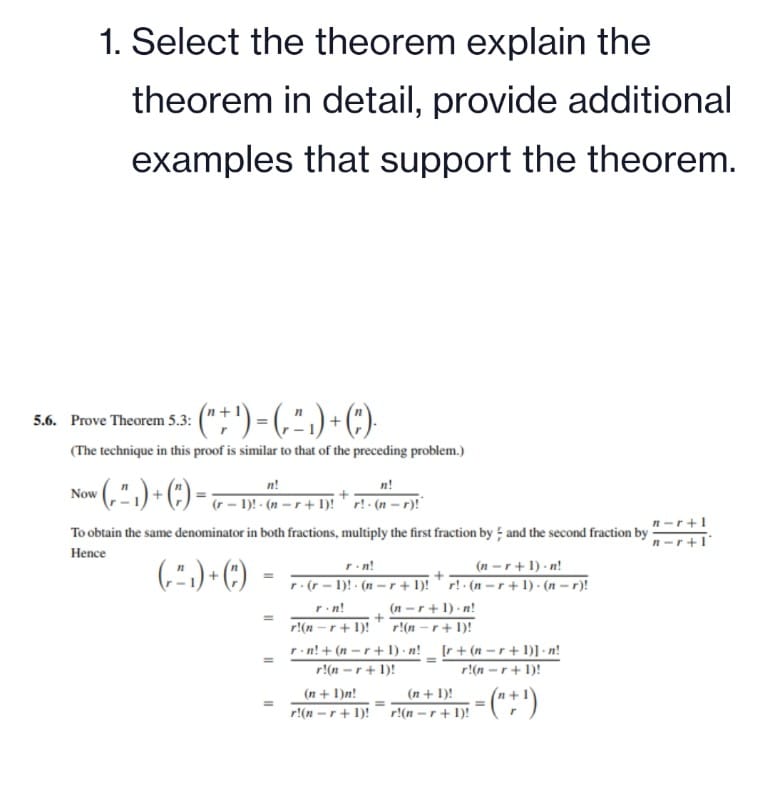
1. Select the Solved Problems. Explain the problem and present the solution also explaining (in detail)each step and why the solution is correct. 13! 7! 5.2. Compute: (a) (b) 10! 13! 13 . 12 . 11 . 10 . 9 . 8 . 7.6 .5-4.3 . 2. 1 (a) = 13 . 12 = 156. 11! 11 . 10 . 9 . 8 . 7 .6 .5 .4.3 .2 . 1 Alternatively, this could be solved as follows: 13! 13 . 12 . 11! II! = 13 . 12 = 156.1. Select the theorem explain the theorem in detail, provide additional examples that support the theorem. 5.6. Prove Theorem 5.3: (" + 1 ) = (, ")+ (") (The technique in this proof is similar to that of the preceding problem.) Now (, ",) + (" = 6-1).(4-r+1)! n! in! r! . (1 - r)! To obtain the same denominator in both fractions, multiply the first fraction by ; and the second fraction by , n-r+ 1 Hence ("1)+) = (n - r + 1) . n! r. (r - 1 ) ! . (n - r+1)! r!. (1-r+1). (1-r)! r . n! (n - r + 1 ) . n! ri(n - r + 1)! r!(m -r+ 1)! r . n! + (n - r+ 1).m! Ir+ (-r+ 1)] . n! r!(n - r + 1)! r!(n - r + 1)! (n + 1)n! (n + 1)! = r!(n - r+ 1)! r!(m - r+ 1)
Step by Step Solution
There are 3 Steps involved in it

Get step-by-step solutions from verified subject matter experts
 Study Help