



Question: 1. Shape of a Graph, Part I Use the graph of f(x) below to answer the following questions. TO 10 10 pt. (a) List all
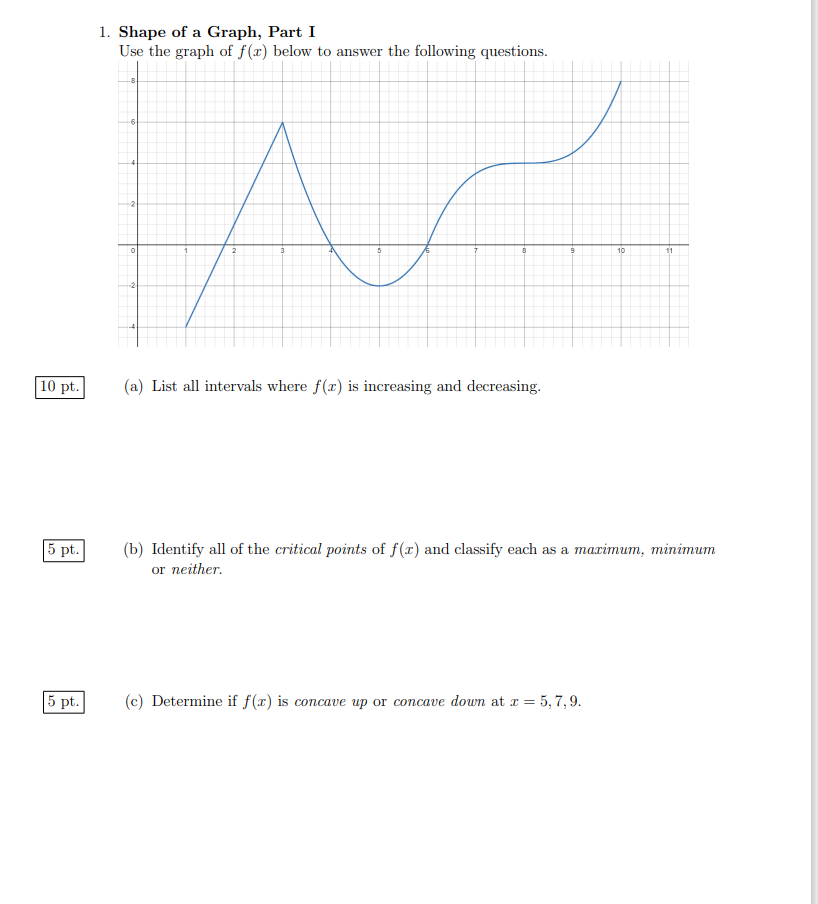
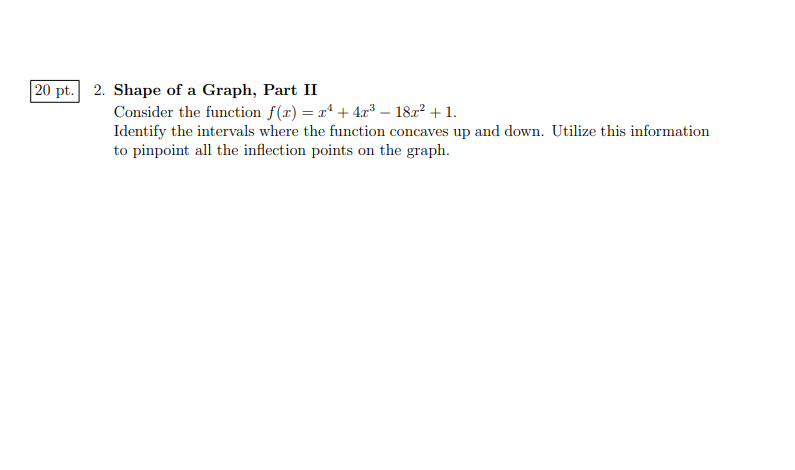
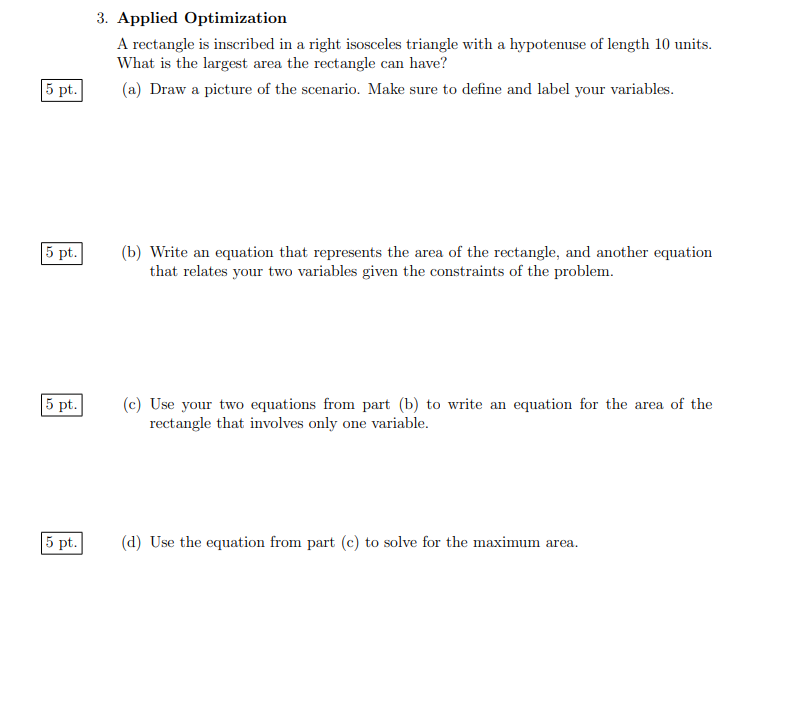
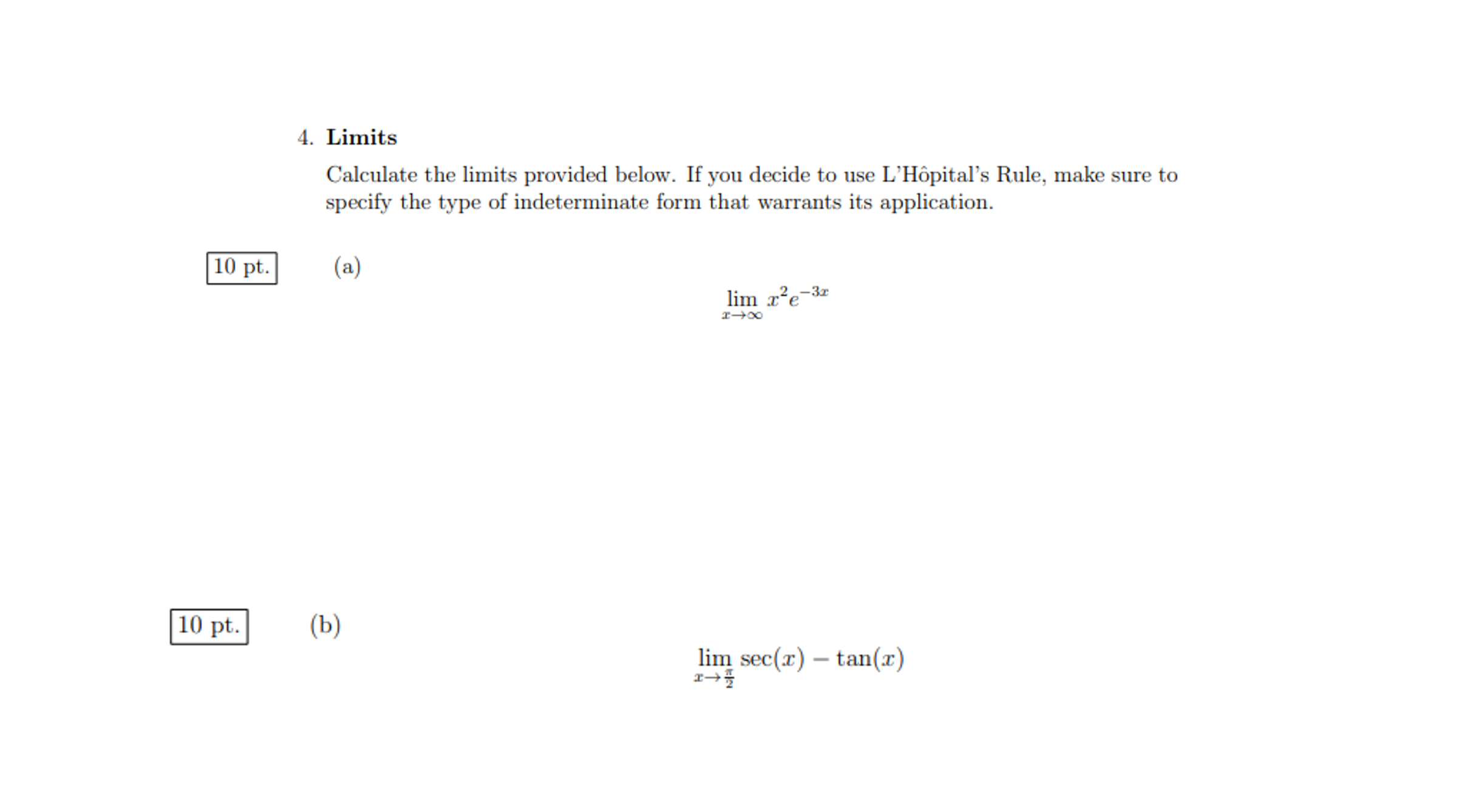
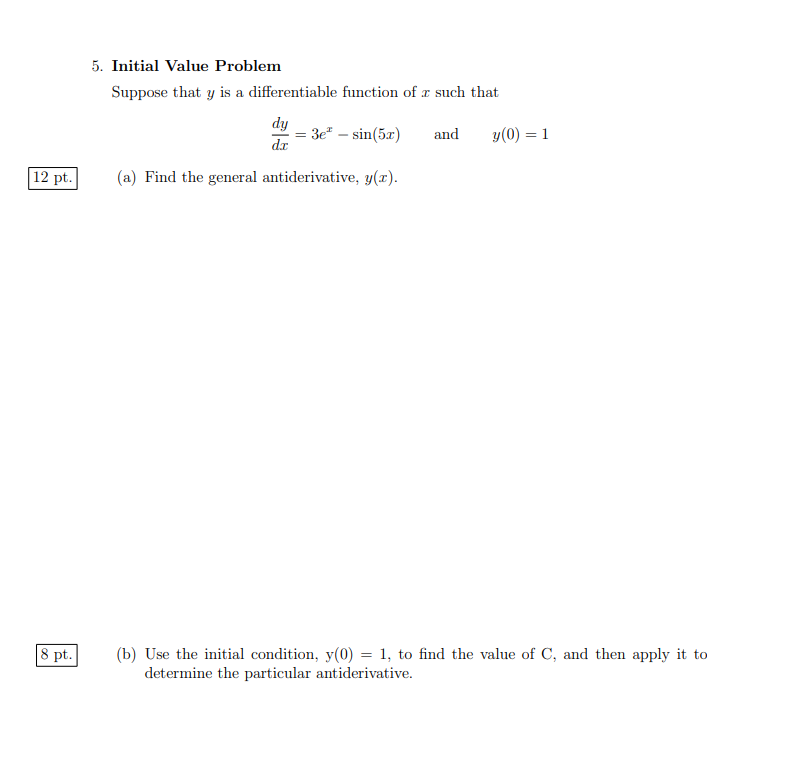
1. Shape of a Graph, Part I Use the graph of f(x) below to answer the following questions. TO 10 10 pt. (a) List all intervals where f(r) is increasing and decreasing. 5 pt. (b) Identify all of the critical points of f(r) and classify each as a marimum, minimum or neither. 5 pt. (c) Determine if f(x) is concave up or concave down at x = 5, 7,9.2. Shape of a Graph, Part 11 Consider the function f(r) = ' + 473 182% + 1. Identify the intervals where the function concaves up and down. Utilize this information to pinpoint all the inflection points on the graph. 5 pt. 3. Applied Optimization A rectangle is inscribed in a right isosceles triangle with a hypotenuse of length 10 units. What is the largest area the rectangle can have? (a) Draw a picture of the scenario. Make sure to define and label your variables. (b) Write an equation that represents the area of the rectangle, and another equation that relates your two variables given the constraints of the problem. () Use your two equations from part (b) to write an equation for the area of the rectangle that involves only one variable. (d) Use the equation from part (c) to solve for the maximum area. 4. Limits Calculate the limits provided below. If you decide to use L'Hopital's Rule, make sure to specify the type of indeterminate form that warrants its application. (a) lim z%e* r00 (b) lim sec(z) tan(x) 5. Initial Value Problem Suppose that y is a differentiable function of a such that dy - = 3el - sin(5x) and y(0) = 1 12 pt. (a) Find the general antiderivative, y(I). 8 pt. (b) Use the initial condition, y(0) = 1, to find the value of C, and then apply it to determine the particular antiderivative
Step by Step Solution
There are 3 Steps involved in it

Get step-by-step solutions from verified subject matter experts