







Question: 1) Simple harmonic motion is given with the following equation, x = 5 sin 3t. Determine a) The amplitude of the wave b) The
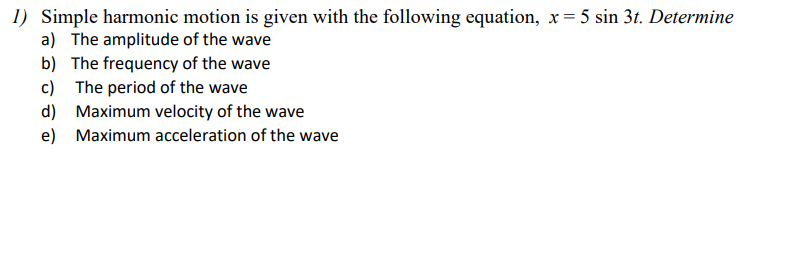
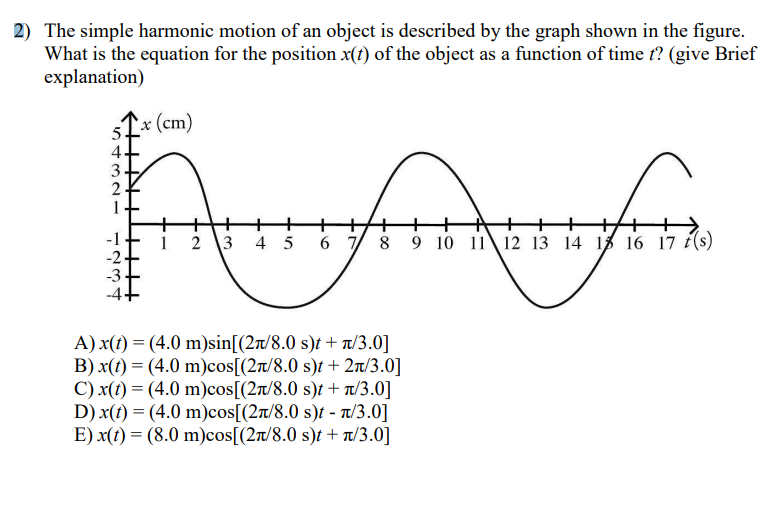
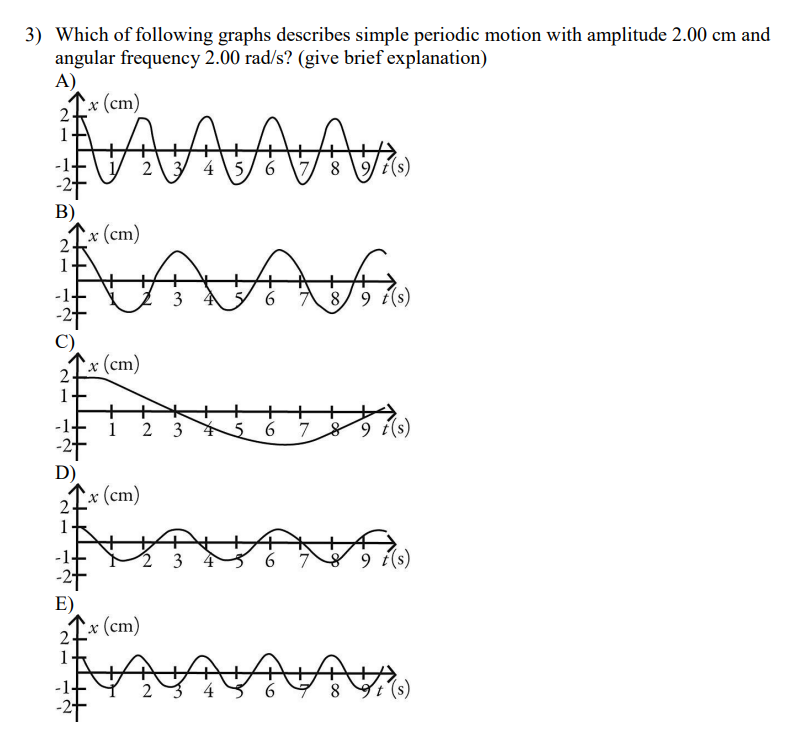
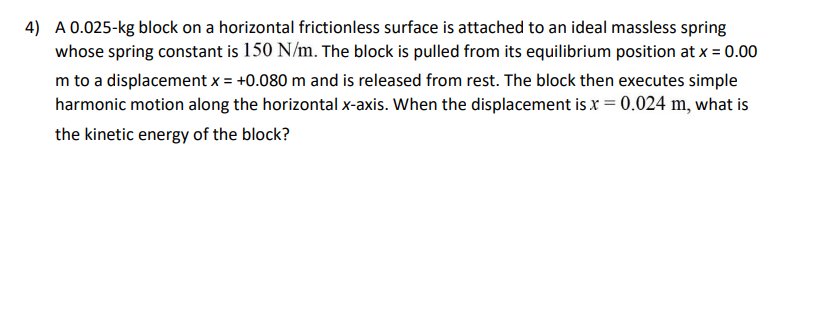
1) Simple harmonic motion is given with the following equation, x = 5 sin 3t. Determine a) The amplitude of the wave b) The frequency of the wave c) The period of the wave d) Maximum velocity of the wave e) Maximum acceleration of the wave 2) The simple harmonic motion of an object is described by the graph shown in the figure. What is the equation for the position x(t) of the object as a function of time t? (give Brief explanation) 4. 3. x (cm) 2+ 1 -1 2 3 45 6 7 8 9 10 11 12 13 14 15 16 17 t(s) -2- -3 -4- A) x(t)=(4.0 m)sin[(2/8.0 s)t +/3.0] B)x(t) (4.0 m)cos[(2/8.0 s)t + 2/3.0] C) x(t) (4.0 m)cos[(2/8.0 s)t + /3.0] D)x(t) (4.0 m)cos[(2/8.0 s)t - /3.0] = = E) x(t)=(8.0 m)cos[(2/8.0 s)t +/3.0] 3) Which of following graphs describes simple periodic motion with amplitude 2.00 cm and angular frequency 2.00 rad/s? (give brief explanation) A) 2. B) 1- x (cm) x(cm) AAAA A 3 89 (s) 21 120 x (cm) 1 + + 789 t(s) 2 3 5 6 D) x (cm) 2 1 x (cm) 3 6 9 t(s) NA(5) 8 4) A 0.025-kg block on a horizontal frictionless surface is attached to an ideal massless spring whose spring constant is 150 N/m. The block is pulled from its equilibrium position at x = 0.00 m to a displacement x = +0.080 m and is released from rest. The block then executes simple harmonic motion along the horizontal x-axis. When the displacement is x = 0.024 m, what is the kinetic energy of the block?
Step by Step Solution
There are 3 Steps involved in it
1 a The amplitude A of the wave is 5m b The frequency of the wave is given by f2320477 Hz c The time ... View full answer

Get step-by-step solutions from verified subject matter experts
 Study Help