Question: 1 Staffing with the M/M/s Queue McNeese is determining the staffing level for their credit union located within the university, and has recently hired two
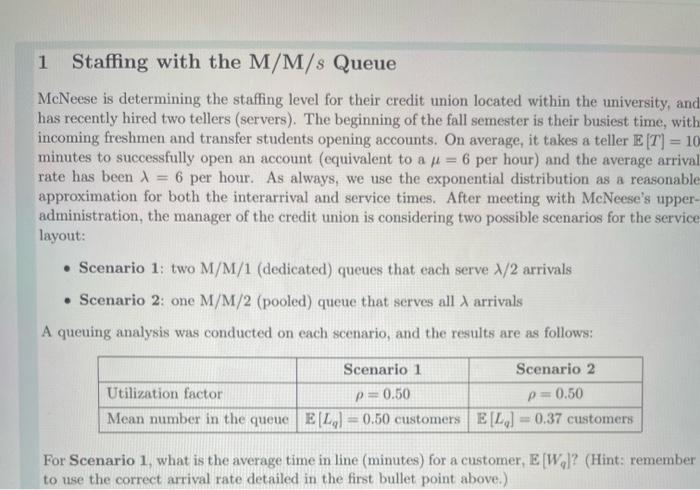
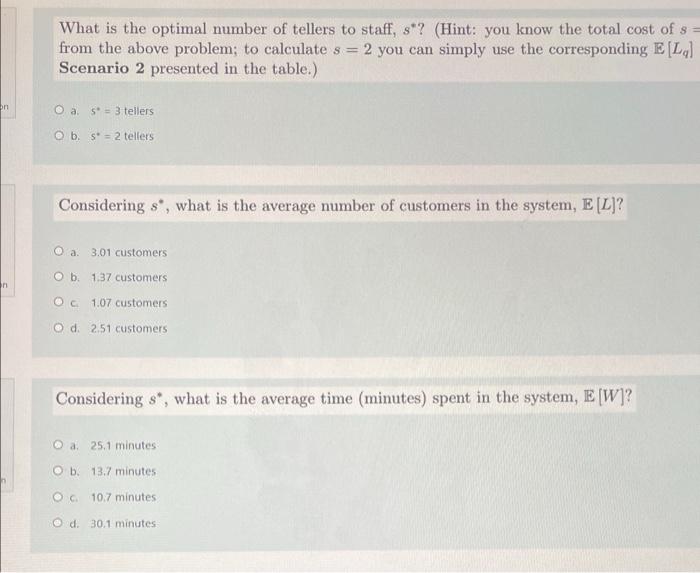
1 Staffing with the M/M/s Queue McNeese is determining the staffing level for their credit union located within the university, and has recently hired two tellers (servers). The beginning of the fall semester is their busiest time, with incoming freshmen and transfer students opening accounts. On average, it takes a teller ET) = 10 minutes to successfully open an account (equivalent to a u = 6 per hour) and the average arrival rate has been 6 per hour. As always, we use the exponential distribution as a reasonable approximation for both the interarrival and service times. After meeting with McNeese's upper- administration, the manager of the credit union is considering two possible scenarios for the service layout: Scenario 1: two M/M/1 (dedicated) queues that each serve X/2 arrivals Scenario 2: one M/M/2 (pooled) queue that serves all ) arrivals A queuing analysis was conducted on each scenario, and the results are as follows: Scenario 1 Scenario 2 Utilization factor Mean number in the queue E(L) = 0.50 customers E [L] =0.37 customers P=0.50 P=0.50 For Scenario 1, what is the average time in line (minutes) for a customer, E [W.]? (Hint: remember to use the correct arrival rate detailed in the first bullet point above.) What is the optimal number of tellers to staff, s"? (Hint: you know the total cost of 8 = from the above problem; to calculate s = 2 you can simply use the corresponding EL Scenario 2 presented in the table.) on O as - 3 tellers O b. S* = 2 tellers Considering s, what is the average number of customers in the system, E [L]? > O a: 3,01 customers Ob 1.37 customers n Oc1.07 customers Od 2.51 customers Considering s*, what is the average time (minutes) spent in the system, E[W]? a 25.1 minutes Ob 13.7 minutes OG 10:7 minutes d. 30.1 minutes 1 Staffing with the M/M/s Queue McNeese is determining the staffing level for their credit union located within the university, and has recently hired two tellers (servers). The beginning of the fall semester is their busiest time, with incoming freshmen and transfer students opening accounts. On average, it takes a teller ET) = 10 minutes to successfully open an account (equivalent to a u = 6 per hour) and the average arrival rate has been 6 per hour. As always, we use the exponential distribution as a reasonable approximation for both the interarrival and service times. After meeting with McNeese's upper- administration, the manager of the credit union is considering two possible scenarios for the service layout: Scenario 1: two M/M/1 (dedicated) queues that each serve X/2 arrivals Scenario 2: one M/M/2 (pooled) queue that serves all ) arrivals A queuing analysis was conducted on each scenario, and the results are as follows: Scenario 1 Scenario 2 Utilization factor Mean number in the queue E(L) = 0.50 customers E [L] =0.37 customers P=0.50 P=0.50 For Scenario 1, what is the average time in line (minutes) for a customer, E [W.]? (Hint: remember to use the correct arrival rate detailed in the first bullet point above.) What is the optimal number of tellers to staff, s"? (Hint: you know the total cost of 8 = from the above problem; to calculate s = 2 you can simply use the corresponding EL Scenario 2 presented in the table.) on O as - 3 tellers O b. S* = 2 tellers Considering s, what is the average number of customers in the system, E [L]? > O a: 3,01 customers Ob 1.37 customers n Oc1.07 customers Od 2.51 customers Considering s*, what is the average time (minutes) spent in the system, E[W]? a 25.1 minutes Ob 13.7 minutes OG 10:7 minutes d. 30.1 minutes









 Study Help