







Question: (1) Study the model for a constant volume adiabatic reactor developed in class lecture 16 and apply it to the combustion of carbon monoxide
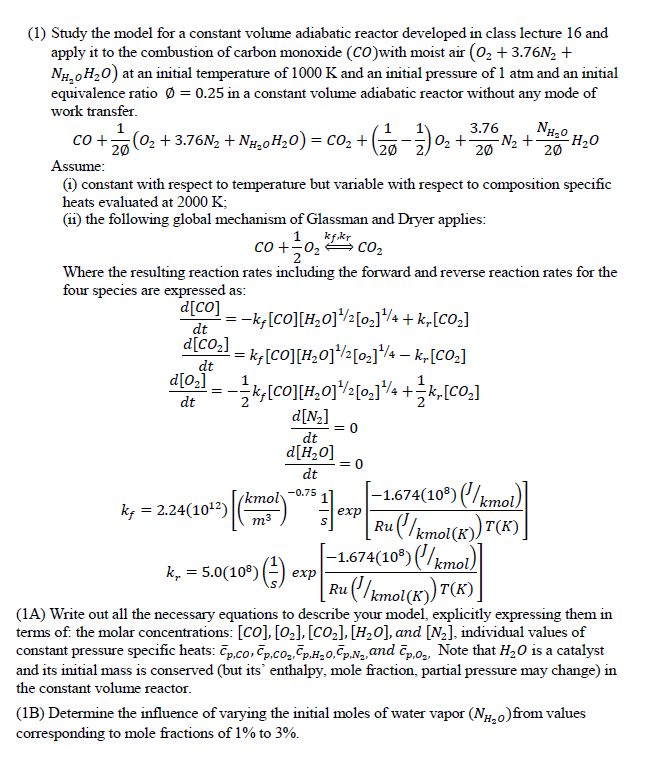
(1) Study the model for a constant volume adiabatic reactor developed in class lecture 16 and apply it to the combustion of carbon monoxide (CO) with moist air (0 +3.76N2 + NOHO) at an initial temperature of 1000 K and an initial pressure of 1 atm and an initial equivalence ratio = 0.25 in a constant volume adiabatic reactor without any mode of work transfer. CO + Assume: 1 20 (0 + 3.76N2 + HO) = CO2 + (2/10-11) 02 -N+ 3.76 NHO 20 HO 20 (i) constant with respect to temperature but variable with respect to composition specific heats evaluated at 2000 K; (ii) the following global mechanism of Glassman and Dryer applies: 1 co +02 CO Where the resulting reaction rates including the forward and reverse reaction rates for the four species are expressed as: d[CO] dt d[CO2] dt =_k[CO][H_O]*/z[oz]*/4+k,[CO] = = k[CO][HO]2[0]/4 k[CO] d[O] = __k,[CO][HO]2[02] + k,[CO] dt d[N2] dt = 0 d[HO] = 0 dt -0.75 ky-2.24(10) (-1674(10) ky = 5.0(108) () exp exp [Ru (1/kmol(K))T(K)] |1.674(103)(/kmol) [Ru (1/kmol(K))T(K)] (1A) Write out all the necessary equations to describe your model, explicitly expressing them in terms of: the molar concentrations: [CO], [0], [CO], [HO], and [N2], individual values of constant pressure specific heats: Cp,co, Cp,CO, p, HO, p.N, and Cp,o, Note that HO is a catalyst and its initial mass is conserved (but its' enthalpy, mole fraction, partial pressure may change) in the constant volume reactor. (1B) Determine the influence of varying the initial moles of water vapor (NHo) from values corresponding to mole fractions of 1% to 3%.
Step by Step Solution
There are 3 Steps involved in it

Get step-by-step solutions from verified subject matter experts
 Study Help