







Question: 1. Summarize the case study in your own words. 2. To show the ability to analyze and write in logical order the collected information. 3.
1. Summarize the case study in your own words.
2. To show the ability to analyze and write in logical order the collected information.
3. Explain the importance of developing employees.
4. Analyse the methods by which Harrods ensures it recruits and retains its employees.
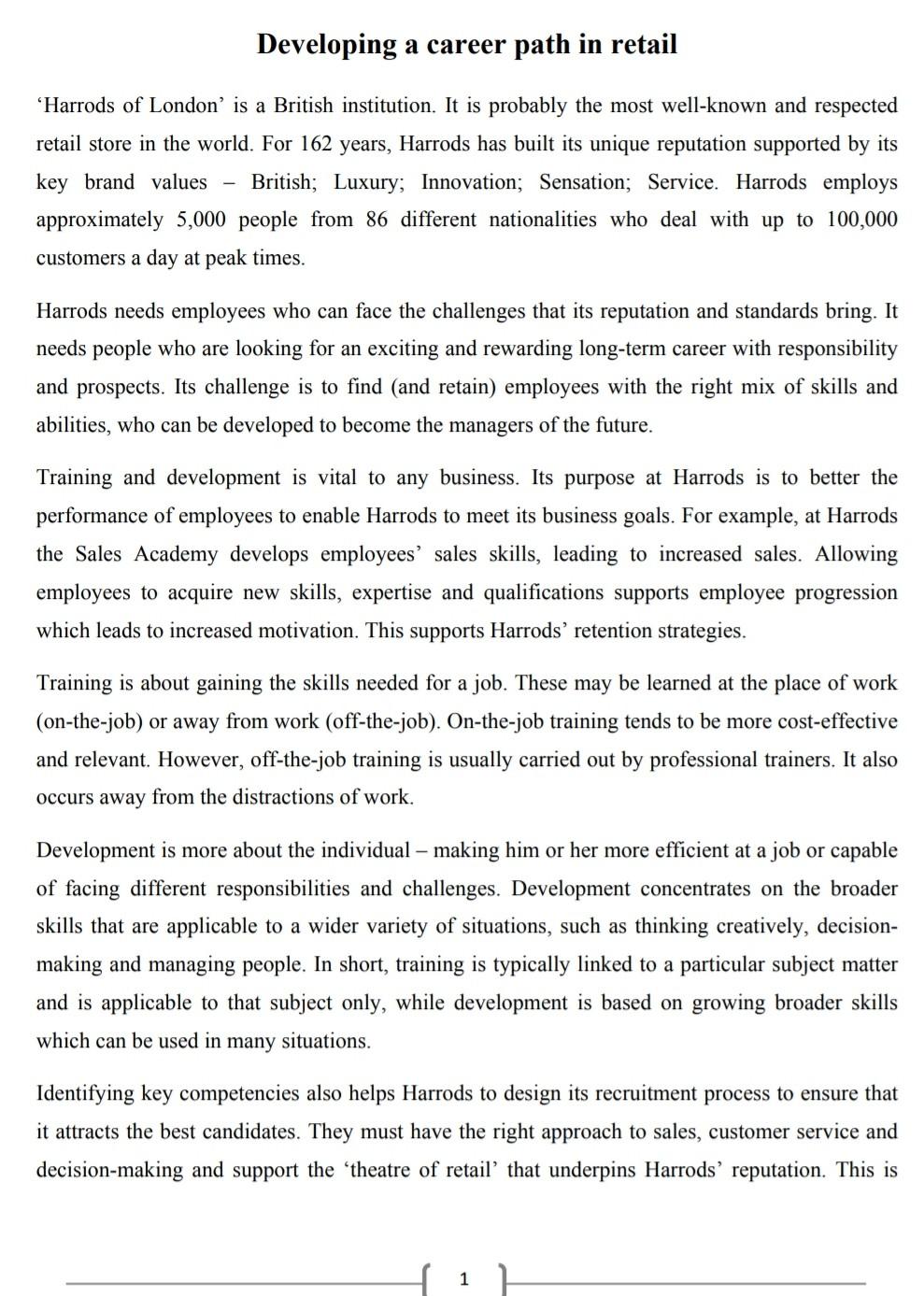
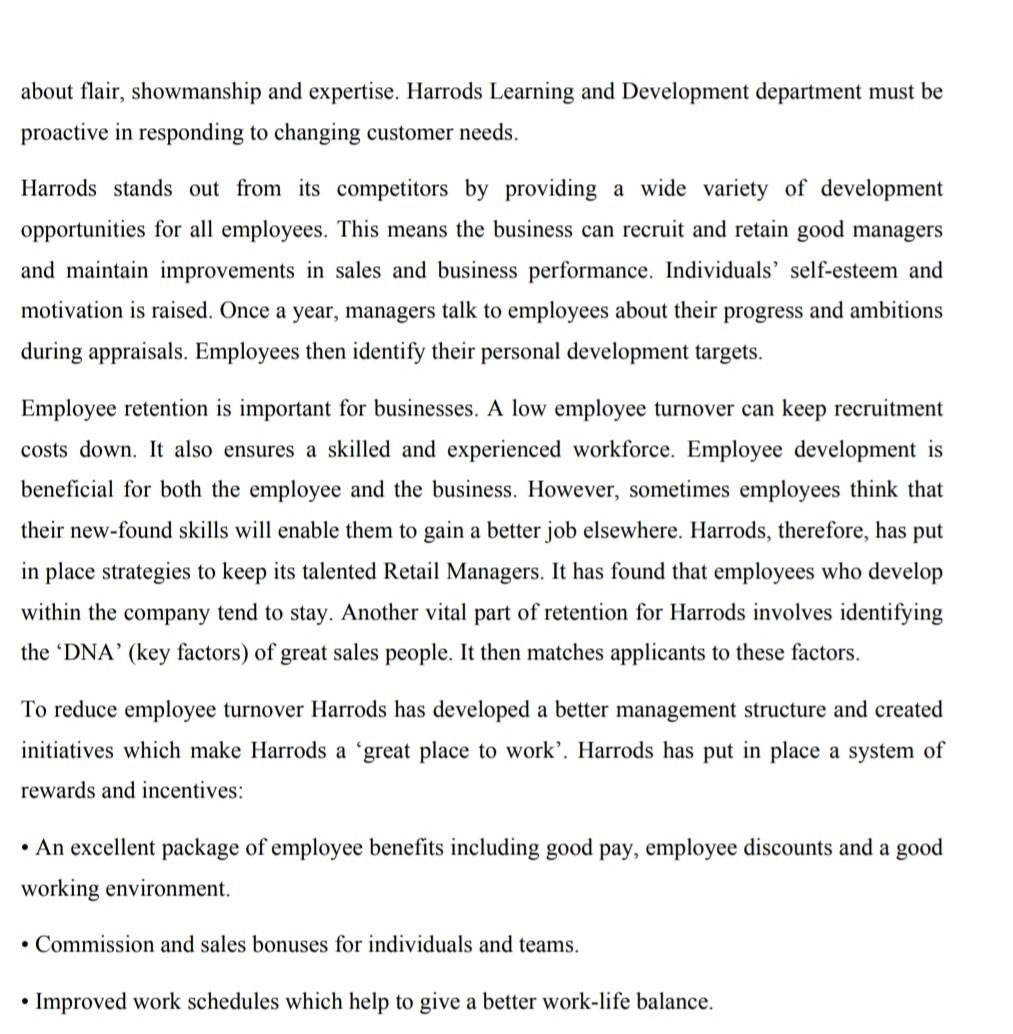
Developing a career path in retail 'Harrods of London' is a British institution. It is probably the most well-known and respected retail store in the world. For 162 years, Harrods has built its unique reputation supported by its key brand values British; Luxury; Innovation; Sensation; Service. Harrods employs approximately 5,000 people from 86 different nationalities who deal with up to 100,000 customers a day at peak times. Harrods needs employees who can face the challenges that its reputation and standards bring. It needs people who are looking for an exciting and rewarding long-term career with responsibility and prospects. Its challenge is to find (and retain) employees with the right mix of skills and abilities, who can be developed to become the managers of the future. Training and development is vital to any business. Its purpose at Harrods is to better the performance of employees to enable Harrods to meet its business goals. For example, at Harrods the Sales Academy develops employees' sales skills, leading to increased sales. Allowing employees to acquire new skills, expertise and qualifications supports employee progression which leads to increased motivation. This supports Harrods' retention strategies. Training is about gaining the skills needed for a job. These may be learned at the place of work (on-the-job) or away from work (off-the-job). On-the-job training tends to be more cost-effective and relevant. However, off-the-job training is usually carried out by professional trainers. It also occurs away from the distractions of work. Development is more about the individual making him or her more efficient at a job or capable of facing different responsibilities and challenges. Development concentrates on the broader skills that are applicable to a wider variety of situations, such as thinking creatively, decision- making and managing people. In short, training is typically linked to a particular subject matter and is applicable to that subject only, while development is based on growing broader skills which can be used in many situations. Identifying key competencies also helps Harrods to design its recruitment process to ensure that it attracts the best candidates. They must have the right approach to sales, customer service and decision-making and support the theatre of retail that underpins Harrods' reputation. This is 1) about flair, showmanship and expertise. Harrods Learning and Development department must be proactive in responding to changing customer needs. Harrods stands out from its competitors by providing a wide variety of development opportunities for all employees. This means the business can recruit and retain good managers and maintain improvements in sales and business performance. Individuals' self-esteem and motivation is raised. Once a year, managers talk to employees about their progress and ambitions during appraisals. Employees then identify their personal development targets. Employee retention is important for businesses. A low employee turnover can keep recruitment costs down. It also ensures a skilled and experienced workforce. Employee development is beneficial for both the employee and the business. However, sometimes employees think that their new-found skills will enable them to gain a better job elsewhere. Harrods, therefore, has put in place strategies to keep its talented Retail Managers. It has found that employees who develop within the company tend to stay. Another vital part of retention for Harrods involves identifying the 'DNA' (key factors) of great sales people. It then matches applicants to these factors. To reduce employee turnover Harrods has developed a better management structure and created initiatives which make Harrods a great place to work. Harrods has put in place a system of rewards and incentives: An excellent package of employee benefits including good pay, employee discounts and a good working environment Commission and sales bonuses for individuals and teams. Improved work schedules which help to give a better work-life balance
Step by Step Solution
There are 3 Steps involved in it
1 Expert Approved Answer
Step: 1 Unlock

Question Has Been Solved by an Expert!
Get step-by-step solutions from verified subject matter experts
Step: 2 Unlock
Step: 3 Unlock
 Study Help