







Question: 1. Suppose the agent's utility function is U = Y - E2/2. The production function is Q=E + k, where Os ks 1, and the
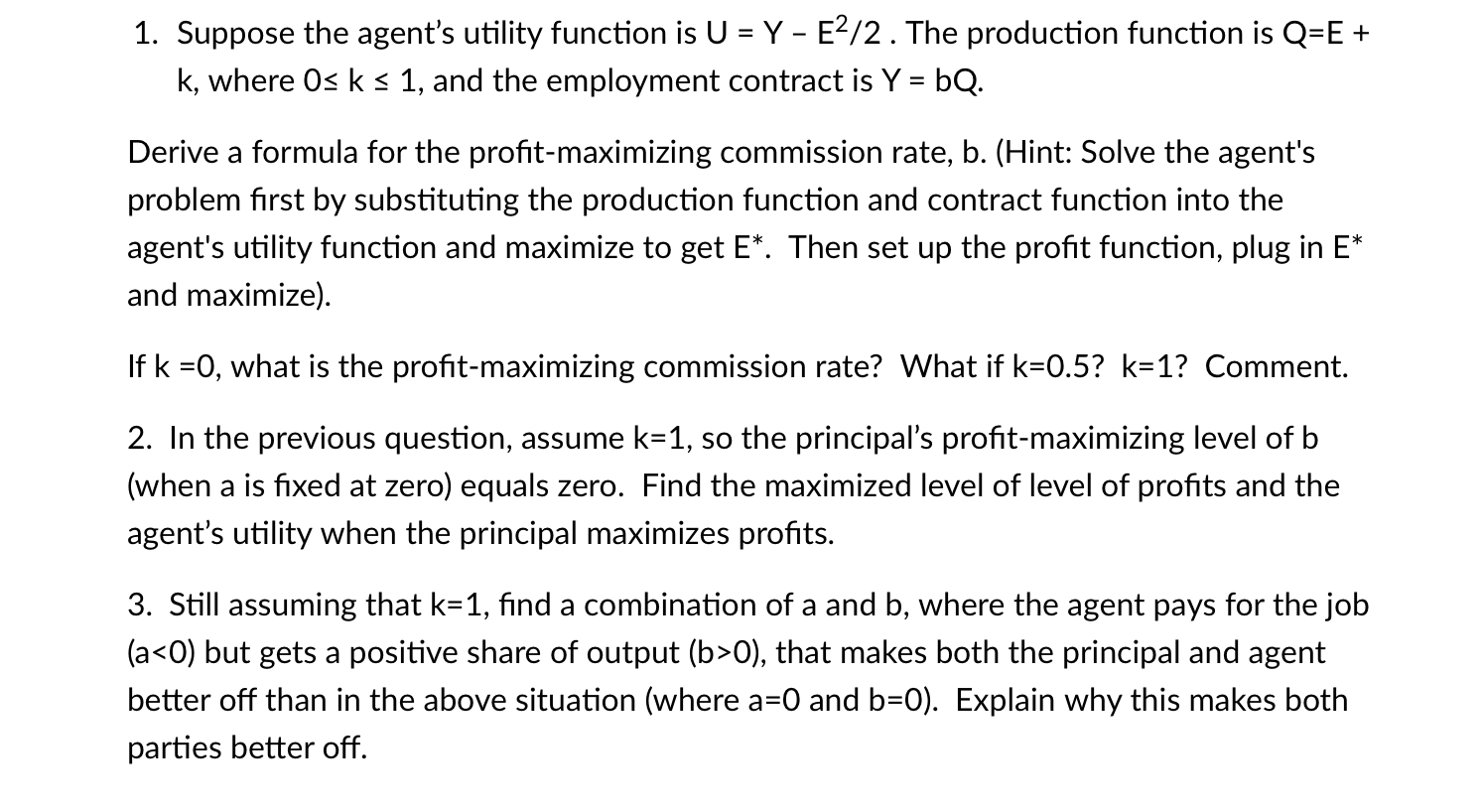
1. Suppose the agent's utility function is U = Y - E2/2. The production function is Q=E + k, where Os ks 1, and the employment contract is Y = bQ. Derive a formula for the profit-maximizing commission rate, b. (Hint: Solve the agent's problem first by substituting the production function and contract function into the agent's utility function and maximize to get E*. Then set up the profit function, plug in E* and maximize). If k =0, what is the profit-maximizing commission rate? What if k=0.5? k=1? Comment. 2. In the previous question, assume k=1, so the principal's profit-maximizing level of b (when a is fixed at zero) equals zero. Find the maximized level of level of profits and the agent's utility when the principal maximizes profits. 3. Still assuming that k=1, find a combination of a and b, where the agent pays for the job (a0), that makes both the principal and agent better off than in the above situation (where a=0 and b=0). Explain why this makes both parties better off. 1. Suppose the agent's utility function is U = Y - E2/2. The production function is Q=E + k, where Os ks 1, and the employment contract is Y = bQ. Derive a formula for the profit-maximizing commission rate, b. (Hint: Solve the agent's problem first by substituting the production function and contract function into the agent's utility function and maximize to get E*. Then set up the profit function, plug in E* and maximize). If k =0, what is the profit-maximizing commission rate? What if k=0.5? k=1? Comment. 2. In the previous question, assume k=1, so the principal's profit-maximizing level of b (when a is fixed at zero) equals zero. Find the maximized level of level of profits and the agent's utility when the principal maximizes profits. 3. Still assuming that k=1, find a combination of a and b, where the agent pays for the job (a0), that makes both the principal and agent better off than in the above situation (where a=0 and b=0). Explain why this makes both parties better off
Step by Step Solution
There are 3 Steps involved in it

Get step-by-step solutions from verified subject matter experts
 Study Help