



Question: A principal hires an agent to work on a project. The agent chooses effort e {e, en} with cost of effort c(e) = 0
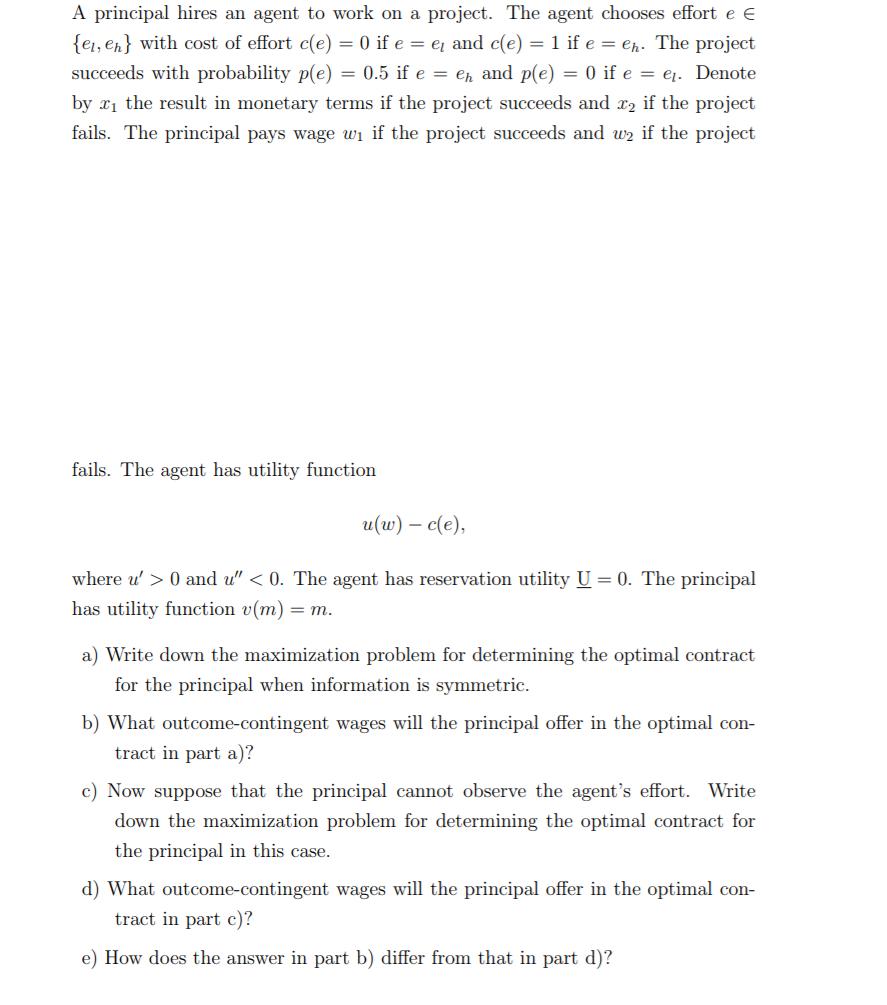
A principal hires an agent to work on a project. The agent chooses effort e {e, en} with cost of effort c(e) = 0 if e = e, and c(e) = 1 if e = eh. The project succeeds with probability p(e) = 0.5 if e = en and p(e) = 0 if e = e. Denote by the result in monetary terms if the project succeeds and if the project fails. The principal pays wage w if the project succeeds and w if the project fails. The agent has utility function u(w) - c(e), where u' > 0 and u" < 0. The agent has reservation utility U = 0. The principal has utility function v(m) = m. a) Write down the maximization problem for determining the optimal contract for the principal when information is symmetric. b) What outcome-contingent wages will the principal offer in the optimal con- tract in part a)? c) Now suppose that the principal cannot observe the agent's effort. Write down the maximization problem for determining the optimal contract for the principal in this case. d) What outcome-contingent wages will the principal offer in the optimal con- tract in part c)? e) How does the answer in part b) differ from that in part d)?
Step by Step Solution
3.39 Rating (155 Votes )
There are 3 Steps involved in it
a The maximization problem for determining the optimal contract for the principal when information is symmetric is Maximize vm m Subject to w ce U w 0 ... View full answer

Get step-by-step solutions from verified subject matter experts