







Question: 1. The Cobb-Douglas production function represents the relationship between two or more inputs and the outputs that can be produced. In its most standard form
1.
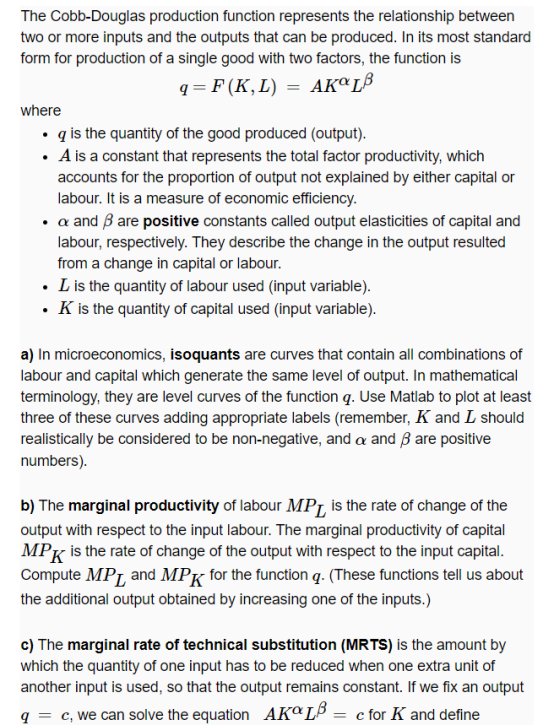
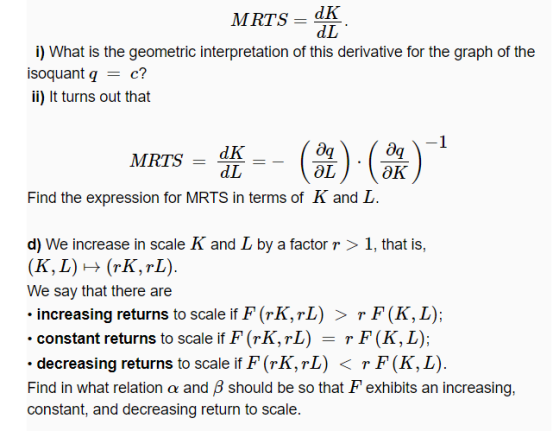
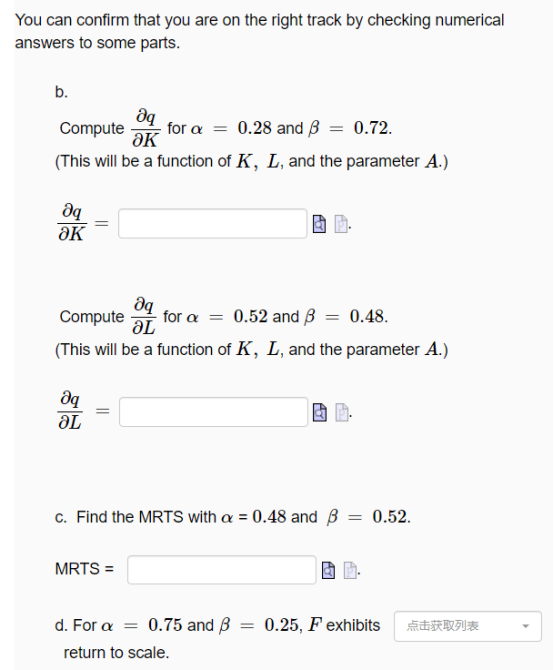
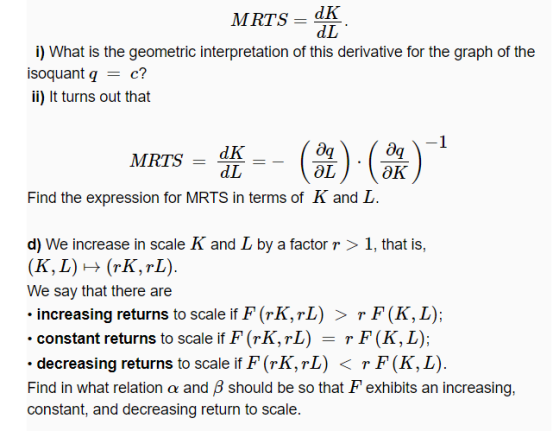
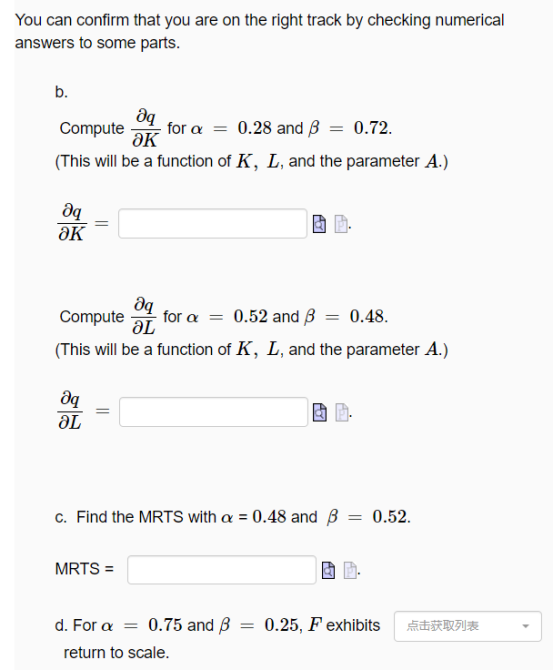
The Cobb-Douglas production function represents the relationship between two or more inputs and the outputs that can be produced. In its most standard form for production of a single good with two factors, the function is q = F(K, L) = AKOLB where . q is the quantity of the good produced (output). . A is a constant that represents the total factor productivity, which accounts for the proportion of output not explained by either capital or labour. It is a measure of economic efficiency. . o and B are positive constants called output elasticities of capital and labour, respectively. They describe the change in the output resulted from a change in capital or labour. . L is the quantity of labour used (input variable). . K is the quantity of capital used (input variable). a) In microeconomics, isoquants are curves that contain all combinations of labour and capital which generate the same level of output. In mathematical terminology, they are level curves of the function q. Use Matlab to plot at least three of these curves adding appropriate labels (remember, K and L should realistically be considered to be non-negative, and o and B are positive numbers). b) The marginal productivity of labour MPy, is the rate of change of the output with respect to the input labour. The marginal productivity of capital MPg is the rate of change of the output with respect to the input capital. Compute MP, and MP for the function q. (These functions tell us about the additional output obtained by increasing one of the inputs.) c) The marginal rate of technical substitution (MRTS) is the amount by which the quantity of one input has to be reduced when one extra unit of another input is used, so that the output remains constant. If we fix an output q = c, we can solve the equation AKOLP = c for K and defineMRTS = dK dL i) What is the geometric interpretation of this derivative for the graph of the isoquant q = c? ii) It turns out that 1 MRTS = dK aq aq dL OL OK Find the expression for MRTS in terms of K and L. d) We increase in scale K 1, that is, (K, L) H (rK, rL). We say that there are . increasing returns to scale if F (rK, rL) > r F(K, L); . constant returns to scale if F (rK, rL) = r F(K, L); . decreasing returns to scale if F (rK, rL)
Step by Step Solution
There are 3 Steps involved in it

Get step-by-step solutions from verified subject matter experts
 Study Help