







Question: Please answer 5, 6 & 8. Let us consider an economy endowed at every time t for tZ+with Nt perfectly competitive identical adult(s) and 1
Please answer 5, 6 & 8.
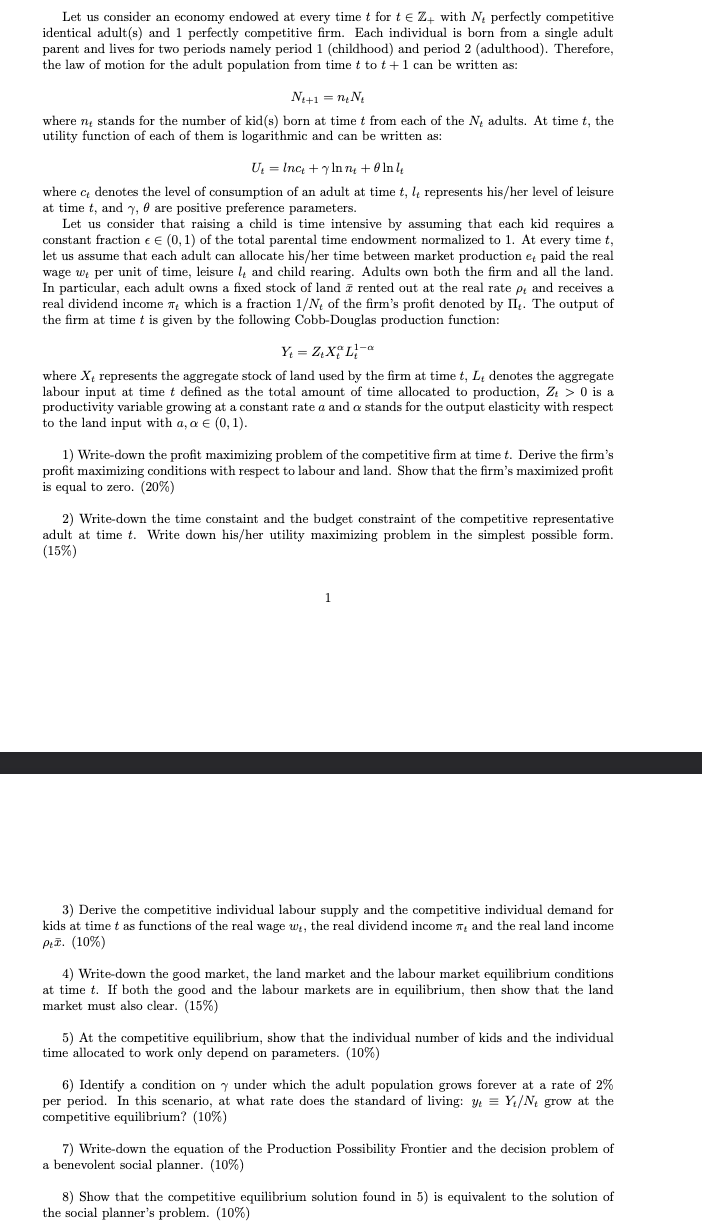
Let us consider an economy endowed at every time t for tZ+with Nt perfectly competitive identical adult(s) and 1 perfectly competitive firm. Each individual is born from a single adult parent and lives for two periods namely period 1 (childhood) and period 2 (adulthood). Therefore, the law of motion for the adult population from time t to t+1 can be written as: Nt+1=ntNt where nt stands for the number of kid(s) born at time t from each of the Nt adults. At time t, the utility function of each of them is logarithmic and can be written as: Ut=lnct+lnnt+lnlt where ct denotes the level of consumption of an adult at time t,lt represents his/her level of leisure at time t, and , are positive preference parameters. Let us consider that raising a child is time intensive by assuming that each kid requires a constant fraction (0,1) of the total parental time endowment normalized to 1 . At every time t, let us assume that each adult can allocate his/her time between market production et paid the real wage wt per unit of time, leisure lt and child rearing. Adults own both the firm and all the land. In particular, each adult owns a fixed stock of land x rented out at the real rate t and receives a real dividend income t which is a fraction 1/Nt of the firm's profit denoted by t. The output of the firm at time t is given by the following Cobb-Douglas production function: Yt=ZtXtLt1 where Xt represents the aggregate stock of land used by the firm at time t,Lt denotes the aggregate labour input at time t defined as the total amount of time allocated to production, Zt>0 is a productivity variable growing at a constant rate a and stands for the output elasticity with respect to the land input with a,(0,1). 1) Write-down the profit maximizing problem of the competitive firm at time t. Derive the firm's profit maximizing conditions with respect to labour and land. Show that the firm's maximized profit is equal to zero. (20%) 2) Write-down the time constaint and the budget constraint of the competitive representative adult at time t. Write down his/her utility maximizing problem in the simplest possible form. (15%) 3) Derive the competitive individual labour supply and the competitive individual demand for kids at time t as functions of the real wage wt, the real dividend income t and the real land income tx.(10%) 4) Write-down the good market, the land market and the labour market equilibrium conditions at time t. If both the good and the labour markets are in equilibrium, then show that the land market must also clear. (15\%) 5) At the competitive equilibrium, show that the individual number of kids and the individual time allocated to work only depend on parameters. (10\%) 6) Identify a condition on under which the adult population grows forever at a rate of 2% per period. In this scenario, at what rate does the standard of living: ytYt/Nt grow at the competitive equilibrium? (10\%) 7) Write-down the equation of the Production Possibility Frontier and the decision problem of a benevolent social planner. (10%) 8) Show that the competitive equilibrium solution found in 5) is equivalent to the solution of the social planner's problem. (10%) Let us consider an economy endowed at every time t for tZ+with Nt perfectly competitive identical adult(s) and 1 perfectly competitive firm. Each individual is born from a single adult parent and lives for two periods namely period 1 (childhood) and period 2 (adulthood). Therefore, the law of motion for the adult population from time t to t+1 can be written as: Nt+1=ntNt where nt stands for the number of kid(s) born at time t from each of the Nt adults. At time t, the utility function of each of them is logarithmic and can be written as: Ut=lnct+lnnt+lnlt where ct denotes the level of consumption of an adult at time t,lt represents his/her level of leisure at time t, and , are positive preference parameters. Let us consider that raising a child is time intensive by assuming that each kid requires a constant fraction (0,1) of the total parental time endowment normalized to 1 . At every time t, let us assume that each adult can allocate his/her time between market production et paid the real wage wt per unit of time, leisure lt and child rearing. Adults own both the firm and all the land. In particular, each adult owns a fixed stock of land x rented out at the real rate t and receives a real dividend income t which is a fraction 1/Nt of the firm's profit denoted by t. The output of the firm at time t is given by the following Cobb-Douglas production function: Yt=ZtXtLt1 where Xt represents the aggregate stock of land used by the firm at time t,Lt denotes the aggregate labour input at time t defined as the total amount of time allocated to production, Zt>0 is a productivity variable growing at a constant rate a and stands for the output elasticity with respect to the land input with a,(0,1). 1) Write-down the profit maximizing problem of the competitive firm at time t. Derive the firm's profit maximizing conditions with respect to labour and land. Show that the firm's maximized profit is equal to zero. (20%) 2) Write-down the time constaint and the budget constraint of the competitive representative adult at time t. Write down his/her utility maximizing problem in the simplest possible form. (15%) 3) Derive the competitive individual labour supply and the competitive individual demand for kids at time t as functions of the real wage wt, the real dividend income t and the real land income tx.(10%) 4) Write-down the good market, the land market and the labour market equilibrium conditions at time t. If both the good and the labour markets are in equilibrium, then show that the land market must also clear. (15\%) 5) At the competitive equilibrium, show that the individual number of kids and the individual time allocated to work only depend on parameters. (10\%) 6) Identify a condition on under which the adult population grows forever at a rate of 2% per period. In this scenario, at what rate does the standard of living: ytYt/Nt grow at the competitive equilibrium? (10\%) 7) Write-down the equation of the Production Possibility Frontier and the decision problem of a benevolent social planner. (10%) 8) Show that the competitive equilibrium solution found in 5) is equivalent to the solution of the social planner's problem. (10%)
Step by Step Solution
There are 3 Steps involved in it

Get step-by-step solutions from verified subject matter experts
 Study Help