







Question: 1) The correct name for the compound shown below is: a) 3-bromobenzene b) 4-bromobenzene c) m-bromobenzene d) o-bromotoluene e) bromomethylbenzene Toluene is the name commonly
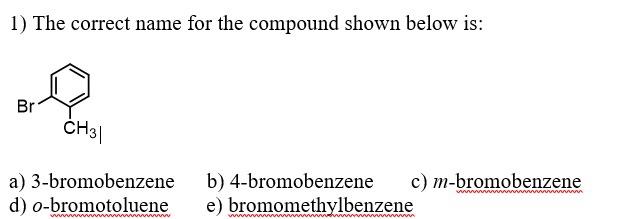
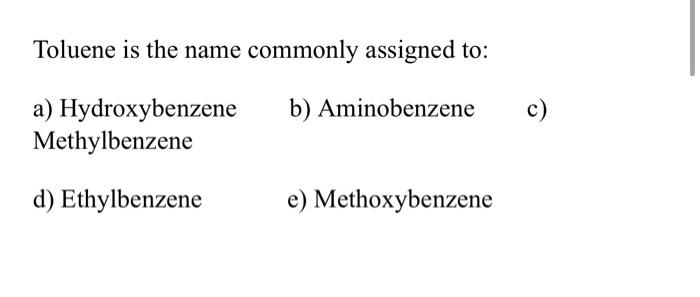
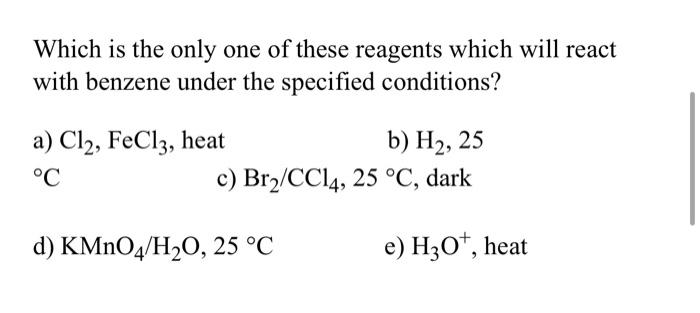
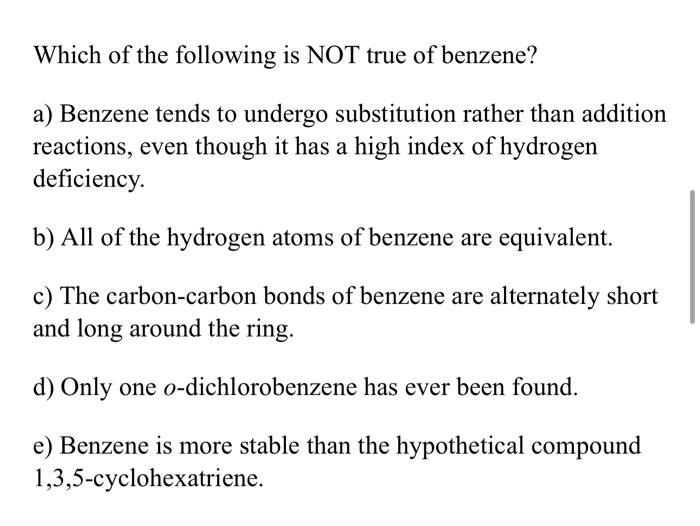
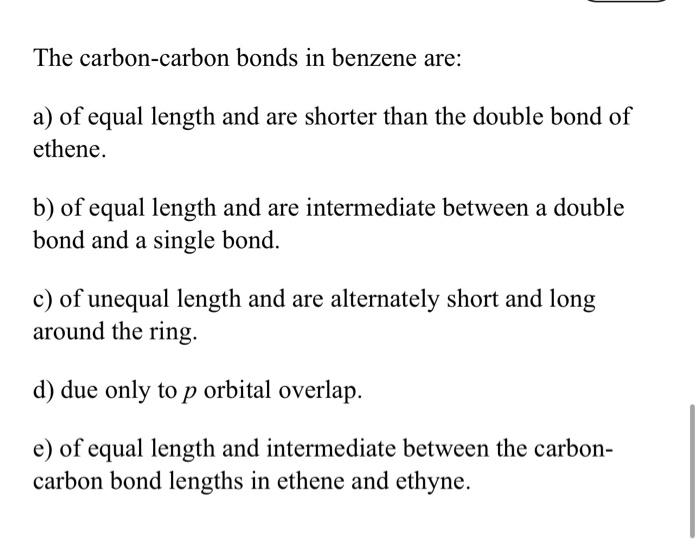
1) The correct name for the compound shown below is: a) 3-bromobenzene b) 4-bromobenzene c) m-bromobenzene d) o-bromotoluene e) bromomethylbenzene Toluene is the name commonly assigned to: a) Hydroxybenzene b) Aminobenzene c) Methylbenzene d) Ethylbenzene e) Methoxybenzene Which is the only one of these reagents which will react with benzene under the specified conditions? a) Cl2,FeCl3, heat b) H2,25 C c) Br2/CCl4,25C, dark d) KMnO4/H2O,25C e) H3O+, heat Which of the following is NOT true of benzene? a) Benzene tends to undergo substitution rather than addition reactions, even though it has a high index of hydrogen deficiency. b) All of the hydrogen atoms of benzene are equivalent. c) The carbon-carbon bonds of benzene are alternately short and long around the ring. d) Only one o-dichlorobenzene has ever been found. e) Benzene is more stable than the hypothetical compound 1,3,5-cyclohexatriene. The carbon-carbon bonds in benzene are: a) of equal length and are shorter than the double bond of ethene. b) of equal length and are intermediate between a double bond and a single bond. c) of unequal length and are alternately short and long around the ring. d) due only to p orbital overlap. e) of equal length and intermediate between the carboncarbon bond lengths in ethene and ethyne
Step by Step Solution
There are 3 Steps involved in it

Get step-by-step solutions from verified subject matter experts
 Study Help