







Question: 1. The forward and reverse mutation rates at a certain locus in E. coli are Atoa 5x10 atoA 3x10 a. What are the expected allelic
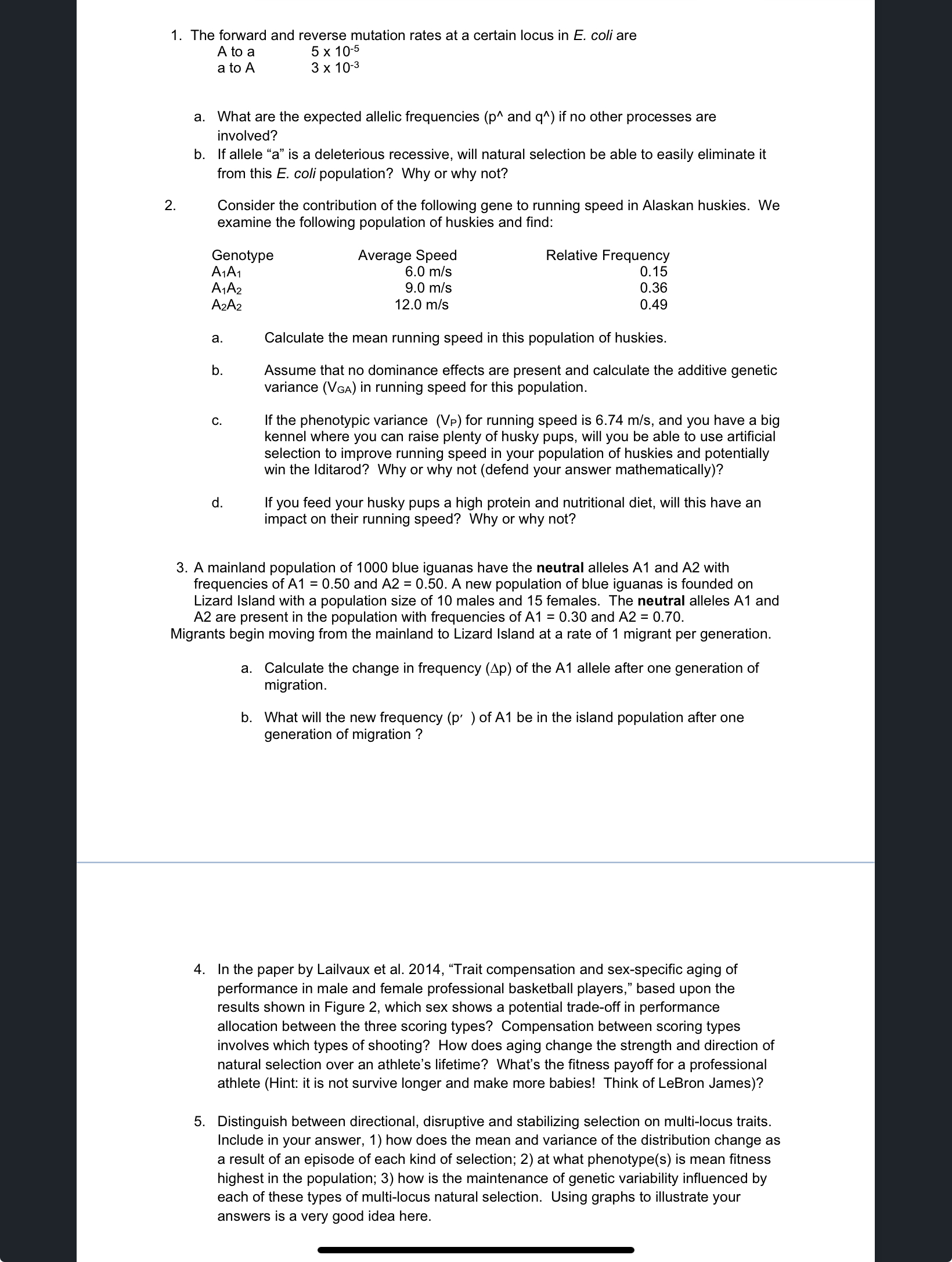
1. The forward and reverse mutation rates at a certain locus in E. coli are Atoa 5x10 atoA 3x10 a. What are the expected allelic frequencies (p\" and g*) if no other processes are involved? b. If allele \"a\" is a deleterious recessive, will natural selection be able to easily eliminate it from this E. coli population? Why or why not? 2. Consider the contribution of the following gene to running speed in Alaskan huskies. We examine the following population of huskies and find: Genotype Average Speed Relative Frequency AtAq 6.0 m/s 0.15 AqAz 9.0 m/s 0.36 AzAz 12.0 m/s 0.49 a. Calculate the mean running speed in this population of huskies. b. Assume that no dominance effects are present and calculate the additive genetic variance (Vga) in running speed for this population. C. If the phenotypic variance (Ve) for running speed is 6.74 m/s, and you have a big kennel where you can raise plenty of husky pups, will you be able to use artificial selection to improve running speed in your population of huskies and potentially win the Iditarod? Why or why not (defend your answer mathematically)? d. If you feed your husky pups a high protein and nutritional diet, will this have an impact on their running speed? Why or why not? 3. A mainland population of 1000 blue iguanas have the neutral alleles A1 and A2 with frequencies of A1 = 0.50 and A2 = 0.50. A new population of blue iguanas is founded on Lizard Island with a population size of 10 males and 15 females. The neutral alleles A1 and A2 are present in the population with frequencies of A1 = 0.30 and A2 = 0.70. Migrants begin moving from the mainland to Lizard Island at a rate of 1 migrant per generation. a. Calculate the change in frequency (Ap) of the A1 allele after one generation of migration. b. What will the new frequency (p' ) of A1 be in the island population after one generation of migration ? 4. Inthe paper by Lailvaux et al. 2014, \"Trait compensation and sex-specific aging of performance in male and female professional basketball players,\" based upon the results shown in Figure 2, which sex shows a potential trade-off in performance allocation between the three scoring types? Compensation between scoring types involves which types of shooting? How does aging change the strength and direction of natural selection over an athlete's lifetime? What's the fitness payoff for a professional athlete (Hint: it is not survive longer and make more babies! Think of LeBron James)? 5. Distinguish between directional, disruptive and stabilizing selection on multi-locus traits. Include in your answer, 1) how does the mean and variance of the distribution change as a result of an episode of each kind of selection; 2) at what phenotype(s) is mean fitness highest in the population; 3) how is the maintenance of genetic variability influenced by each of these types of multi-locus natural selection. Using graphs to illustrate your answers is a very good idea here
Step by Step Solution
There are 3 Steps involved in it

Get step-by-step solutions from verified subject matter experts
 Study Help