







Question: 1 The molecule bipyridine (C10H8N2, bpy) forms a complex with a ruthenium ion (Ru+2) The resulting complex is Ru(bpy)2+ .This complex, in the excitation state
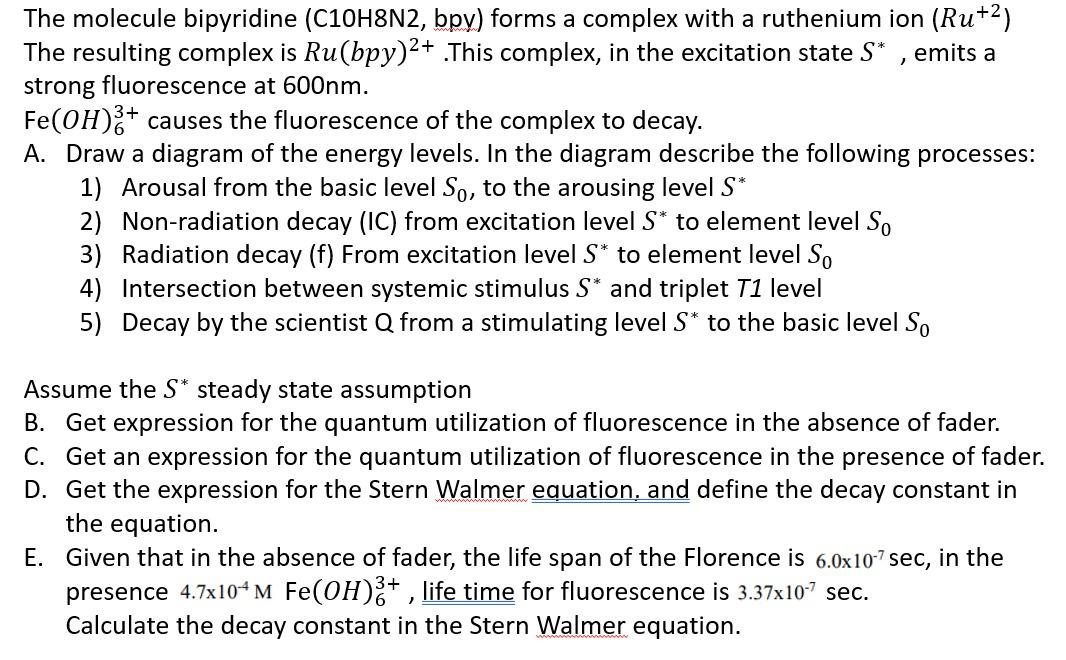
1 The molecule bipyridine (C10H8N2, bpy) forms a complex with a ruthenium ion (Ru+2) The resulting complex is Ru(bpy)2+ .This complex, in the excitation state S* emits a strong fluorescence at 600nm. Fe(OH)3+ causes the fluorescence of the complex to decay. A. Draw a diagram of the energy levels. In the diagram describe the following processes: 1) Arousal from the basic level So, to the arousing level S* 2) Non-radiation decay (IC) from excitation level S* to element level So 3) Radiation decay (f) From excitation level S* to element level So 4) Intersection between systemic stimulus S* and triplet T1 level 5) Decay by the scientist Q from a stimulating level S* to the basic level So Assume the S* steady state assumption B. Get expression for the quantum utilization of fluorescence in the absence of fader. C. Get an expression for the quantum utilization of fluorescence in the presence of fader. D. Get the expression for the Stern Walmer equation, and define the decay constant in the equation. E. Given that in the absence of fader, the life span of the Florence is 6.0x10⁻⁷ sec, in the presence 4.7x10* M Fe(OH)3+ , life time for fluorescence is 3.37x10⁻⁷ sec. Calculate the decay constant in the Stern Walmer equation
Step by Step Solution
There are 3 Steps involved in it

Get step-by-step solutions from verified subject matter experts
 Study Help