







Question: 1. The term structure based on government strips is flat at 10%% (annualized with continuously compounded) for all maturities. Assume throughout this problem that you
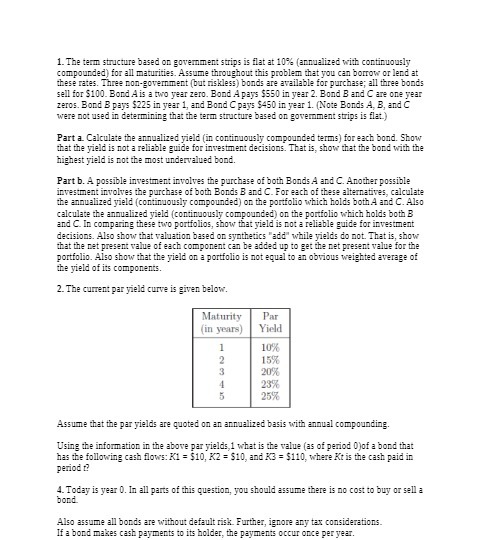
1. The term structure based on government strips is flat at 10%% (annualized with continuously compounded) for all maturities. Assume throughout this problem that you can borrow or lend at these rates. Three non-government (but riskless) bonds are available for purchase; all three bonds sell for $100. Bond A is a two year zero. Bond A pays $550 in year 2. Bond B and C are one year zeros. Bond B pays $225 in year 1, and Bond Cpays $450 in year 1. (Note Bonds A, B, and C were not used in determining that the term structure based on government strips is flet) Part a. Calculate the annualized yield (in continuously compounded terms) for each bond. Show that the yield is not a reliable guide for investment decisions. That is, show that the bond with the highest yield is not the most undervalued bond. Part b. A possible investment involves the purchase of both Bonds A and C. Another possible investment involves the purchase of both Bonds B and C. For each of these alternatives, calculate the annualized yield (continuously compounded) on the portfolio which holds bothA and C. Also calculate the annualized yield (continuously compounded) on the portfolio which holds both B and C. In comparing these two portfolios, show that yield is not a reliable guide for investment decisions. Also show that valuation based on synthetics "add" while yields do not. That is, show that the net present value of each component can be added up to get the net present value for the portfolio. Also show that the yield on a portfolio is not equal to an obvious weighted average of the yield of its components. 2. The current par yield curve is given below. Maturity Par (in years Yield 10% 15% 20% 23% 25% Assume that the par yields are quoted on an annualized basis with annual compounding. Using the information in the above par yields,1 what is the value (as of period 0) of a bond that has the following cash flows: KI = $10, K2 = $10, and K3 = $110, where At is the cash paid in period t? 4. Today is year 0. In all parts of this question, you should assume there is no cost to buy or sell a bond Also assume all bonds are without default risk Further, ignore any tax considerations. If a bond makes cash payments to its holder, the payments occur once per year
Step by Step Solution
There are 3 Steps involved in it

Get step-by-step solutions from verified subject matter experts
 Study Help