



Question: 1) This problem involves blackbody radiation. a) Calculate the wavelength where the spectral radiant energy density (denoted in your textbook and (,T) in lecture) of
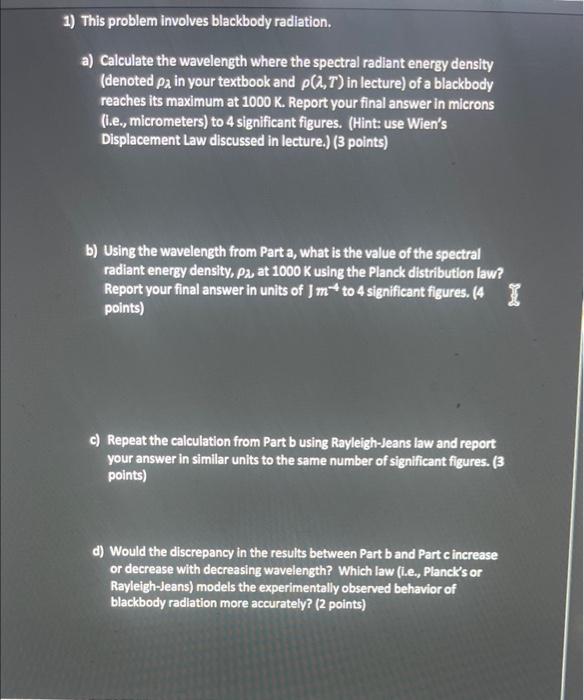
1) This problem involves blackbody radiation. a) Calculate the wavelength where the spectral radiant energy density (denoted in your textbook and (,T) in lecture) of a blackbody reaches its maximum at 1000K. Report your final answer in microns (i.e., micrometers) to 4 significant figures. (Hintt use Wien's Displacement Law discussed in lecture.) (3 points) b) Using the wavelength from Part a, what is the value of the spectral radiant energy density, 2, at 1000K using the Planck distribution law? Report your final answer in units of J4 to 4 significant figures. (4) points) c) Repeat the calculation from Part b using Rayleigh-leans law and report your answer in similar units to the same number of significant figures. (3 points) d) Would the discrepancy in the results between Part b and Part c increase or decrease with decreasing wavelength? Which law (i.e., Planck's or Rayleigh-Jeans) models the experimentally observed behavior of blackbody radlation more accurately? (2 points)
Step by Step Solution
There are 3 Steps involved in it

Get step-by-step solutions from verified subject matter experts