







Question: Problem 1. This problem involves a cost-benefit process analysis for laying out a facility. The process involves a Chipotle-style line whereby customers arrive, order food,
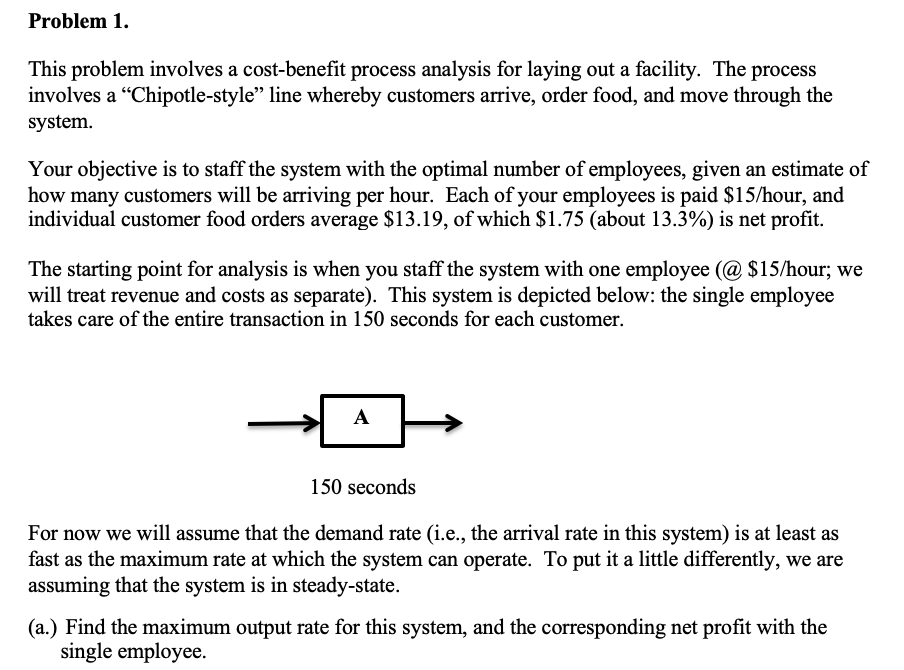
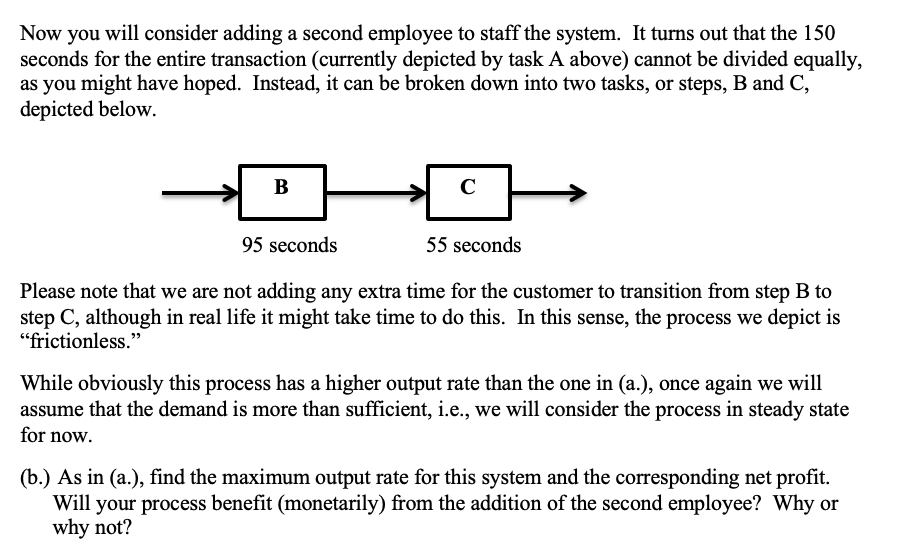
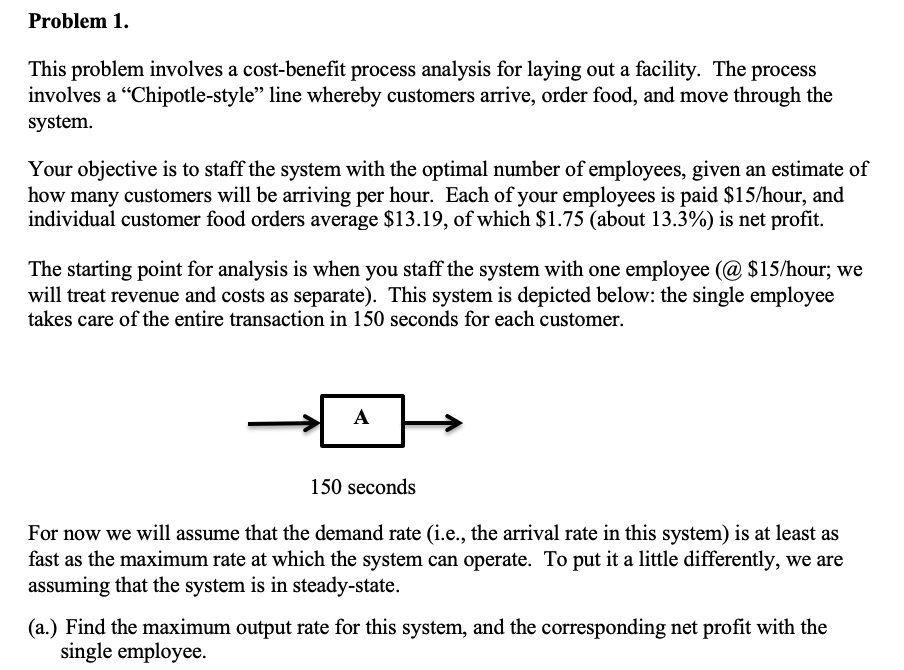
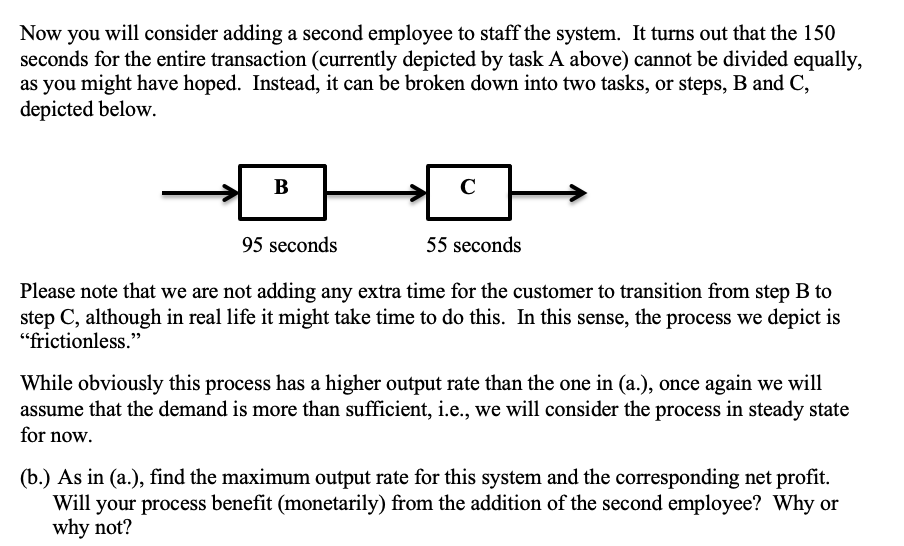
Problem 1. This problem involves a cost-benefit process analysis for laying out a facility. The process involves a \"Chipotle-style\" line whereby customers arrive, order food, and move through the system. Your objective is to staff the system with the optimal number of employees, given an estimate of how many customers will be arriving per hour. Each of your employees is paid $15fhour, and individual customer food orders average $13.19, of which $1.75 (about 13.3%) is net prot. The starting point for analysis is when you staff the system with one employee (@ $15r'hour; we will treat revenue and costs as separate). This system is depicted below: the single employee takes care of the entire transaction in 150 seconds for each customer. 150 seconds For now we will assume that the demand rate (i.e., the arrival rate in this system) is at least as fast as the maximum rate at which the system can operate. To put it a little differently, we are assuming that the system is in steady-state. (a.) Find the maximum output rate for this system, and the corresponding net profit with the single employee. Now you will consider adding a second employee to staff the system. It turns out that the 150 seconds for the entire transaction (currently depicted by task A above) cannot be divided equally, as you might have hoped. Instead, it can be broken down into two tasks, or steps, B and C, depicted below. II 95 seconds 55 seconds Please note that we are not adding any extra time for the customer to transition from step B to step C, although in real life it might take time to do this. In this sense, the process we depict is \"frictionless.\" While obviously this process has a higher output rate than the one in (a), once again we will assume that the demand is more than sufficient, i.e., we will consider the process in steady state for now. (b) As in (a), find the maximum output rate for this system and the corresponding net profit. Will your process benefit (monetarily) 'om the addition of the second employee? Why or why not
Step by Step Solution
There are 3 Steps involved in it

Get step-by-step solutions from verified subject matter experts
 Study Help