







Question: 1. This problem is about using randomly generated binomial sample data to estimate a population proportion (or binomial success probability) p. Let X Bin(20;p) where
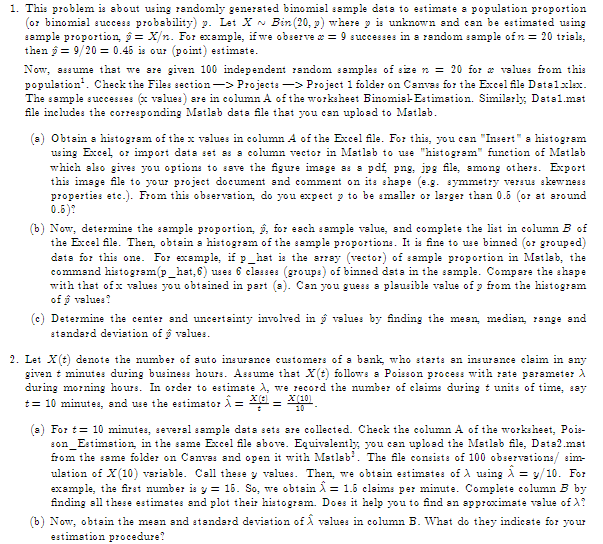
1. This problem is about using randomly generated binomial sample data to estimate a population proportion (or binomial success probability) p. Let X Bin(20;p) where p is unknown and can be estimated using sample proportion, ^p = X=n. For example, if we observe x = 9 successes in a random sample of n = 20 trials, then ^p = 9=20 = 0:45 is our (point) estimate. Now, assume that we are given 100 independent random samples of size n = 20 for x values from this population1. Check the Files section > Projects > Project 1 folder on Canvas for the Excel le Data1.xlsx. The sample successes (x values) are in column A of the worksheet Binomial-Estimation. Similarly, Data1.mat le includes the corresponding Matlab data le that you can upload to Matlab. (a) Obtain a histogram of the x values in column A of the Excel le. For this, you can "Insert" a histogram using Excel, or import data set as a column vector in Matlab to use "histogram" function of Matlab which also gives you options to save the gure image as a pdf, png, jpg le, among others. Export this image le to your project document and comment on its shape (e.g. symmetry versus skewness properties etc.). From this observation, do you expect p to be smaller or larger than 0.5 (or at around 0.5)? (b) Now, determine the sample proportion, ^p, for each sample value, and complete the list in column B of the Excel le. Then, obtain a histogram of the sample proportions. It is ne to use binned (or grouped) data for this one. For example, if p_hat is the array (vector) of sample proportion in Matlab, the command histogram(p_hat,6) uses 6 classes (groups) of binned data in the sample. Compare the shape with that of x values you obtained in part (a). Can you guess a plausible value of p from the histogram of ^p values? (c) Determine the center and uncertainty involved in ^p values by nding the mean, median, range and standard deviation of ^p values. 2. Let X(t) denote the number of auto insurance customers of a bank, who starts an insurance claim in any given t minutes during business hours. Assume that X(t) follows a Poisson process with rate parameter during morning hours. In order to estimate , we record the number of claims during t units of time, say t = 10 minutes, and use the estimator ^ = X(t) t = X(10) 10 . (a) For t = 10 minutes, several sample data sets are collected. Check the column A of the worksheet, Pois- son_Estimation, in the same Excel le above. Equivalently, you can upload the Matlab le, Data2.mat from the same folder on Canvas and open it with Matlab2. The le consists of 100 observations/ sim- ulation of X(10) variable. Call these y values. Then, we obtain estimates of using ^ = y=10. For example, the rst number is y = 15. So, we obtain ^ = 1:5 claims per minute. Complete column B by nding all these estimates and plot their histogram. Does it help you to nd an approximate value of ? (b) Now, obtain the mean and standard deviation of ^ values in column B. What do they indicate for your estimation procedure?
1. This problem is about using randomly generated binomial sample data to estimate a population proportion (o: binomial success probability) 7. Let X Bin (20,7) where p is unknown and can be estimated using sample proportion = x. For example, if we observe x = 9 successes in a random sample ofn = 20 trials, then 5 = 9/20 = 0.46 is our point) estimate. Now, asume that we are given 100 independent random samples of size n = 20 for a values from this population'. Check the Files section Project: -> Project 1 folder on Canvas for the Excel file Datalles. The sample successes (x values) are in column A of the worksheet Binomis.Estimation. Similarly; Datal.mat file includes the corresponding Matlab data file that you can upload to Matlab. (a) Obtain a histogram of the x values in column 4 of the Excel file. For this, you can "Insert" a histogram using Excel or import data set as a column vector in Matlab to use "histogram" function of Matlab which also gives you options to save the figure image 21 a pdf png, jpg file, among others. Export this image file to your project document and comment on its shape (e.g. symmetry versus skewness properties etc.). From this observation, do you expect to be smaller or larger than 0.5 (or at around 0.6) (b) Now, determine the sample proportion, i, for each : ample value, and complete the list in column B of the Excel file. Then, obtain a histogram of the sample proportion. It is fine to use binned or grouped) data for this one. For example, if p_hat is the array (vector) of sample proportion in Matlab, the command histogram(p_hat, 6) uae: 6 classes (group) of binned data in the sample. Compare the shape with that ofx values you obtained in part (a). Can you guess a plausible value of p from the histogram of value (c) Determine the center and uncertainty involved in o values by finding the mean, median, range and standard deviation of values. 2. Let X(t) denote the number of auto insurance customers of a bank who starte en ins urance claim in any given t minutes during business hours. Assume that X(t) follows a Poisson process with rate parameter during morning hours. In order to estimate 1, we record the number of claims during t units of time, say X () t= 10 minutes, and use the estimator i = * = *170) (a) For t= 10 minutes, several :smple data sets are collected. Check the column A of the worksheet, Pois- 20n_Estimation in the same Excel file above. Equivalently you can upload the Matlab file, Dats2.mat from the same folder on Canvas and open it with Matlab?. The file consists of 100 observations, aim- ulation of X (10) variable. Call these y values. Then, we obtain estimates of X using i = y/10. For example, the first number is y = 16. So, we obtsin = 1.6 claims per minute. Complete column B by finding all these estimates and plot their histogram. Does it help you to find an approximate value of ? (b) Now, obtain the mean and standard deviation of values in column B. What do they indicate for you estimation procedure? 1. This problem is about using randomly generated binomial sample data to estimate a population proportion (o: binomial success probability) 7. Let X Bin (20,7) where p is unknown and can be estimated using sample proportion = x. For example, if we observe x = 9 successes in a random sample ofn = 20 trials, then 5 = 9/20 = 0.46 is our point) estimate. Now, asume that we are given 100 independent random samples of size n = 20 for a values from this population'. Check the Files section Project: -> Project 1 folder on Canvas for the Excel file Datalles. The sample successes (x values) are in column A of the worksheet Binomis.Estimation. Similarly; Datal.mat file includes the corresponding Matlab data file that you can upload to Matlab. (a) Obtain a histogram of the x values in column 4 of the Excel file. For this, you can "Insert" a histogram using Excel or import data set as a column vector in Matlab to use "histogram" function of Matlab which also gives you options to save the figure image 21 a pdf png, jpg file, among others. Export this image file to your project document and comment on its shape (e.g. symmetry versus skewness properties etc.). From this observation, do you expect to be smaller or larger than 0.5 (or at around 0.6) (b) Now, determine the sample proportion, i, for each : ample value, and complete the list in column B of the Excel file. Then, obtain a histogram of the sample proportion. It is fine to use binned or grouped) data for this one. For example, if p_hat is the array (vector) of sample proportion in Matlab, the command histogram(p_hat, 6) uae: 6 classes (group) of binned data in the sample. Compare the shape with that ofx values you obtained in part (a). Can you guess a plausible value of p from the histogram of value (c) Determine the center and uncertainty involved in o values by finding the mean, median, range and standard deviation of values. 2. Let X(t) denote the number of auto insurance customers of a bank who starte en ins urance claim in any given t minutes during business hours. Assume that X(t) follows a Poisson process with rate parameter during morning hours. In order to estimate 1, we record the number of claims during t units of time, say X () t= 10 minutes, and use the estimator i = * = *170) (a) For t= 10 minutes, several :smple data sets are collected. Check the column A of the worksheet, Pois- 20n_Estimation in the same Excel file above. Equivalently you can upload the Matlab file, Dats2.mat from the same folder on Canvas and open it with Matlab?. The file consists of 100 observations, aim- ulation of X (10) variable. Call these y values. Then, we obtain estimates of X using i = y/10. For example, the first number is y = 16. So, we obtsin = 1.6 claims per minute. Complete column B by finding all these estimates and plot their histogram. Does it help you to find an approximate value of ? (b) Now, obtain the mean and standard deviation of values in column B. What do they indicate for you estimation procedure
Step by Step Solution
There are 3 Steps involved in it

Get step-by-step solutions from verified subject matter experts
 Study Help