







Question: 1. This problem works with the dynamic model like we used in class to study optimal allocations, but now we focus on a sub-optimal one.
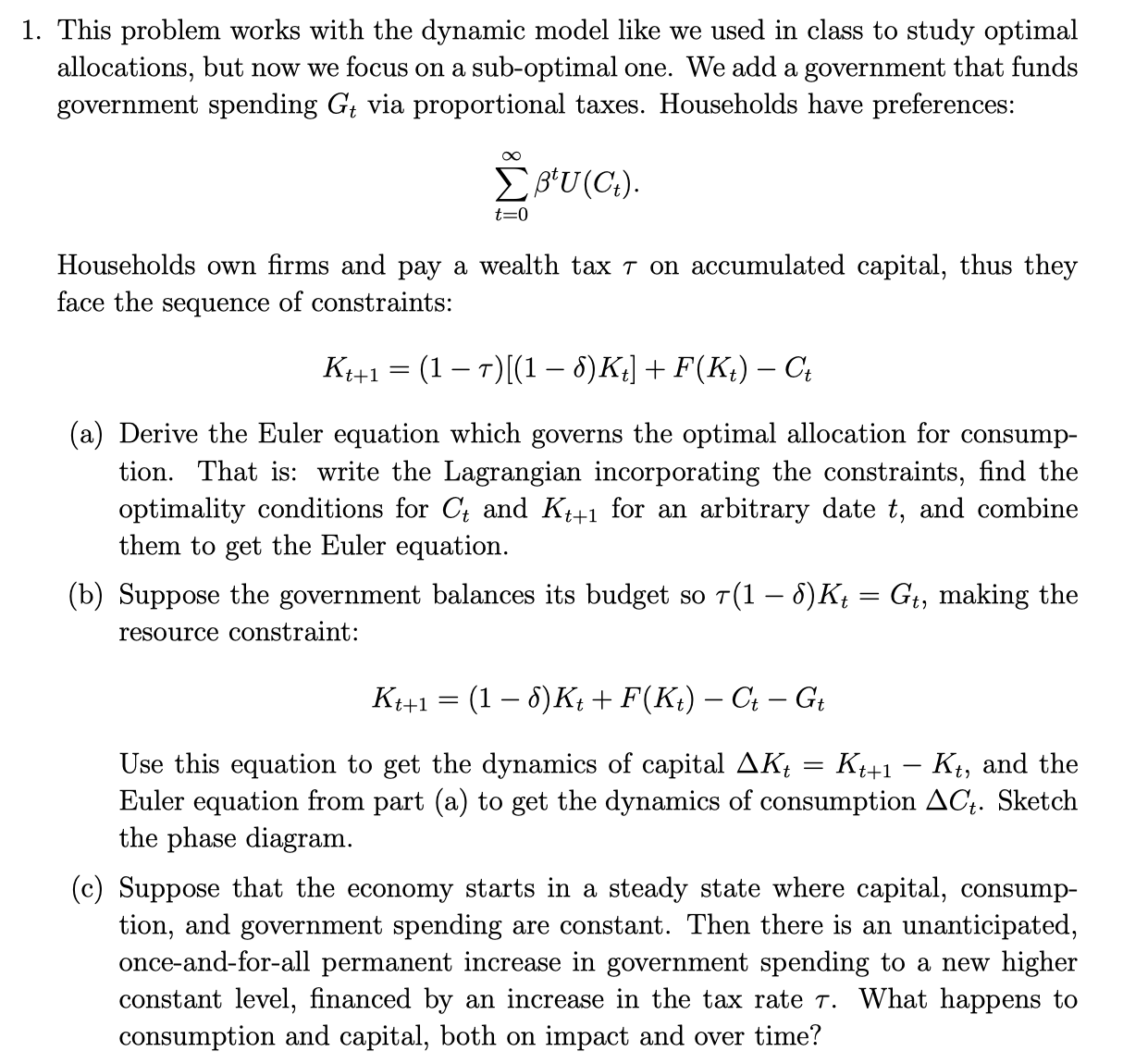
1. This problem works with the dynamic model like we used in class to study optimal allocations, but now we focus on a sub-optimal one. We add a government that funds government spending Gt via proportional taxes. Households have preferences: ism). t={} Households own rms and pay a wealth tax 1" on accumulated capital, thus they face the sequence of constraints: (a) (b) Kt+1 = (1 THU _ 6)Ktl + F(Kt) Ct Derive the Euler equation which governs the optimal allocation for consump- tion. That is: write the Lagrangian incorporating the constraints, nd the optimality conditions for Ct and Kt\" for an arbitrary date t, and combine them to get the Euler equation. Suppose the government balances its budget so 7(1 {UK} = Gt, making the resource constraint: Kt+1 = (1 6)Kt + F(Kt) Ct Gt Use this equation to get the dynamics of capital AK; = Kt+1 Kt, and the Euler equation from part (a) to get the dynamics of consumption Act. Sketch the phase diagram. Suppose that the economy starts in a steady state where capital, consump- tion, and government spending are constant. Then there is an unanticipated, once-andforall permanent increase in government spending to a new higher constant level, nanced by an increase in the tax rate 1'. What happens to consumption and capital, both on impact and over time
Step by Step Solution
There are 3 Steps involved in it

Get step-by-step solutions from verified subject matter experts
 Study Help