







Question: 1. (Total 60 points) EOQ and Power-of-Two reorder intervals: LCB-OpsMega (LCB-OM) sells toy Legotype bricks that can be used to construct a wide range of
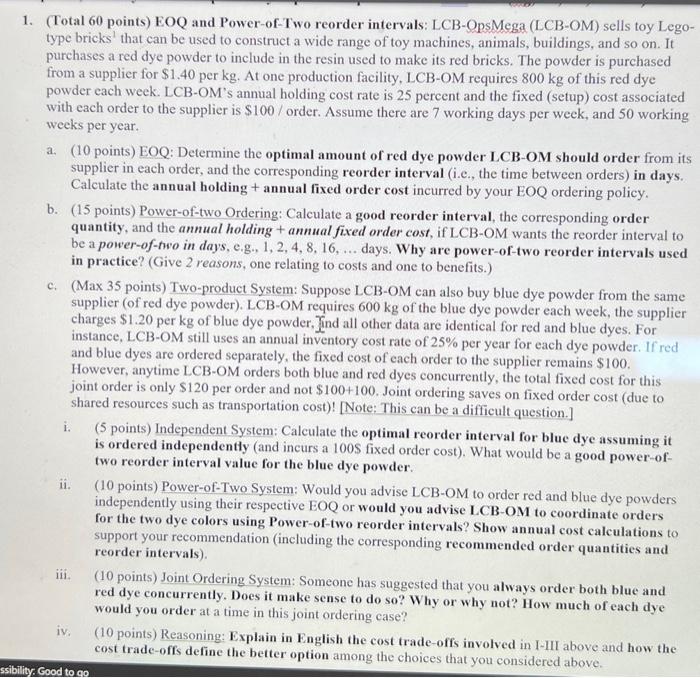
1. (Total 60 points) EOQ and Power-of-Two reorder intervals: LCB-OpsMega (LCB-OM) sells toy Legotype bricks that can be used to construct a wide range of toy machines, animals, buildings, and so on. It purchases a red dye powder to include in the resin used to make its red bricks. The powder is purchased from a supplier for $1.40 per kg. At one production facility, LCB-OM requires 800kg of this red dye powder each week. LCB-OM's annual holding cost rate is 25 percent and the fixed (setup) cost associated with each order to the supplier is $100/ order. Assume there are 7 working days per week, and 50 working weeks per year. a. (10 points) EOQ: Determine the optimal amount of red dye powder LCB-OM should order from its supplier in each order, and the corresponding reorder interval (i.c., the time between orders) in days. Calculate the annual holding + annual fixed order cost incurred by your EOQ ordering policy. b. (15 points) Power-of-two Ordering: Calculate a good reorder interval, the corresponding order quantity, and the annual holding + annual fixed order cost, if LCB-OM wants the reorder interval to be a power-of-two in days, e.g., 1, 2, 4, 8, 16, ... days. Why are power-of-two reorder intervals used in practice? (Give 2 reasons, one relating to costs and one to benefits.) c. (Max 35 points) Two-product System: Suppose LCB-OM can also buy blue dye powder from the same supplier (of red dye powder). LCB-OM requires 600kg of the blue dye powder each week, the supplier charges $1.20 per kg of blue dye powder, find all other data are identical for red and blue dyes. For instance, LCB-OM still uses an annual inventory cost rate of 25% per year for each dye powder. If red and blue dyes are ordered separately, the fixed cost of each order to the supplier remains $100. However, anytime LCB-OM orders both blue and red dyes concurrently, the total fixed cost for this joint order is only $120 per order and not $100+100. Joint ordering saves on fixed order cost (due to shared resources such as transportation cost)! [Note: This can be a difficult question.] i. (5 points) Independent System: Calculate the optimal reorder interval for blue dye assuming it is ordered independently (and incurs a 100 S fixed order cost). What would be a good power-oftwo reorder interval value for the blue dye powder. ii. (10 points) Power-of-Two System: Would you advise LCB-OM to order red and blue dye powders independently using their respective EOQ or would you advise LCB-OM to coordinate orders for the two dye colors using Power-of-two reorder intervals? Show annual cost calculations to support your recommendation (including the corresponding recommended order quantities and reorder intervals). iii. (10 points) Joint Ordering System: Someone has suggested that you always order both blue and red dye concurrently. Does it make sense to do so? Why or why not? How much of each dye would you order at a time in this joint ordering case? iv. (10 points) Reasoning: Explain in English the cost trade-offs involved in I-III above and how the cost trade-offs define the better option among the choices that you considered above. ity. Good to oo
Step by Step Solution
There are 3 Steps involved in it

Get step-by-step solutions from verified subject matter experts
 Study Help