



Question: 1 Trade and Inequality In this question we will use the Specic Factors Model. Consider the case of Brazil, which we assume can produce Soybeans
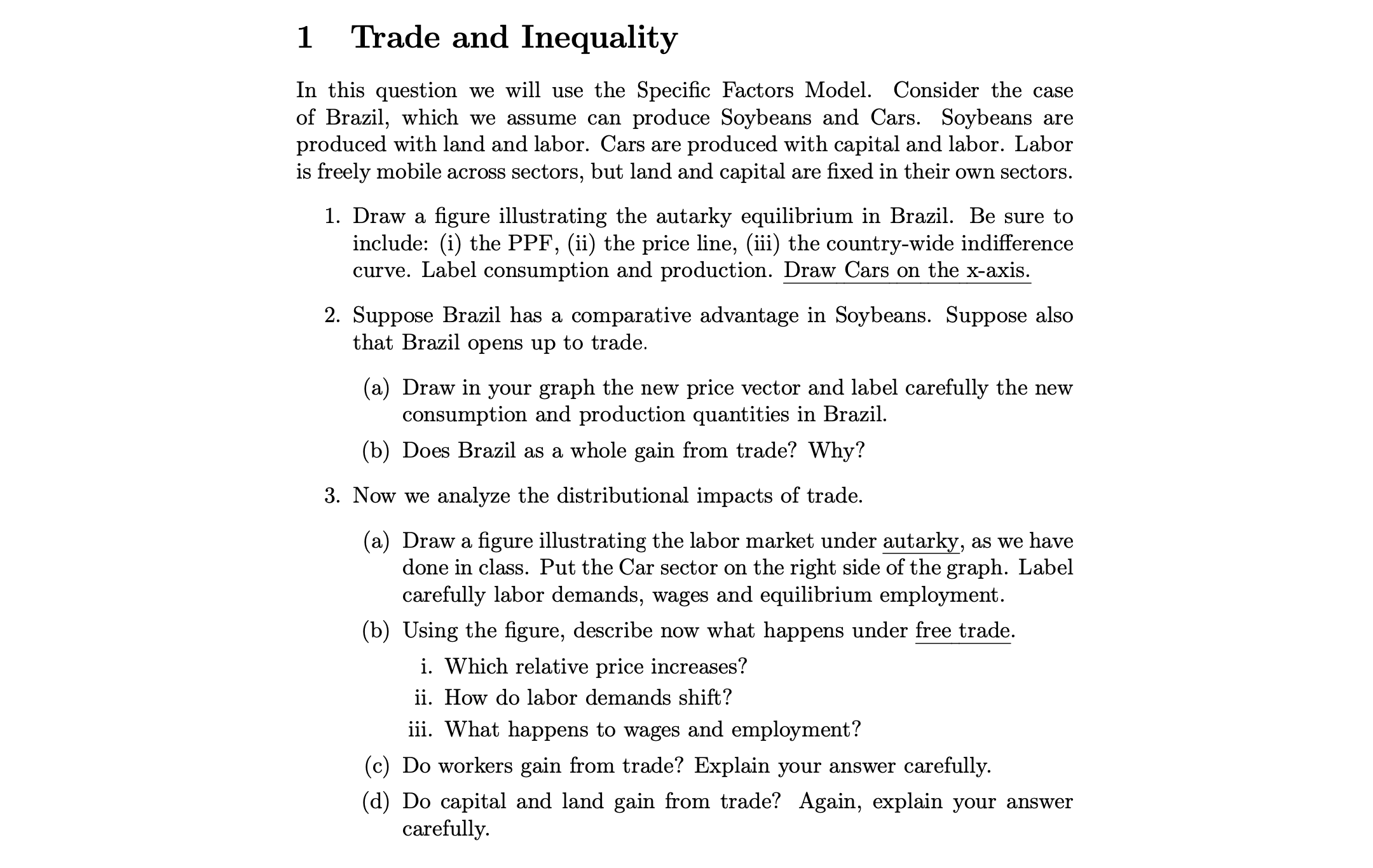
1 Trade and Inequality In this question we will use the Specic Factors Model. Consider the case of Brazil, which we assume can produce Soybeans and Cars. Soybeans are produced with land and labor. Cars are produced with capital and labor. Labor is freely mobile across sectors, but land and capital are xed in their own sectors. 1. Draw a gure illustrating the autarky equilibrium in Brazil. Be sure to include: (i) the PPF, (ii) the price line, (iii) the country-wide indifference curve. Label consumption and production. Draw Cars on the xaxis. 2. Suppose Brazil has a comparative advantage in Soybeans. Suppose also that Brazil opens up to trade. (a) Draw in your graph the new price vector and label carefully the new consumption and production quantities in Brazil. (b) Does Brazil as a whole gain from trade? Why? 3. Now we analyze the distributional impacts of trade. (a) Draw a gure illustrating the labor market under autarky, as we have done in class. Put the Car sector on the right side of the graph. Label carefully labor demands, wages and equilibrium employment. (b) Using the gure, describe now what happens under free trade. i. Which relative price increases? ii. How do labor demands shift? iii. What happens to wages and employment? (0) Do workers gain from trade? Explain your answer carefully. ((1) Do capital and land gain from trade? Again, explain your answer carefully
Step by Step Solution
There are 3 Steps involved in it

Get step-by-step solutions from verified subject matter experts