





Question: 1. Transform normal forms from lower normal forms to higher normal forms. 2. Use ER modeling concurrently with normalization to produce a database design INSTRUCTIONS
1. Transform normal forms from lower normal forms

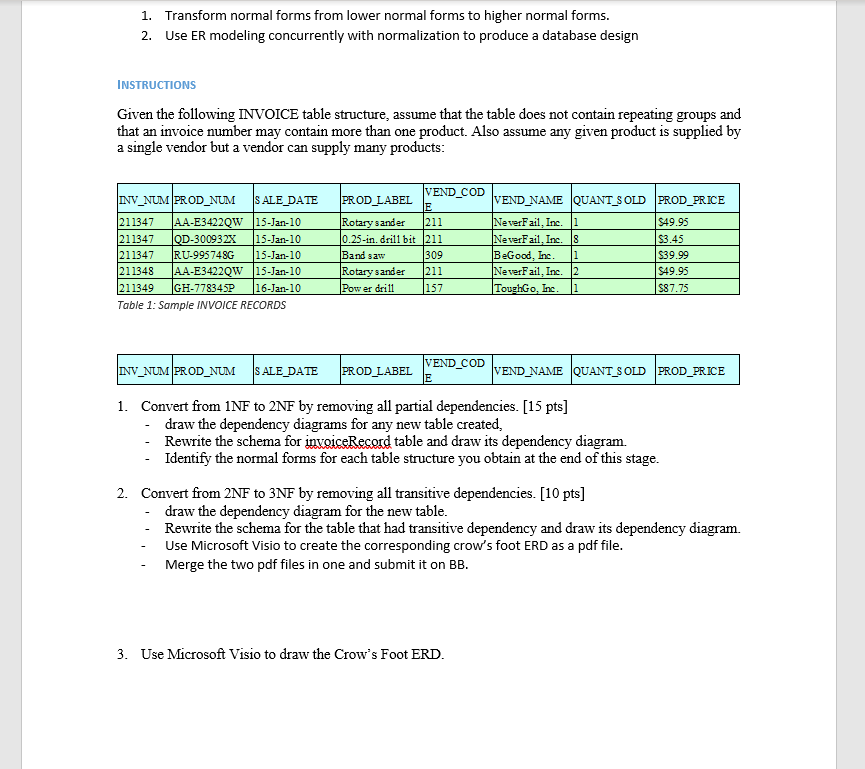
1. Transform normal forms from lower normal forms to higher normal forms. 2. Use ER modeling concurrently with normalization to produce a database design INSTRUCTIONS Given the following INVOICE table structure, assume that the table does not contain repeating groups and that an invoice number may contain more than one product. Also assume any given product is supplied by a single vendor but a vendor can supply many products: INV_NUM PROD_NUM SALE_DATE 211347 AA-E34220W 15-Jan-10 211347 QD-300932x 15-Jan-10 211347 RU-995 748G 15-Jan-10 211348 AA-E3422QW 15-Jan-10 211349 GH-778345P 16-Jan-10 Table 1: Sample INVOICE RECORDS PROD_LABEL VEND_COD E Rotary sander 211 0.25-in. drill bit 211 Band saw Rotary sander 211 Power drill 157 VEND_NAME QUANT_SOLD PROD_PRICE NeverFail,Inc. 1 $49.95 NeverFail, Inc. S $3.45 BeGood, Ine. 1 $39.99 Never Fail, Inc. 2 $49.95 ToughGo, Ine. S87.75 309 1 INV_NUM PROD_NUM SALE_DATE VEND_COD PROD_LABEL VEND_NAME QUANT_SOLD PROD_PRICE 1. Convert from 1NF to 2NF by removing all partial dependencies. [15 pts] - draw the dependency diagrams for any new table created, Rewrite the schema for invoiceRecord table and draw its dependency diagram. - Identify the normal forms for each table structure you obtain at the end of this stage. 2. Convert from 2NF to 3NF by removing all transitive dependencies. [10 pts] draw the dependency diagram for the new table. Rewrite the schema for the table that had transitive dependency and draw its dependency diagram. Use Microsoft Visio to create the corresponding crow's foot ERD as a pdf file. Merge the two pdf files in one and submit it on BB. 3. Use Microsoft Visio to draw the Crow's Foot ERD. 1. Transform normal forms from lower normal forms to higher normal forms. 2. Use ER modeling concurrently with normalization to produce a database design INSTRUCTIONS Given the following INVOICE table structure, assume that the table does not contain repeating groups and that an invoice number may contain more than one product. Also assume any given product is supplied by a single vendor but a vendor can supply many products: INV_NUM PROD_NUM SALE_DATE 211347 AA-E34220W 15-Jan-10 211347 QD-300932x 15-Jan-10 211347 RU-995 748G 15-Jan-10 211348 AA-E3422QW 15-Jan-10 211349 GH-778345P 16-Jan-10 Table 1: Sample INVOICE RECORDS PROD_LABEL VEND_COD E Rotary sander 211 0.25-in. drill bit 211 Band saw Rotary sander 211 Power drill 157 VEND_NAME QUANT_SOLD PROD_PRICE NeverFail,Inc. 1 $49.95 NeverFail, Inc. S $3.45 BeGood, Ine. 1 $39.99 Never Fail, Inc. 2 $49.95 ToughGo, Ine. S87.75 309 1 INV_NUM PROD_NUM SALE_DATE VEND_COD PROD_LABEL VEND_NAME QUANT_SOLD PROD_PRICE 1. Convert from 1NF to 2NF by removing all partial dependencies. [15 pts] - draw the dependency diagrams for any new table created, Rewrite the schema for invoiceRecord table and draw its dependency diagram. - Identify the normal forms for each table structure you obtain at the end of this stage. 2. Convert from 2NF to 3NF by removing all transitive dependencies. [10 pts] draw the dependency diagram for the new table. Rewrite the schema for the table that had transitive dependency and draw its dependency diagram. Use Microsoft Visio to create the corresponding crow's foot ERD as a pdf file. Merge the two pdf files in one and submit it on BB. 3. Use Microsoft Visio to draw the Crow's Foot ERD

Step by Step Solution

There are 3 Steps involved in it

1 Expert Approved Answer
Step: 1 Unlock blur-text-image

Question Has Been Solved by an Expert!

Get step-by-step solutions from verified subject matter experts

Step: 2 Unlock
Step: 3 Unlock

Students Have Also Explored These Related General Management Questions!