







Question: 1) True or false: Statistically, we can not conclude that the proportions of people who do and do not feel safe walking in their neighborhood
1) True or false: Statistically, we can not conclude that the proportions of people who do and do not feel safe walking in their neighborhood at night are unequal?
-True
-False
2) Which statement appropriately characterizes the pattern of the relationship observed for the one-way designed?
Select a choice:
-There is not a significant difference in the number of people who do and do not feel safe walking in their neighborhood at night.
-There are significantly more people than expected, under the assumption of equality, who feel afraid of walking in their neighborhood at night.
-There are significantly fewer people than expected, under the assumption of equality, who feel afraid of walking in their neighborhood at night.
3) True or false: Statistically, we can not conclude that the proportions of people who do and do not feel safe walking in their neighborhood at night are dependent upon class?
-true
-false
4) Which social class had a greater proportion of people who were afraid to walk outside at night than those who were not?
-Lower
-Working
-Middle
-Upper
-None
5) How could you follow up this two way analysis?
-tests to compare means by social class
-Calculating a correlation coefficient for the two variables
-One-way ?2tests for each class separately
-You couldn't
6) Two social classes were more likely than expected to be afraid of walking outside at night in their neighborhood: working and _______
-Lower
-Upper Middle
-Upper
-Middle
-None
7) Which statement captures the nature of the observed dependency most effectively?
-People who identify as middle class are significantly more likely than expected to feel afraid walking outside in their neighborhood at night.
-People who identify as lower class are significantly less likely than expected to feel afraid walking outside in their neighborhood at night.
-People who identify as upper class are significantly less likely than expected to feel afraid walking outside in their neighborhood at night.
-People who identify as lower class are significantly more likely than expected to feel afraid walking outside in their neighborhood at night.
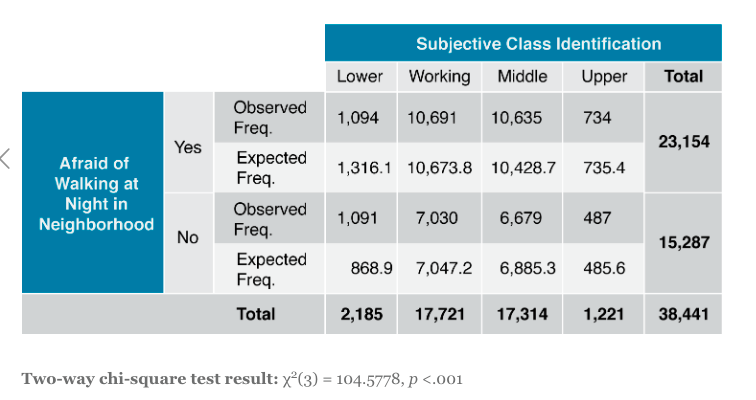
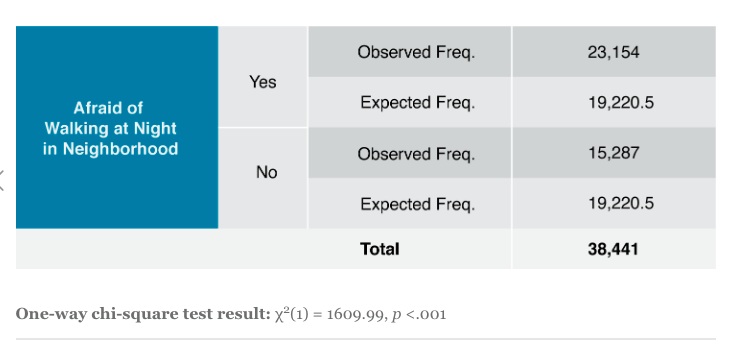
Subjective Class Identification Lower Working Middle Upper Total Observed 1,094 10,691 10,635 734 Freq. Yes 23,154 Afraid of Expected 1,316.1 10,673.8 10,428.7 735.4 Walking at Freq Night in Observed Neighborhood 1,091 7,030 6,679 487 No Freq. 15,287 Expected 868.9 7,047.2 6,885.3 485.6 Freq. Total 2,185 17,721 17,314 1,221 38,441 Two-way chi-square test result: x (3) = 104.5778, p <.001observed freq. yes afraid of expected walking at night in neighborhood observed no total one-way chi-square test result: x p>
Step by Step Solution
There are 3 Steps involved in it

Get step-by-step solutions from verified subject matter experts
 Study Help