







Question: 1 . ( Use INVENTORY and WAREHOUSE tables ) We want to generate a report to inform warehouse managers about the total quantity of SKUs
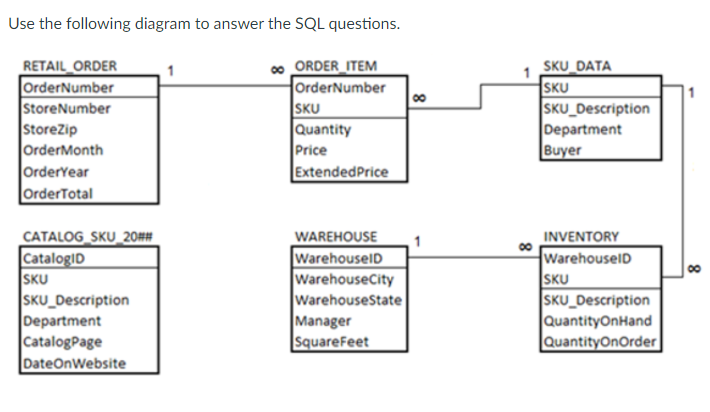
Use INVENTORY and WAREHOUSE tables We want to generate a report to inform warehouse managers about the total quantity of SKUs in their warehouses. Write an SQL statement to display the names of managers, the IDs of the warehouses managed by the managers, and then the sum of QuantityonHand across all the SKUs in their warehouses.
Use INVENTORY and WAREHOUSE tables We want to generate a report to alert warehouse managers about SKUs out of stock in the warehouses they manage. Write an SQL statement to display the names of managers, the IDs of the warehouses managed by the managers, and then the count of different SKUs whose quantitiesonhand are zeros in the warehouses the managers manage.
Use ORDERITEM and SKUDATA tables, and LEFT JOIN We want to generate a pricing chart for SKUs. Write an SQL statement to display all SKUs, their description, and their unit price ie the column Price of the ORDERITEM table Display NULL if an SKUs unit price is not available. Hint: you can use DISTINCT to avoid duplicated records for the same SKU in your results.
Use ORDERITEM and SKUDATA tables, and LEFT JOIN We want to generate a sales report for all the SKUs. Write an SQL statement to display all SKUs, their description, and the total quantity of units each SKU has been sold based on the OrderItem table. Display NULL if an SKU has never been sold according to the OrderItem table. Sort the results based on the number of units each SKU has been sold from high to low.Use the following diagram to answer the SQL questions.
Step by Step Solution
There are 3 Steps involved in it
1 Expert Approved Answer
Step: 1 Unlock

Question Has Been Solved by an Expert!
Get step-by-step solutions from verified subject matter experts
Step: 2 Unlock
Step: 3 Unlock
 Study Help