







Question: 1. Using the 4-quarter moving average: What is the forecast for 3Q2022,4Q2022,1Q 2023 , and 2Q2023 Moving Average for 2Q 2021: N/A (not enough data)
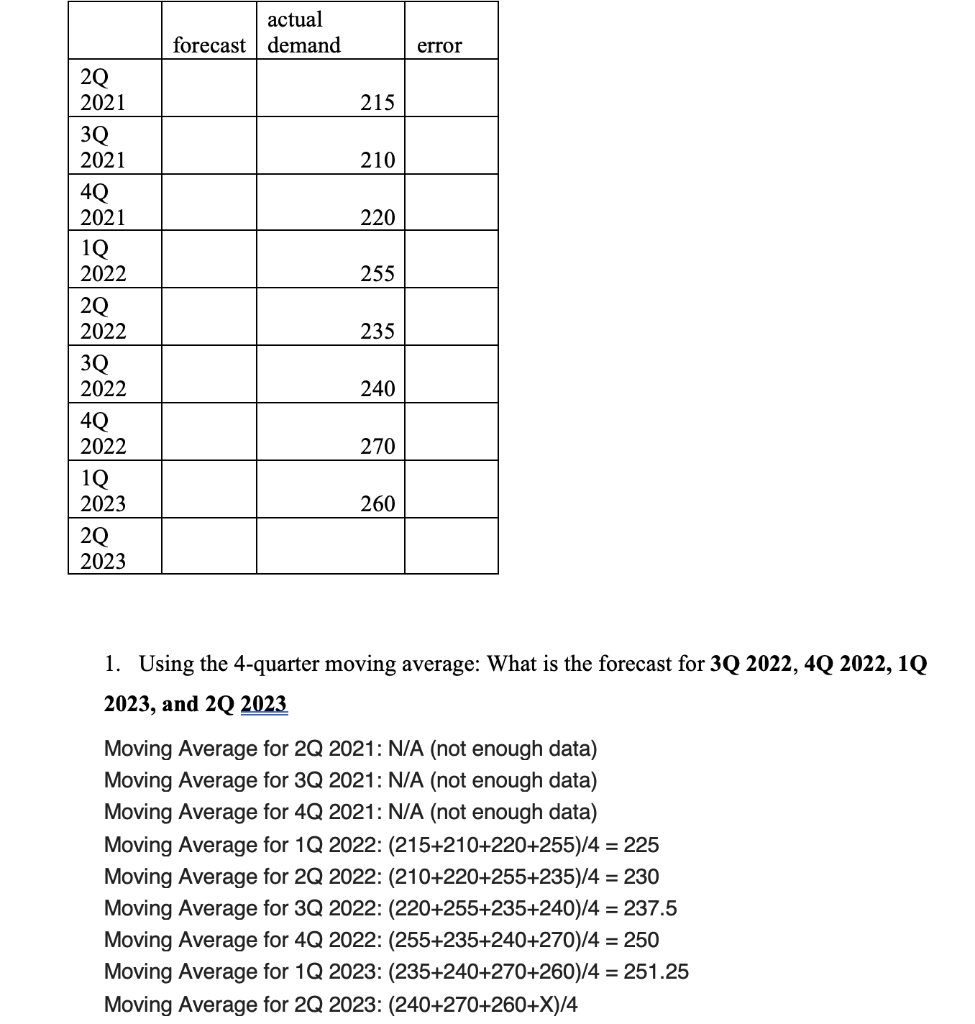
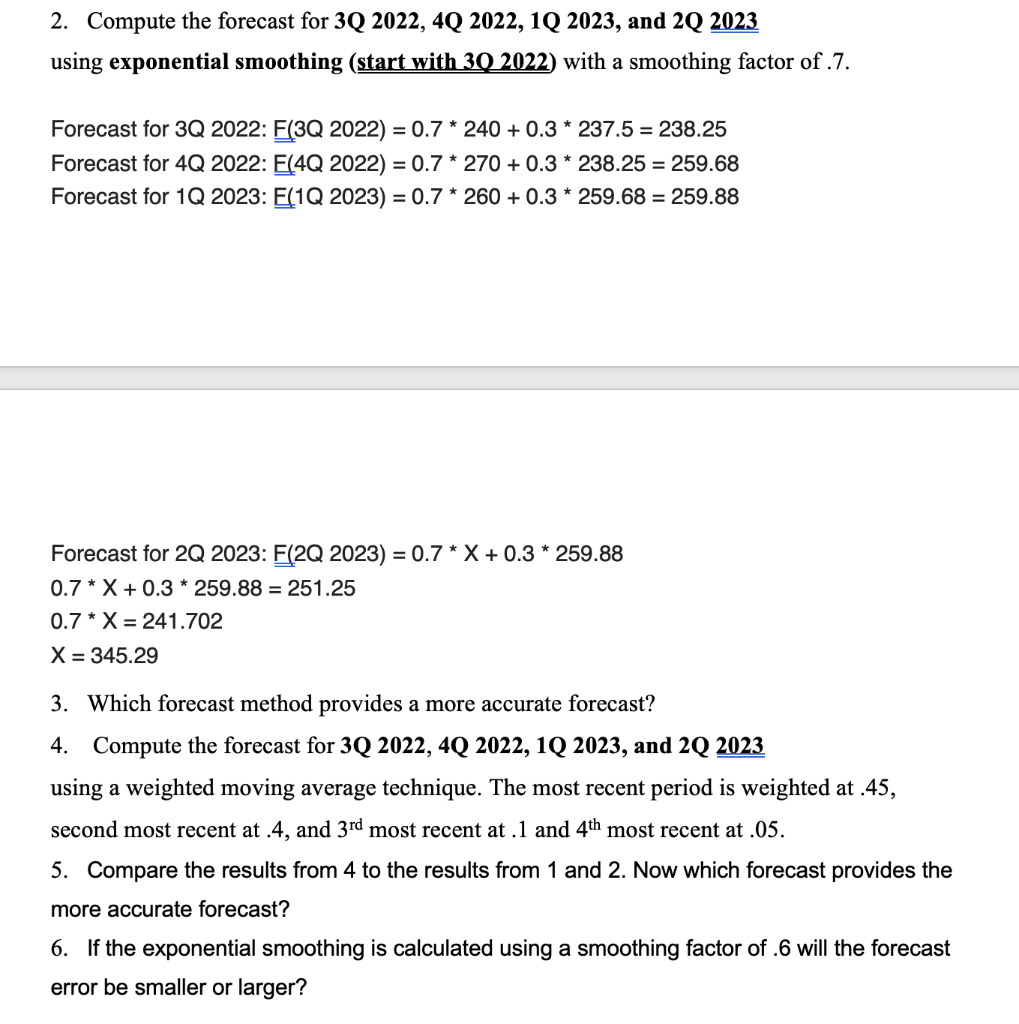
1. Using the 4-quarter moving average: What is the forecast for 3Q2022,4Q2022,1Q 2023 , and 2Q2023 Moving Average for 2Q 2021: N/A (not enough data) Moving Average for 3Q 2021: N/A (not enough data) Moving Average for 4Q 2021: N/A (not enough data) Moving Average for 1Q 2022: (215+210+220+255)/4=225 Moving Average for 2Q 2022: (210+220+255+235)/4=230 Moving Average for 3Q 2022: (220+255+235+240)/4=237.5 Moving Average for 4Q 2022: (255+235+240+270)/4=250 Moving Average for 1Q 2023: (235+240+270+260)/4=251.25 Moving Average for 2Q 2023: (240+270+260+X)/4 2. Compute the forecast for 3Q2022,4Q2022,1Q2023, and 2Q2023 using exponential smoothing (start with 30 2022) with a smoothing factor of .7. Forecast for 4Q 2022: E(4Q2022)=0.7270+0.3238.25=259.68 Forecast for 1Q 2023: E(1Q2023)=0.7260+0.3259.68=259.88 0.7X+0.3259.88=251.25 0.7X=241.702 X=345.29 3. Which forecast method provides a more accurate forecast? 4. Compute the forecast for 3Q2022,4Q2022,1Q2023, and 2Q2023 using a weighted moving average technique. The most recent period is weighted at .45 , second most recent at .4 , and 3rd most recent at .1 and 4th most recent at .05 . 5. Compare the results from 4 to the results from 1 and 2 . Now which forecast provides the more accurate forecast? 6. If the exponential smoothing is calculated using a smoothing factor of .6 will the forecast error be smaller or larger
Step by Step Solution
There are 3 Steps involved in it

Get step-by-step solutions from verified subject matter experts
 Study Help