







Question: 1. Using the master recurrence theorem, what is the solution of T (n) = 4T() + ? The log (base 4) of 3 is ~
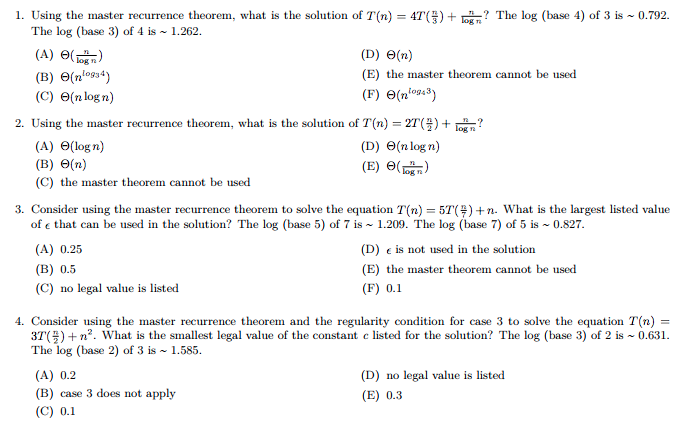
1. Using the master recurrence theorem, what is the solution of T (n) = 4T() + ? The log (base 4) of 3 is ~ 0792. The log (base 3) of 4 is 1.262. (B) (n10934) (C) (n logn) (D) (n) (E) the master theorem cannot be used (F) (nlog43) 2. Using the master recurrence theorem, what is the solution of T(n) = 21"(3) + n? (A) (log n) (B) (n) (C) the master theorem cannot be used (D) (n log n) (E) (log n) 3 Consider using the master recurrence theorem to solve the equation T(n) = 5T(#) + n. what is the largest listed value of e that can be used in the solution? The log (base 5) of 7 is1.209. The log (base 7) of 5 is0.827 (A) 0.25 (B) 0.5 (C) no legal value is listed (D) e is not used in the solution (E) the master theorem cannot be used (F) 0.1 4. Consider using the master recurrence theorem and the regularity condition for case 3 to solve the equation T(n)- 3T(3) + n2. What is the smallest legal value of the constant c listed for the solution? The log (base 3) of 2 is 0.631 The log (base 2) of 3 is 1.585. (A) 0.2 (B) case 3 does not apply (C) 0.1 (D) no legal value is listed (E) 0.3
Step by Step Solution
There are 3 Steps involved in it

Get step-by-step solutions from verified subject matter experts
 Study Help