







Question: 1- We estimate a CCAPM model using the GMM estimator. In the model we have assumed that the utility function is u(ct) 4. The model
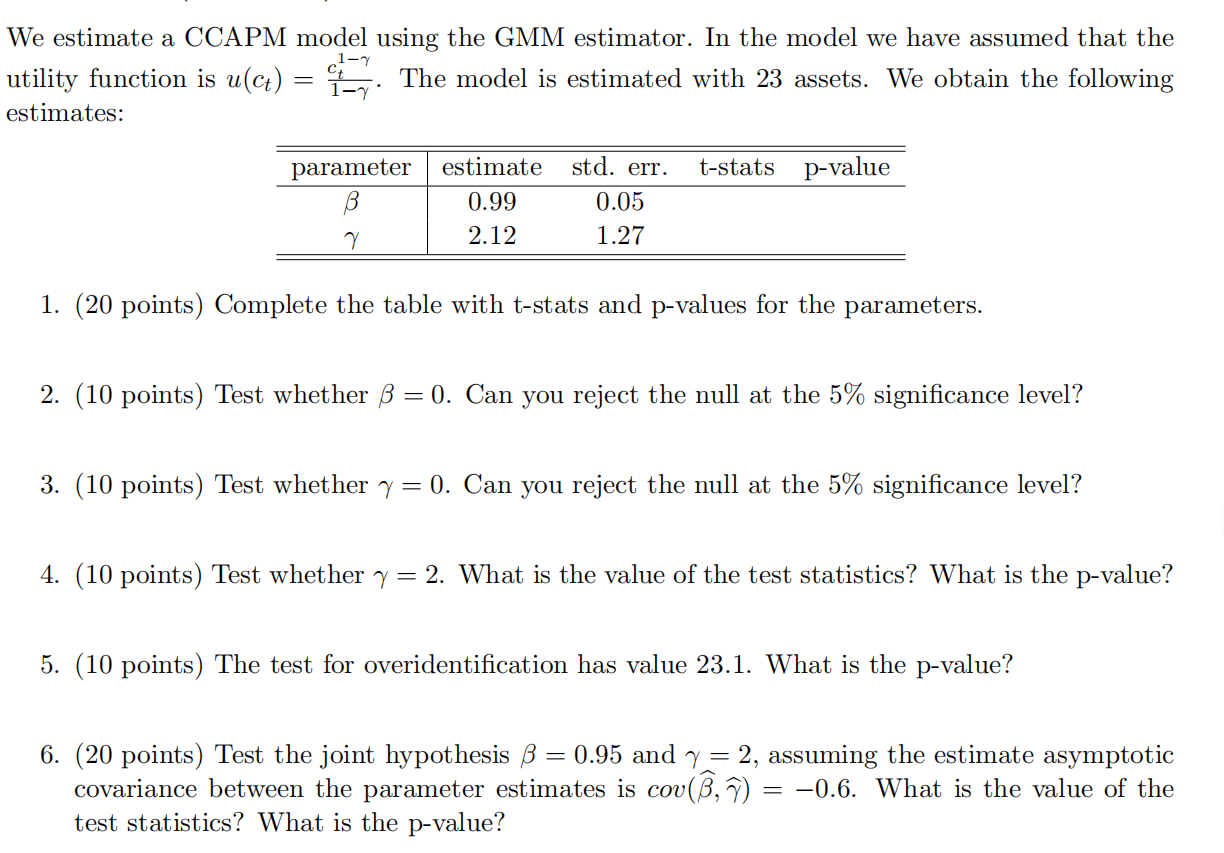
1- We estimate a CCAPM model using the GMM estimator. In the model we have assumed that the utility function is u(ct) 4. The model is estimated with 23 assets. We obtain the following estimates: std. err. t-stats p-value parameter B estimate 0.99 2.12 0.05 1.27 7 1. (20 points) Complete the table with t-stats and p-values for the parameters. 2. (10 points) Test whether = 0. Can you reject the null at the 5% significance level? 3. (10 points) Test whether y = 0. Can you reject the null at the 5% significance level? 4. (10 points) Test whether y = 2. What is the value of the test statistics? What is the p-value? 5. (10 points) The test for overidentification has value 23.1. What is the p-value? 6. (20 points) Test the joint hypothesis = 0.95 and 7 = 2, assuming the estimate asymptotic covariance between the parameter estimates is cov(, = -0.6. What is the value of the test statistics? What is the p-value? 1- We estimate a CCAPM model using the GMM estimator. In the model we have assumed that the utility function is u(ct) 4. The model is estimated with 23 assets. We obtain the following estimates: std. err. t-stats p-value parameter B estimate 0.99 2.12 0.05 1.27 7 1. (20 points) Complete the table with t-stats and p-values for the parameters. 2. (10 points) Test whether = 0. Can you reject the null at the 5% significance level? 3. (10 points) Test whether y = 0. Can you reject the null at the 5% significance level? 4. (10 points) Test whether y = 2. What is the value of the test statistics? What is the p-value? 5. (10 points) The test for overidentification has value 23.1. What is the p-value? 6. (20 points) Test the joint hypothesis = 0.95 and 7 = 2, assuming the estimate asymptotic covariance between the parameter estimates is cov(, = -0.6. What is the value of the test statistics? What is the p-value
Step by Step Solution
There are 3 Steps involved in it

Get step-by-step solutions from verified subject matter experts
 Study Help