







Question: 1) What advantage does Unilever derive from using Foreign Direct Investment (FDI)? 2) How can Unilever ensure that that its FDI ventures succeed? 3) Are

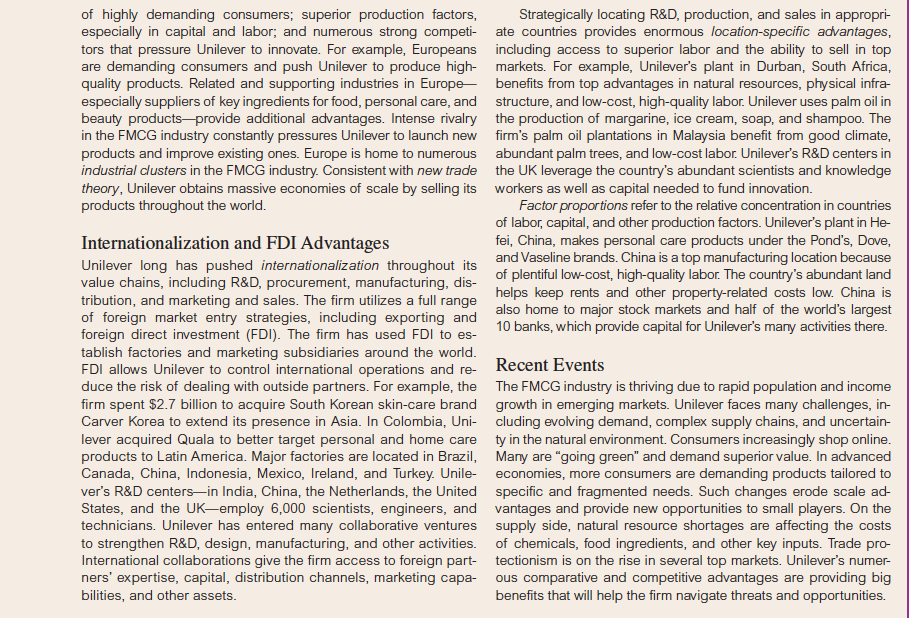
1) What advantage does Unilever derive from using Foreign Direct Investment (FDI)?
2) How can Unilever ensure that that its FDI ventures succeed?
3) Are there any downsides to using FDI?
Unilever's Comparative and Competitive Advantages Unilever is a multinational enterprise in the fast-moving consumer ative advantages to the firm. For example, the UK market is highly goods (FMCG) industry, with headquarters in Rotterdam, Nether- developed, sophisticated, and diversified. The Netherlands is well lands. Unilever has 170,000 employees worldwide and generated located to serve the world and is a key entry market for continental revenue in 2017 of more than 50 billion euros (about $60 billion). Europe. The Netherlands and the UK are leading platforms in new Top competitors include Nestl and Procter \& Gamble. Unilever technology development, with a high concentration of knowledge emerged in 1929 through the merger of Dutch food company Mar- workers who drive innovation in product development and operagarine Unie and British soapmaker Lever Brothers. tions. The UK is one of the world's leading banking centers, with Today, Unilever's products fall into four main categories: per- an active stock market, which provides a ready supply of capital. sonal care, food, beverages, and cleaning agents. Personal care Rotterdam is Europe's largest port. The Netherlands has leveraged accounts for about 38 percent of total sales and includes such its location to establish advanced infrastructure for transporting products as deodorants, cosmetics, lotions, toothpaste, soap, and goods, people, and electronic data. Strong and stable economies shampoo. Unilever's food group contributes 24 percent to total in both the Netherlands and the UK ensure steady demand for Unisales and comprises snacks, soups, margarines, mayonnaise, and lever products. The wide range of countries where Unilever opersalad dressings. Beverages and cleaning agents each contrib- ates provides numerous other comparative advantages. ute 18 percent to total sales. The firm's 400 brands include Ben Unilever possesses many competitive advantages, including \& Jerry's, Best Foods, Dove, Flora, Knorr, Lipton, Lux, Magnum, thousands of patents, superior R\&D capability, high-quality prodNoxzema, Pepsodent, Vaseline, and many others. ucts, innovative technologies, economies of scale, cross-business Unilever has research and production operations in more than synergies, deep distribution channels, excellent marketing capa100 countries. It sells products in almost 200 countries. Emerging bilities, well-known brand names, customer loyalty, and access to markets-especially Brazil, China, India, Mexico, and Russia- lower-cost and superior labor through factories worldwide. Several of accountformorethanhalfoftotalsales.ComparativeandCompetitiveAdvantagesthesestrengthsalsoprovideUnileverwithmonopolisticadvantages,capabilitiesthatfewotherfirmshave.SuchadvantagesgiveUnilever Comparative and Competitive Advantages_ a degree of monopoly power over local firms in international markets. Unilever's headquarters in the Netherlands, and its longstanding Consistent with the Porter Diamond Model, the Netherlands connection to the United Kingdom (UK), provide numerous compar- and the UK are strong locations for R\&D due to the presence of highly demanding consumers; superior production factors, Strategically locating R\&D, production, and sales in appropriespecially in capital and labor; and numerous strong competi- ate countries provides enormous location-specific advantages, tors that pressure Unilever to innovate. For example, Europeans including access to superior labor and the ability to sell in top are demanding consumers and push Unilever to produce high- markets. For example, Unilever's plant in Durban, South Africa, quality products. Related and supporting industries in Europe - benefits from top advantages in natural resources, physical infraespecially suppliers of key ingredients for food, personal care, and structure, and low-cost, high-quality labor. Unilever uses palm oil in beauty products-provide additional advantages. Intense rivalry the production of margarine, ice cream, soap, and shampoo. The in the FMCG industry constantly pressures Unilever to launch new firm's palm oil plantations in Malaysia benefit from good climate, products and improve existing ones. Europe is home to numerous abundant palm trees, and low-cost labor. Unilever's R\&D centers in industrial clusters in the FMCG industry. Consistent with new trade the UK leverage the country's abundant scientists and knowledge theory, Unilever obtains massive economies of scale by selling its workers as well as capital needed to fund innovation. products throughout the world. Factor proportions refer to the relative concentration in countries tablish factories and marketing subsidiaries around the world. FDI allows Unilever to control international operations and re- Recent Events duce the risk of dealing with outside partners. For example, the The FMCG industry is thriving due to rapid population and income firm spent $2.7 billion to acquire South Korean skin-care brand growth in emerging markets. Unilever faces many challenges, inCarver Korea to extend its presence in Asia. In Colombia, Uni- cluding evolving demand, complex supply chains, and uncertainlever acquired Quala to better target personal and home care ty in the natural environment. Consumers increasingly shop online. products to Latin America. Major factories are located in Brazil, Many are "going green" and demand superior value. In advanced Canada, China, Indonesia, Mexico, Ireland, and Turkey. Unile- economies, more consumers are demanding products tailored to ver's R\&D centers-in India, China, the Netherlands, the United specific and fragmented needs. Such changes erode scale adStates, and the UK-employ 6,000 scientists, engineers, and vantages and provide new opportunities to small players. On the technicians. Unilever has entered many collaborative ventures supply side, natural resource shortages are affecting the costs to strengthen R\&D, design, manufacturing, and other activities. of chemicals, food ingredients, and other key inputs. Trade proInternational collaborations give the firm access to foreign part- tectionism is on the rise in several top markets. Unilever's numerners' expertise, capital, distribution channels, marketing capa- ous comparative and competitive advantages are providing big bilities, and other assets. Unilever's Comparative and Competitive Advantages Unilever is a multinational enterprise in the fast-moving consumer ative advantages to the firm. For example, the UK market is highly goods (FMCG) industry, with headquarters in Rotterdam, Nether- developed, sophisticated, and diversified. The Netherlands is well lands. Unilever has 170,000 employees worldwide and generated located to serve the world and is a key entry market for continental revenue in 2017 of more than 50 billion euros (about $60 billion). Europe. The Netherlands and the UK are leading platforms in new Top competitors include Nestl and Procter \& Gamble. Unilever technology development, with a high concentration of knowledge emerged in 1929 through the merger of Dutch food company Mar- workers who drive innovation in product development and operagarine Unie and British soapmaker Lever Brothers. tions. The UK is one of the world's leading banking centers, with Today, Unilever's products fall into four main categories: per- an active stock market, which provides a ready supply of capital. sonal care, food, beverages, and cleaning agents. Personal care Rotterdam is Europe's largest port. The Netherlands has leveraged accounts for about 38 percent of total sales and includes such its location to establish advanced infrastructure for transporting products as deodorants, cosmetics, lotions, toothpaste, soap, and goods, people, and electronic data. Strong and stable economies shampoo. Unilever's food group contributes 24 percent to total in both the Netherlands and the UK ensure steady demand for Unisales and comprises snacks, soups, margarines, mayonnaise, and lever products. The wide range of countries where Unilever opersalad dressings. Beverages and cleaning agents each contrib- ates provides numerous other comparative advantages. ute 18 percent to total sales. The firm's 400 brands include Ben Unilever possesses many competitive advantages, including \& Jerry's, Best Foods, Dove, Flora, Knorr, Lipton, Lux, Magnum, thousands of patents, superior R\&D capability, high-quality prodNoxzema, Pepsodent, Vaseline, and many others. ucts, innovative technologies, economies of scale, cross-business Unilever has research and production operations in more than synergies, deep distribution channels, excellent marketing capa100 countries. It sells products in almost 200 countries. Emerging bilities, well-known brand names, customer loyalty, and access to markets-especially Brazil, China, India, Mexico, and Russia- lower-cost and superior labor through factories worldwide. Several of accountformorethanhalfoftotalsales.ComparativeandCompetitiveAdvantagesthesestrengthsalsoprovideUnileverwithmonopolisticadvantages,capabilitiesthatfewotherfirmshave.SuchadvantagesgiveUnilever Comparative and Competitive Advantages_ a degree of monopoly power over local firms in international markets. Unilever's headquarters in the Netherlands, and its longstanding Consistent with the Porter Diamond Model, the Netherlands connection to the United Kingdom (UK), provide numerous compar- and the UK are strong locations for R\&D due to the presence of highly demanding consumers; superior production factors, Strategically locating R\&D, production, and sales in appropriespecially in capital and labor; and numerous strong competi- ate countries provides enormous location-specific advantages, tors that pressure Unilever to innovate. For example, Europeans including access to superior labor and the ability to sell in top are demanding consumers and push Unilever to produce high- markets. For example, Unilever's plant in Durban, South Africa, quality products. Related and supporting industries in Europe - benefits from top advantages in natural resources, physical infraespecially suppliers of key ingredients for food, personal care, and structure, and low-cost, high-quality labor. Unilever uses palm oil in beauty products-provide additional advantages. Intense rivalry the production of margarine, ice cream, soap, and shampoo. The in the FMCG industry constantly pressures Unilever to launch new firm's palm oil plantations in Malaysia benefit from good climate, products and improve existing ones. Europe is home to numerous abundant palm trees, and low-cost labor. Unilever's R\&D centers in industrial clusters in the FMCG industry. Consistent with new trade the UK leverage the country's abundant scientists and knowledge theory, Unilever obtains massive economies of scale by selling its workers as well as capital needed to fund innovation. products throughout the world. Factor proportions refer to the relative concentration in countries tablish factories and marketing subsidiaries around the world. FDI allows Unilever to control international operations and re- Recent Events duce the risk of dealing with outside partners. For example, the The FMCG industry is thriving due to rapid population and income firm spent $2.7 billion to acquire South Korean skin-care brand growth in emerging markets. Unilever faces many challenges, inCarver Korea to extend its presence in Asia. In Colombia, Uni- cluding evolving demand, complex supply chains, and uncertainlever acquired Quala to better target personal and home care ty in the natural environment. Consumers increasingly shop online. products to Latin America. Major factories are located in Brazil, Many are "going green" and demand superior value. In advanced Canada, China, Indonesia, Mexico, Ireland, and Turkey. Unile- economies, more consumers are demanding products tailored to ver's R\&D centers-in India, China, the Netherlands, the United specific and fragmented needs. Such changes erode scale adStates, and the UK-employ 6,000 scientists, engineers, and vantages and provide new opportunities to small players. On the technicians. Unilever has entered many collaborative ventures supply side, natural resource shortages are affecting the costs to strengthen R\&D, design, manufacturing, and other activities. of chemicals, food ingredients, and other key inputs. Trade proInternational collaborations give the firm access to foreign part- tectionism is on the rise in several top markets. Unilever's numerners' expertise, capital, distribution channels, marketing capa- ous comparative and competitive advantages are providing big bilities, and other assets
Step by Step Solution
There are 3 Steps involved in it

Get step-by-step solutions from verified subject matter experts
 Study Help