







Question: 1. what analyses should Kate perform with this data? Perform these analyses. 2. What problems can you identify from your analyses? 3. What solutions do
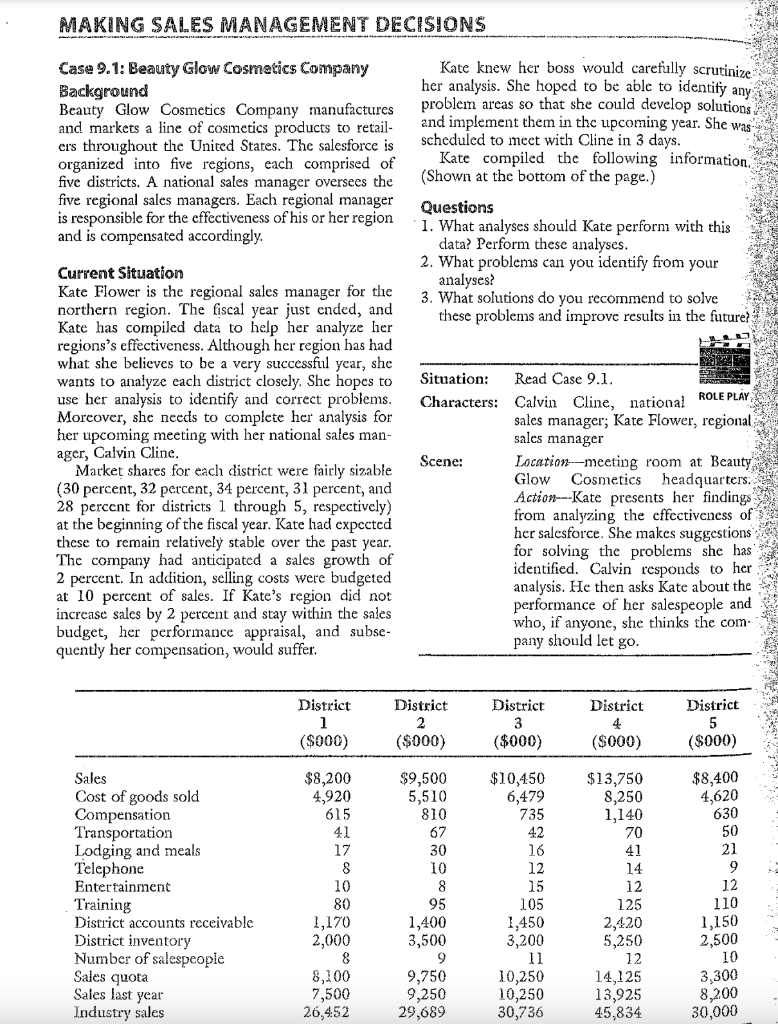
1. what analyses should Kate perform with this data? Perform these analyses.
2. What problems can you identify from your analyses?
3. What solutions do you recommend to solve these problems and improve results in the future?
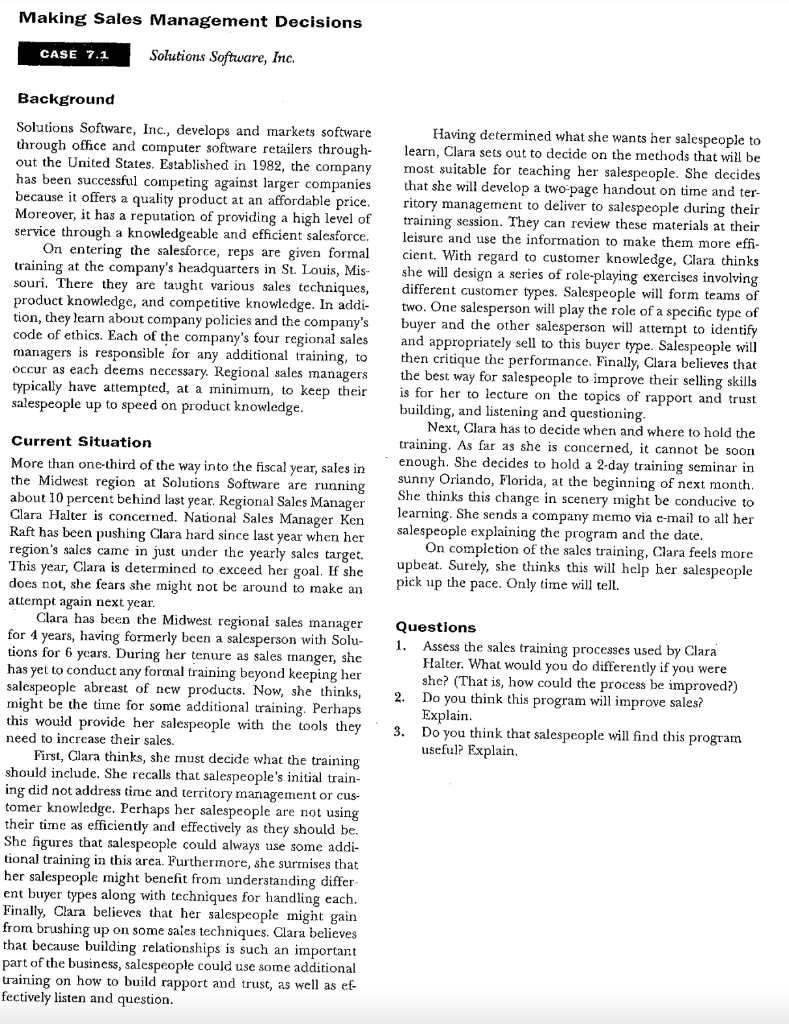
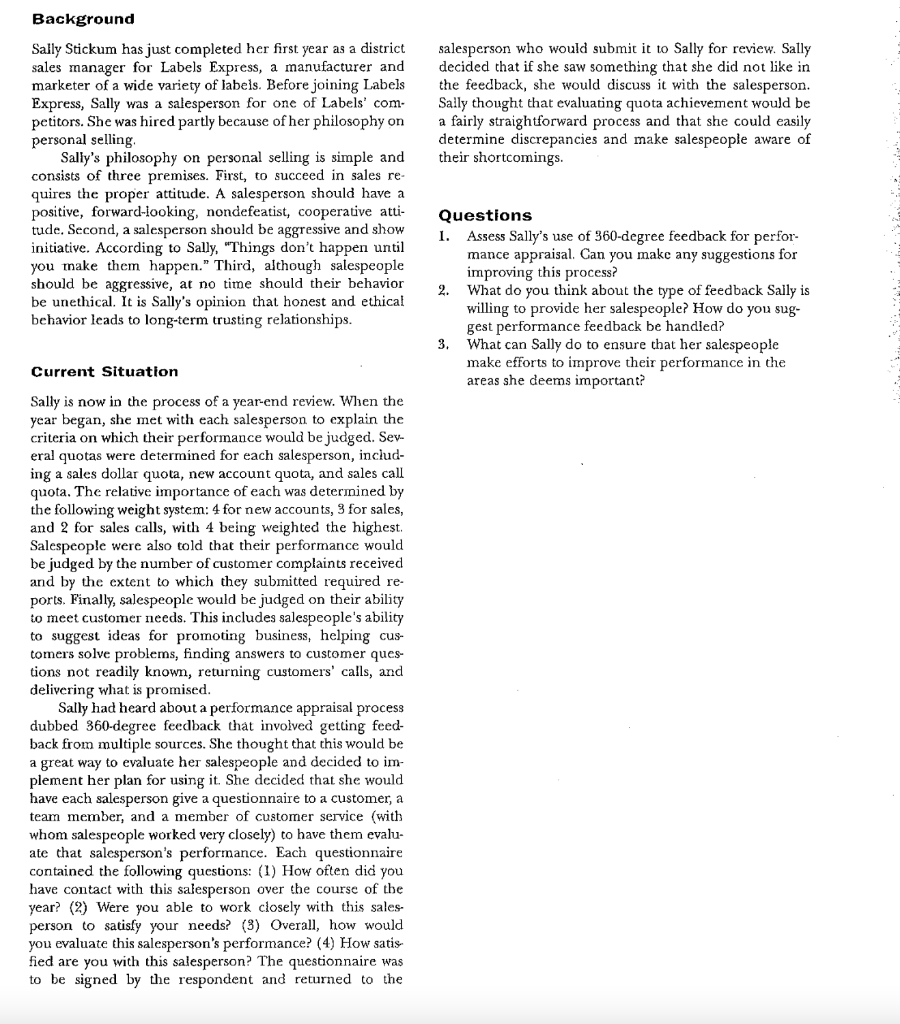
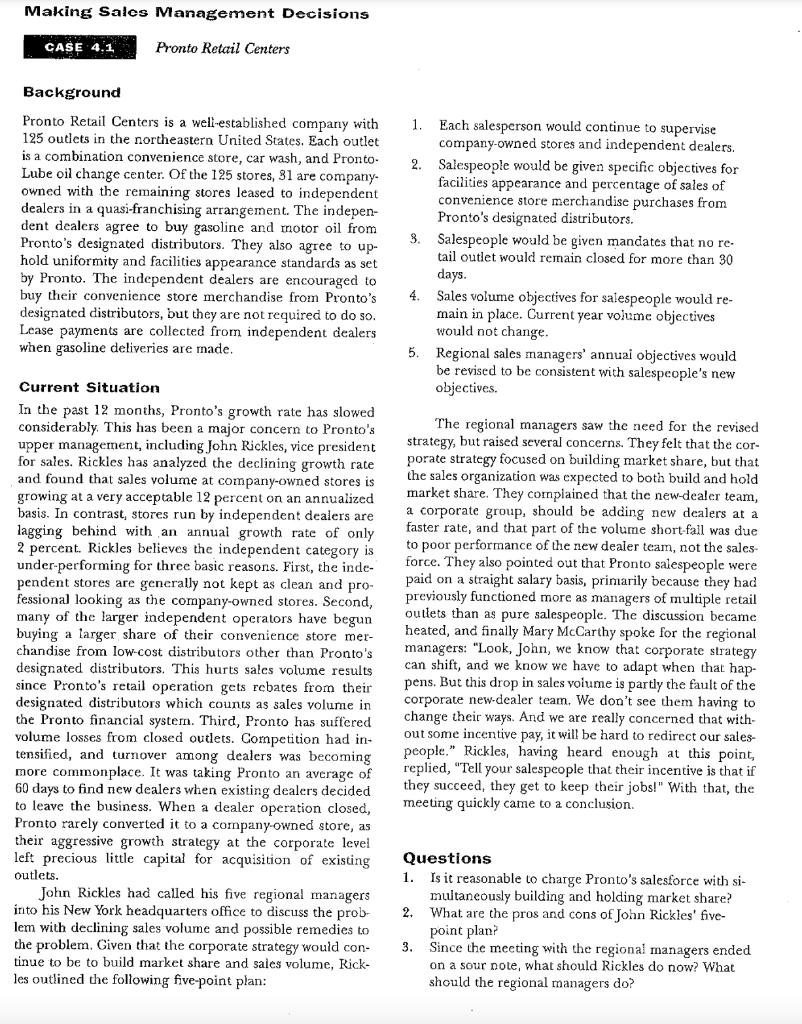
MAKING SALES MANAGEMENT DECISIONS Case 9.1: Beauty Glow Cosmetics Company Background Beauty Glow Cosmetics Company manufactures and markets a line of cosmetics products to retail- ers throughout the United States. The salesforce is organized into five regions, each comprised of five districts. A national sales manager oversees the five regional sales managers. Each regional manager is responsible for the effectiveness of his or her region and is compensated accordingly. Kate knew her boss would carefully scrutinize her analysis. She hoped to be able to identify any problem areas so that she could develop solutions and implement them in the upcoming year. She was scheduled to meet with Cline in 3 days. Kate compiled the following information. (Shown at the bottom of the page.) Questions 1. What analyses should Kate perforn with this data? Perform these analyses. 2. What problems can you identify from your analyses? 3. What solutions do you recommend to solve these problems and improve results in the future? Current Situation Kate Flower is the regional sales manager for the northern region. The fiscal year just ended, and Kate has compiled data to help her analyze her regions's effectiveness. Although her region has had what she believes to be a very successful year, she wants to analyze each district closely. She hopes to use her analysis to identify and correct problems. Moreover, she needs to complete her analysis for her upcoming meeting with her national sales man- ager, Calvin Cline. Market shares for each district were fairly sizable (30 percent, 32 percent, 34 percent, 31 percent, and 28 percent for districts 1 through 5, respectively) at the beginning of the fiscal year. Kate had expected these to remain relatively stable over the past year. The company had anticipated a sales growth of 2 percent. In addition, selling costs were budgeted at 10 percent of sales. If Kate's region did not increase sales by 2 percent and stay within the sales budget, her performance appraisal, and subse- quently her compensation, would suffer. roon WE Situation: Read Case 9.1. Characters: Calvin Cline, national ROLE PLAY sales manager; Kate Flower, regional sales manager Scene: Location=1 Beauty Glow Cosmetics headquarters Action---Kate presents her findings from analyzing the effectiveness of her salesforce. She makes suggestions for solving the problems she has identified. Calvin responds to her analysis. He then asks Kate about the performance of her salespeople and who, if anyone, she thinks the com pany should let go. District District 1 ($000) District 2 ($000) District 4 ($000) District 5 ($000) ($000) Sales Cost of goods sold Compensation Transportation Lodging and meals Telephone Entertainment Training District accounts receivable District inventory Number of salespeople Sales quota Sales last year Industry sales $8,200 4,920 615 41 17 8 10 80 1,170 2,000 8 8,100 7,500 26,452 $9,500 5,510 810 67 30 10 8 95 1,400 3,500 9 9,750 9,250 29,689 $10,450 6,479 735 42 16 12 15 105 1,450 3,200 11 10,250 10,250 30,736 $13,750 8,250 1,140 70 41 14 12 125 2,420 5,250 12 14,125 13,925 45,834 $8,400 4,620 630 50 21 9 12 110 1,150 2,500 10 3,300 8,200 30,000 Making Sales Management Decisions CASE 7.1 Solutions Software, Inc. Background Solutions Software, Inc., develops and markets software through office and computer software retailers through- out the United States. Established in 1982, the company has been successful competing against larger companies because it offers a quality product at an affordable price. Moreover, it has a reputation of providing a high level of service through a knowledgeable and efficient salesforce. On entering the salesforce, reps are given formal training at the company's headquarters in St. Louis, Mis- souri. There they are taught various sales techniques, product knowledge, and competitive knowledge. In addi- tion, they learn about company policies and the company's code of ethics. Each of the company's four regional sales managers is responsible for any additional training, to occur as each deems necessary. Regional sales managers typically have attempted, at a minimum, to keep their salespeople up to speed on product knowledge. Having determined what she wants her salespeople to learn, Clara sets out to decide on the methods that will be most suitable for teaching her salespeople. She decides that she will develop a two-page handout on time and ter- ritory management to deliver to salespeople during their training session. They can review these materials at their leisure and use the information to make them more effi- cient. With regard to customer knowledge, Clara thinks she will design a series of role-playing exercises involving different customer types. Salespeople will form teams of two. One salesperson will play the role of a specific type of buyer and the other salesperson will attempt to identify and appropriately sell to this buyer type. Salespeople will then critique the performance. Finally, Clara believes that the best way for salespeople to improve their selling skills is for her to lecture on the topics of rapport and trust building, and listening and questioning. Next, Clara has to decide when and where to hold the training. As far she is concerned, it cannot be soon enough. She decides to hold a 2-day training seminar in sunny Orlando, Florida, at the beginning of next month. She thinks this change in scenery might be conducive to learning. She sends company memo via e- mail to all her salespeople explaining the program and the date. On completion of the sales training, Clara feels more upbeat. Surely, she thinks this will help her salespeople pick up the pace. Only time will tell. Current Situation More than one-third of the way into the fiscal year, sales in the Midwest region at Solutions Software are running about 10 percent behind last year, Regional Sales Manager Clara Halter is concerned. National Sales Manager Ken Raft has been pushing Clara hard since last year when her region's sales came in just under the yearly sales target. This year, Clara is determined to exceed her goal. If she does not, she fears she might not be around to make an attempt again next year. Clara has been the Midwest regional sales manager for 4 years, having formerly been a salesperson with Solu- tions for 6 years. During her tenure as sales manger, she has yet to conduct any formal training beyond keeping her salespeople abreast of new products. Now, she thinks, might be the time for some additional training. Perhaps this would provide her salespeople with the tools they need to increase their sales. First, Clara thinks, she must decide what the training should include. She recalls that salespeople's initial train- ing did not address time and territory management or cus- tomer knowledge. Perhaps her salespeople are not using their time as efficiently and effectively as they should be. She figures that salespeople could always use some addi- tional training in this area. Furthermore, she surrnises that her salespeople might benefit from understanding differ- ent buyer types along with techniques for handling each. Finally, Clara believes that her salespeople might gain from brushing up on some sales techniques. Clara believes that because building relationships is such an important part of the business, salespeople could use some additional training on how to build rapport and trust, as well as ef- fectively listen and question. Questions 1. Assess the sales training processes used by Clara Halter. What would you do differently if you were she? (That is, how could the process be improved?) 2. Do you think this program will improve sales? Explain. 3. Do you think that salespeople will find this program useful? Explain. salesperson who would submit it to Sally for review. Sally decided that if she saw something that she did not like in the feedback, she would discuss it with the salesperson. Sally thought that evaluating quota achievement would be a fairly straightforward process and that she could easily determine discrepancies and make salespeople aware of their shortcomings. Background Sally Stickum has just completed her first year as a district sales manager for Labels Express, a manufacturer and marketer of a wide variety of labels. Before joining Labels Express, Sally was a salesperson for one of Labels' com- petitors. She was hired partly because of her philosophy on personal selling Sally's philosophy on personal selling is simple and consists of three premises. First, to succeed in sales re- quires the proper attitude. A salesperson should have a positive, forward-looking, nondefeatist, cooperative atti- tude. Second, a salesperson should be aggressive and show initiative. According to Sally, "Things don't happen until you make them happen." Third, although salespeople should be aggressive, at no time should their behavior be unethical. It is Sally's opinion that honest and ethical behavior leads to long-term trusting relationships. Questions 1. Assess Sally's use of 360-degree feedback for perfor- mance appraisal. Can you make any suggestions for improving this process? 2. What do you think about the type of feedback Saily is willing to provide her salespeople? How do you sug- gest performance feedback be handled? 3. What can Sally do to ensure that her salespeople make efforts to improve their performance in the areas she deems important? Current Situation Sally is now in the process of a year-end review. When the year began, she met with each salesperson to explain the criteria on which their performance would be judged. Sev- eral quotas were determined for each salesperson, includ- ing a sales dollar quota, new account quota, and sales call quota. The relative importance of each was determined by the following weight system: 4 for new accounts, 3 for sales, and 2 for sales calls, with 4 being weighted the highest. Salespeople were also told that their performance would be judged by the number of customer complaints received and by the extent to which they submitted required re- ports. Finally, salespeople would be judged on their ability to meet customer needs. This includes salespeople's ability to suggest ideas for promoting business, helping cus- tomers solve problems, finding answers to customer ques. tions not readily known, returning customers' calls, and delivering what is promised. Sally had heard about a performance appraisal process dubbed 360-degree feedback that involved getting feed- back from multiple sources. She thought that this would be a great way to evaluate her salespeople and decided to im- plement her plan for using it. She decided that she would have each salesperson give a questionnaire to a customer, a team member, and a member of customer service (with whom salespeople worked very closely) to have them evalu- ate that salesperson's performance. Each questionnaire contained the following questions: (1) How often did you have contact with this salesperson over the course of the year? (2) Were you able to work closely with this sales. person to satisfy your needs? (3) Overall, how would you evaluate this salesperson's performance? (4) How satis- fied are you with this salesperson? The questionnaire was to be signed by the respondent and returned to the Making Sales Management Decisions CASE 4.1 Pronto Retail Centers Background Pronto Retail Centers is a well-established company with 125 outlets in the northeastern United States. Each outlet is a combination convenience store, car wash, and Pronto. Lube oil change center. Of the 125 stores, 31 are company owned with the remaining stores leased to independent dealers in a quasi-franchising arrangement. The indepen- dent dealers agree to buy gasoline and motor oil from Pronto's designated distributors. They also agree to up- hold uniformity and facilities appearance standards as set by Pronto. The independent dealers are encouraged to buy their convenience store merchandise from Pronto's designated distributors, but they are not required to do so. Lease payments are collected from independent dealers when gasoline deliveries are made. 1. Each salesperson would continue to supervise company-owned stores and independent dealers. 2. Salespeople would be given specific objectives for facilities appearance and percentage of sales of convenience store merchandise purchases from Pronto's designated distributors. 3 Salespeople would be given mandates that no re- tail outlet would remain closed for more than 30 days. 4. Sales volume objectives for salespeople would re- main in place. Current year volume objectives would not change. 5. Regional sales managers' annual objectives would be revised to be consistent with salespeople's new objectives. Current Situation In the past 12 months, Pronto's growth rate has slowed considerably. This has been a major concern to Pronto's upper management, including John Rickles, vice president for sales. Rickles has analyzed the declining growth rate and found that sales volume at company-owned stores is growing at a very acceptable 12 percent on an annualized basis. In contrast, stores run by independent dealers are lagging behind with an annual growth rate of only 2 percent. Rickles believes the independent category is under-performing for three basic reasons. First, the inde- pendent stores are generally not kept as clean and pro- fessional looking as the company-owned stores. Second, many of the larger independent operators have begun buying a larger share of their convenience store mer- chandise from low-cost distributors other than Pronto's designated distributors. This hurts sales volume results since Pronto's retail operation gets rebates from their designated distributors which counts as sales volume in the Pronto financial system. Third, Pronto has suffered volume losses from closed outlets. Competition had in- tensified, and turnover among dealers was becoming more commonplace. It was taking Pronto an average of 60 days to find new dealers when existing dealers decided to leave the business. When a dealer operation closed, Pronto rarely converted it to a company-owned store, as their aggressive growth strategy at the corporate level left precious little capital for acquisition of existing ets. John Rickles had called his five regional managers into his New York headquarters office to discuss the prob- lem with declining sales volume and possible remedies to the problem. Given that the corporate strategy would con- tinue to be to build market share and sales volume, Rick- les outlined the following five-point plan: The regional managers saw the need for the revised strategy, but raised several concerns. They felt that the cor- porate strategy focused on building market share, but that the sales organization was expected to both build and hold market share. They complained that the new-dealer team, a corporate group, should be adding new dealers at a faster rate, and that part of the volume short fall was due to poor performance of the new dealer team, not the sales- force. They also pointed out that Pronto salespeople were paid on a straight salary basis, primarily because they had previously functioned more as managers of multiple retail outlets than as pure salespeople. The discussion became heated, and finally Mary McCarthy spoke for the regional managers: "Look, John, we know that corporate strategy can shift, and we know we have to adapt when that hap- pens. But this drop in sales volume is partly the fault of the corporate new-dealer team. We don't see them having to change their ways. And we are really concerned that with out some incentive pay, it will be hard to redirect our sales people. Rickles, having heard enough at this point, replied, "Tell your salespeople that their incentive is that if they succeed, they get to keep their jobs!" With that, the meeting quickly came to a conclusion Questions 1. Is it reasonable to charge Pronto's salesforce with si- multaneously building and holding market share? 2. What are the pros and cons of John Rickles' five- point plan? 3. Since the meeting with the regional managers ended on a sour note, what should Rickles do now? What should the regional managers doStep by Step Solution
There are 3 Steps involved in it
1 Expert Approved Answer
Step: 1 Unlock

Question Has Been Solved by an Expert!
Get step-by-step solutions from verified subject matter experts
Step: 2 Unlock
Step: 3 Unlock
 Study Help