



Question: 1. What are the first and fourth steps in the systems approach to training? a. program administration and evaluation b. needs assessment and evaluation c.
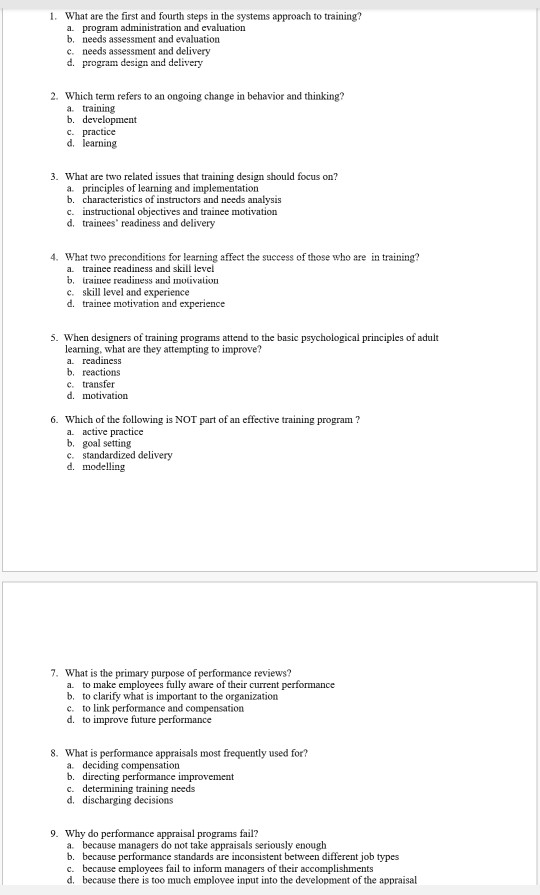
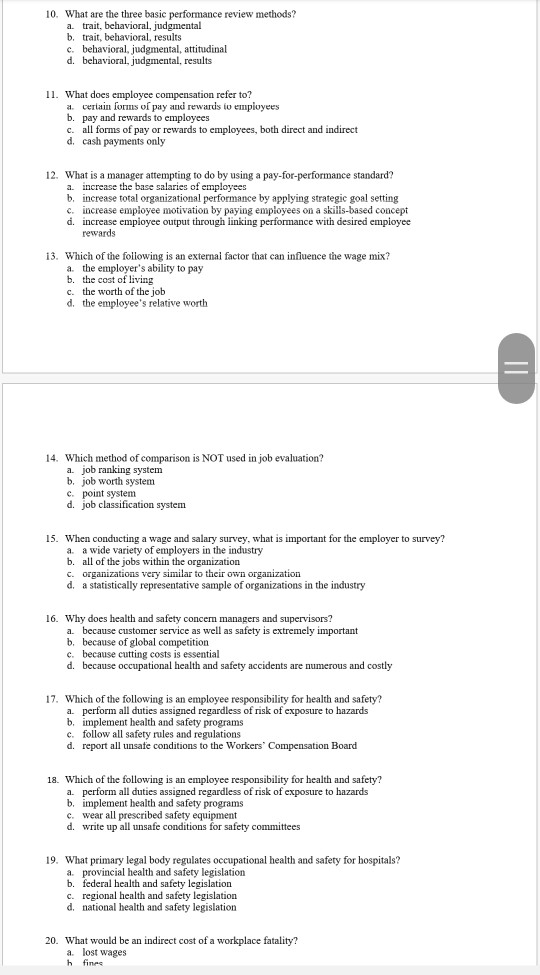
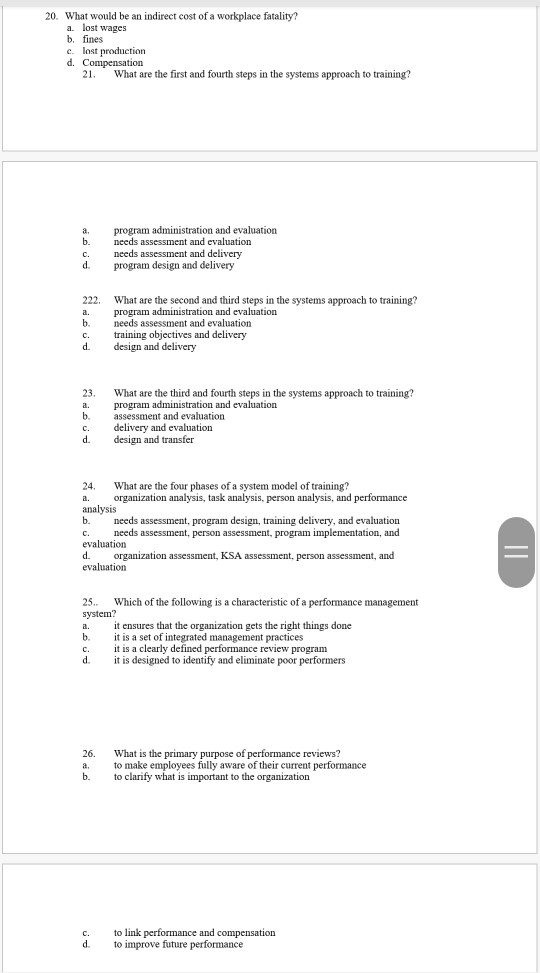
1. What are the first and fourth steps in the systems approach to training? a. program administration and evaluation b. needs assessment and evaluation c. needs assessment and delivery d. program design and delivery 2. Which term refers to an ongoing change in behavior and thinking? a. training b. development c. practice d. learning 3. What are two related issues that training design should focus on? a. principles of learning and implementation b. characteristics of instructors and needs analysis c. instructional objectives and trainee motivation d. trainees' readiness and delivery 4. What two preconditions for learning affect the success of those who are in training? a trainee readiness and skill level b. trainee readiness and motivation c. skill level and experience d. trainee motivation and experience 5. When designers of training programs attend to the basic psychological principles of adult learning, what are they attempting to improve? a. readiness b. reactions c. transfer d. motivation 6. Which of the following is NOT part of an effective training program ? a. active practice b.goal setting c. standardized delivery d. modelling 7. What is the primary purpose of performance reviews? a. to make employees fully aware of their current performance b. to clarify what is important to the organization c. to link performance and compensation d. to improve future performance 8. What is performance appraisals most frequently used for? a deciding compensation b. directing performance improvement c. determining training needs d. discharging decisions 9. Why do performance appraisal programs fail? a. because managers do not take appraisals seriously enough b. because performance standards are inconsistent between different job types c. because employees fail to inform managers of their accomplishments d. because there is too much employee input into the development of the appraisal 10. What are the three basic performance review methods? a trait, behavioral, judgmental b. trait, behavioral, results c. behavioral, judgmental, attitudinal d. behavioral, judgmental, results 11. What does employee compensation refer to? a certain forms of pay and rewards to employees b. pay and rewards to employees c. all forms of pay or rewards to employees, both direct and indirect d. cash payments only 12. What is a manager attempting to do by using a pay-for-performance standard? a. increase the base salaries of employees b. increase total organizational performance by applying strategic goal setting c. increase employee motivation by paying employees on a skills-based concept d. increase employee output through iinking performance with desired empioyee rewards 13. Which of the following is an external factor that can influence the wage mix? a. the employer's ability to pay b. the cost of living c. the worth of the job d. the employee's relative worth 14. Which method of comparison is NOT used in job evaluation? a. job ranking system b. job worth system c. point system d. job classification system 15. When conducting a wage and salary survey, what is important for the employer to survey? a. a wide variety of employers in the industry b. all of the jobs within the organization c. organizations very similar to their own organization d. a statistically representative sample of organizations in the industry 16. Why does health and safety concem managers and supervisors? a. because customer service as well as safety is extremely important b. because of global competition c. because cutting costs is essential d. because occupational health and safety accidents are numerous and costly 17. Which of the following is an employee responsibility for health and safety? a. perform all duties assigned regardless of risk of exposure to hazards b. implement health and safety programs c. follow all safety rules and regulations d. report all unsafe conditions to the Workers' Compensation Board 18. Which of the following is an employee responsibility for health and safety? a. perform all duties assigned regardless of risk of exposure to hazards b. implement health and safety programs c. wear all prescribed safety equipment d. write up all unsafe conditions for safety committees 19. What primary legal body regulates occupational health and safety for hospitals? a provincial health and safety legislation b. federal health and safety legislation c. regional health and safety legislation d. national health and safety legislation 20. What would be an indirect cost of a workplace fatality? a lost wages h fines 20. What would be an indirect cost of a workplace fatality? a. lost wages b. fines c. lost production d. Compensation 21. What are the first and fourth steps in the systems approach to training? a. b c. d program administration and evaluation needs assessment and evaluation needs assessment and delivery program design and delivery 222 a. b c. d. What are the second and third steps in the systems approach to training? program administration and evaluation needs assessment and evaluation training objectives and delivery design and delivery 23. b. c. d. What are the third and fourth steps in the systems approach to training? program administration and evaluation assessment and evaluation delivery and evaluation design and transfer 24. What are the four phases of a system model of training? a. organization analysis, task analysis, person analysis, and performance analysis b needs assessment, program design, training delivery, and evaluation c. needs assessment, person assessment, program implementation, and evaluation d. organization assessment, KSA assessment, person assessment, and evaluation 25.. Which of the following is a characteristic of a performance management system? a. it ensures that the organization gets the right things done b. it is a set of integrated management practices c. it is a clearly defined performance review program d. it is designed to identify and eliminate poor performers 26. a. b. What is the primary purpose of performance reviews? to make employees fully aware of their current performance to clarify what is important to the organization c. d. to link performance and compensation to improve future performance
Step by Step Solution
There are 3 Steps involved in it
1 Expert Approved Answer
Step: 1 Unlock

Question Has Been Solved by an Expert!
Get step-by-step solutions from verified subject matter experts
Step: 2 Unlock
Step: 3 Unlock