Question: 1- What barriers to group and team problem solving do you find evident in this group? (Minimum: 2) Cite reasons from the case to support
1- What barriers to group and team problem solving do you find evident in this group? (Minimum: 2) Cite reasons from the case to support your answer.
2- What should be done to overcome the barriers? Briefly explain three points relating to the case.
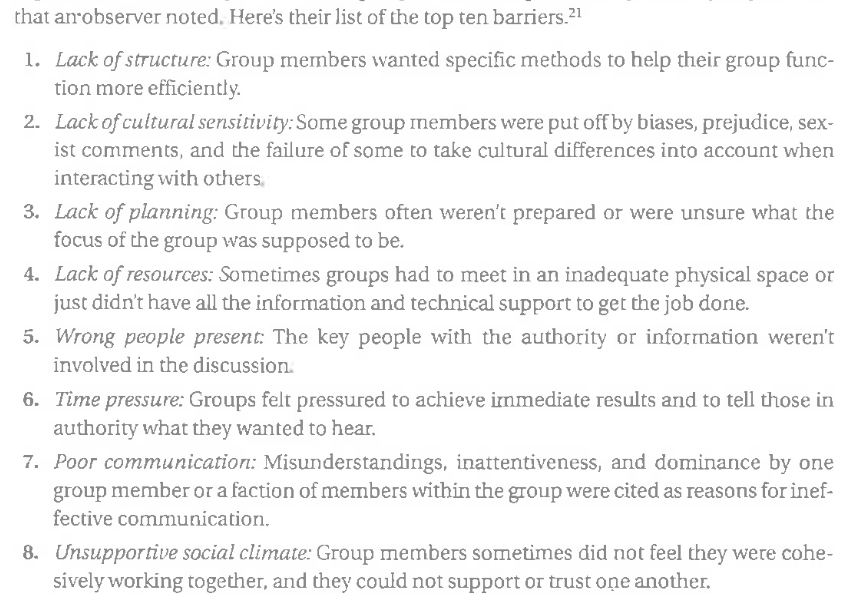

CEPS Student Governance (CEPS-SG), representative students' to the Student Board Council of SQU, was informed that students' of CEPS (College of Economics & Political Science) will need to undergo mandatory two internships from next semester onwards, adding three more credits to the current degree plan. The College Board discussed in their previous meeting that employers have emphasized the need for more experience and skills among college graduates. Therefore, a suggestion from the Board was to have more internship exposure that lets students have a richer set of experience to talk about in their CV's and interviews giving them an added advantage. Many students' of CEPS were concerned about doing two internship programs that it is a lot to juggle between academics and a two eight week internship during their four year tenure. This means that the regular semester will be packed. So, the Dean appointed a student task force from CEPS-SG to study the issue and make a recommendation in a month's time as to whether the CEPS students' would support two mandatory internships from next semester. Five students' were appointed to the task force: Shaima, Jenan, Salim, Basma & Mohammed. Shaima was appointed as chair of the task force; she is a Marketing majored student who had finished her internship last summer and thought about the second internship program as an opportunity to gain more experience before graduation. Jenan, a pre-majored student, was quite skeptical about doing two internship programs, as it means sacrificing a number of hours daily for two summers. Salim, an Information Systems majored student and a small time entrepreneur is not so happy with doing two internship programs, as it would not help him to focus on his small business, where he is gaining rich experience. Basma & Mohammed, pre-majored students, really didn't care of the proposed idea. They seemed to stand neutral. When Shaima called the first meeting together she quickly determined that the task force members already had their minds made up based upon their personal circumstances. Shaima, Basma & Mohammed made it known that they didn't care much whether multiple internships were implemented or not. Jenan & Salim expressed their disagreement heavily on the proposed idea for the above reasons. Shaima knew from her group communication course that the best decisions were made after thoroughly evaluating the information. She was determined to get the task force to make an informed decision, on behalf of all the students' in the college, rather than rely on pre-conceived personal opinions. But after the first meeting, she understood that the group was not going in the right direction. that arrobserver noted. Here's their list of the top ten barriers 21 1. Lack of structure: Group members wanted specific methods to help their group func- tion more efficiently. 2. Lack of cultural sensitivity: Some group members were put off by biases, prejudice, sex- ist comments, and the failure of some to take cultural differences into account when interacting with others 3. Lack of planning: Group members often weren't prepared or were unsure what the focus of the group was supposed to be. 4. Lack of resources: Sometimes groups had to meet in an inadequate physical space or just didn't have all the information and technical support to get the job done. 5. Wrong people present. The key people with the authority or information weren't involved in the discussion 6. Time pressure: Groups felt pressured to achieve immediate results and to tell those in authority what they wanted to hear. 7. Poor communication: Misunderstandings, inattentiveness, and dominance by one group member or a faction of members within the group were cited as reasons for inef- fective communication, 8. Unsupportive social climate: Group members sometimes did not feel they were cohe- sively working together, and they could not support or trust one another. 9. Negative attitudes: Some group members weren't flexible, were unwilling to compro- mise about procedures, or had unrealistic expectations about the group. 10. Lack of problem-solving skill: Group members tended to focus on the solution before defining the problem, or there was a lack of balanced participation









 Study Help