







Question: 1 . What is the difference between activity-based costing and segment profitability analysis? How would you counter the arguments by other managers concerning the most
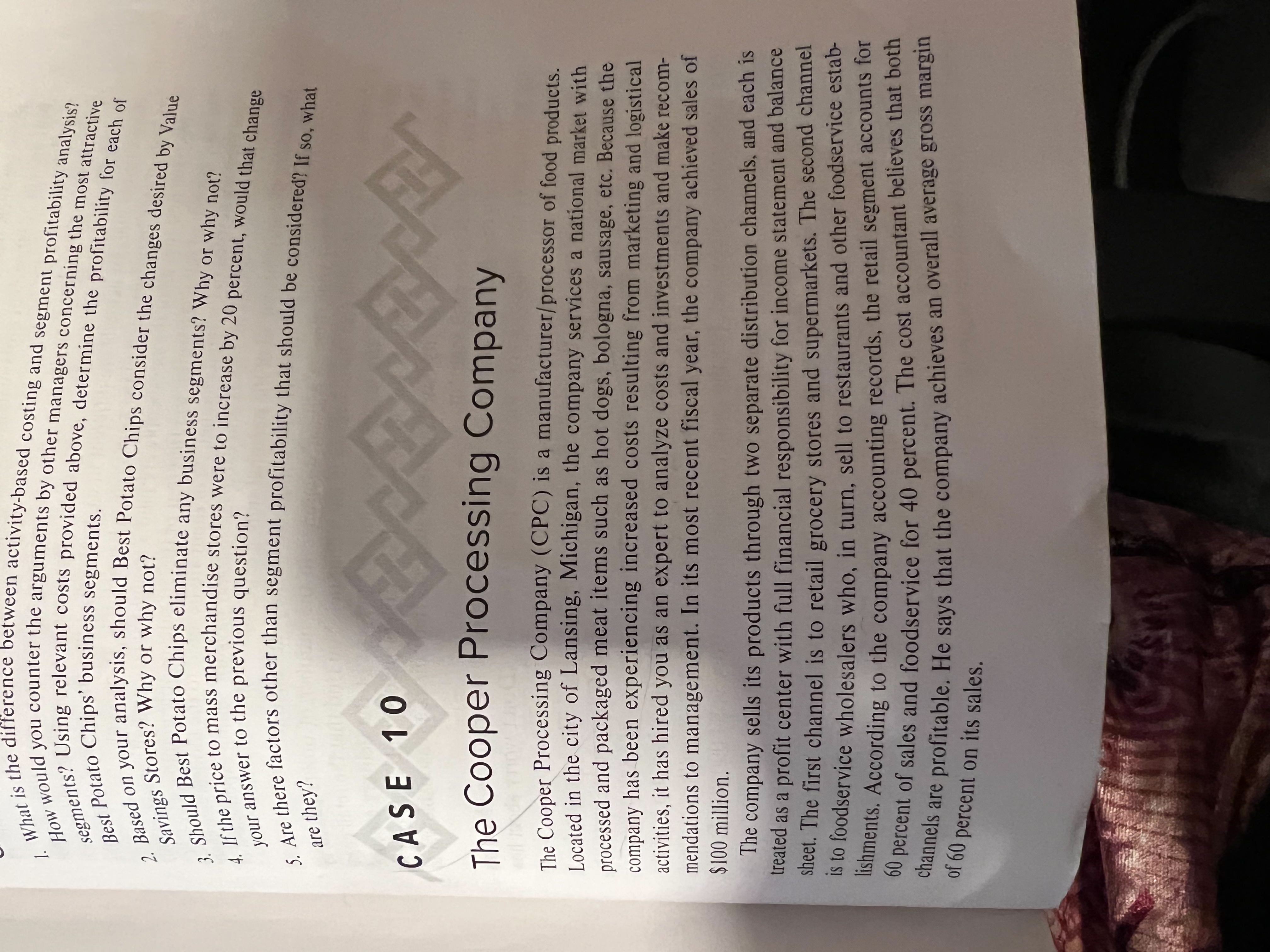
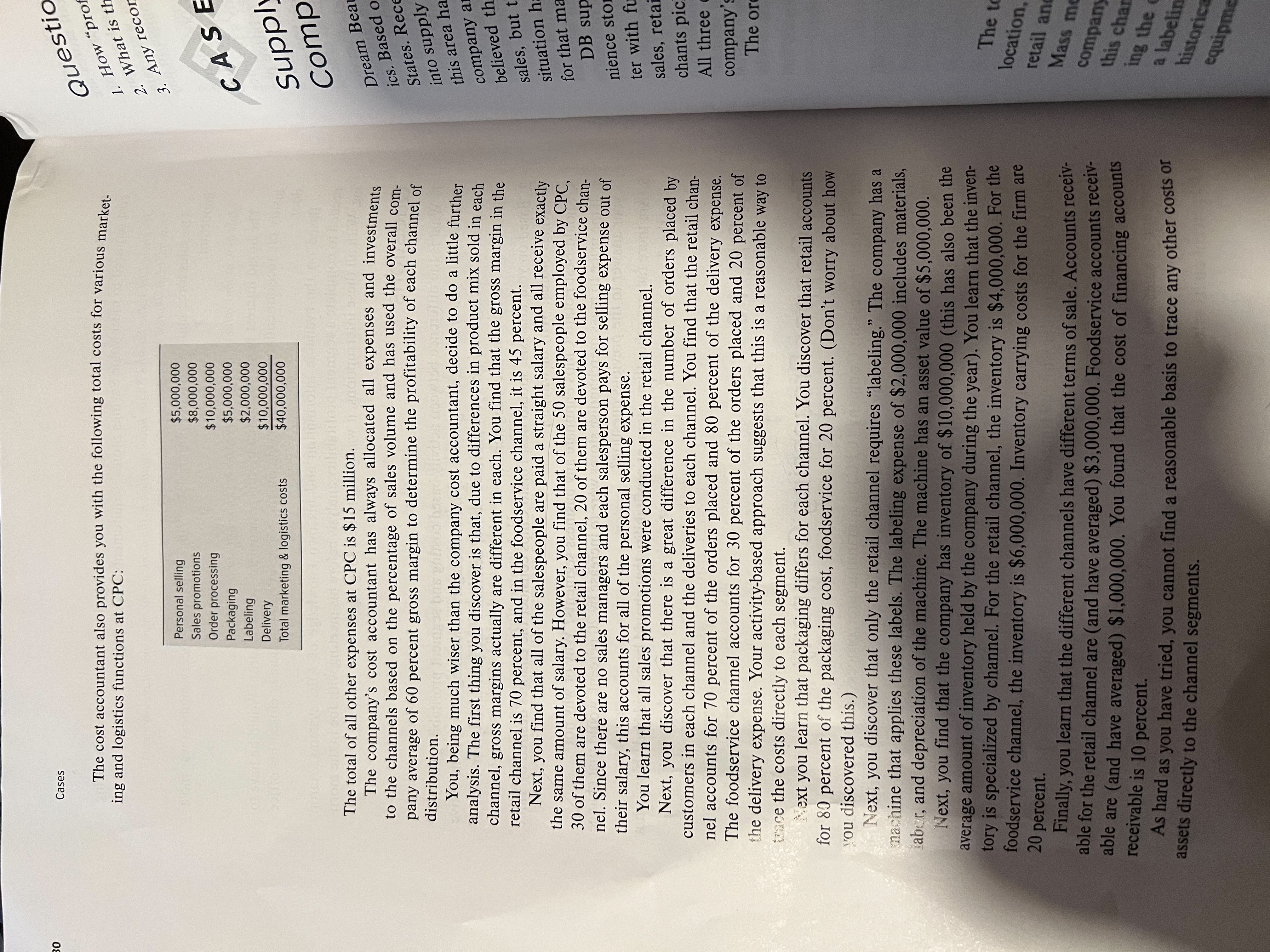
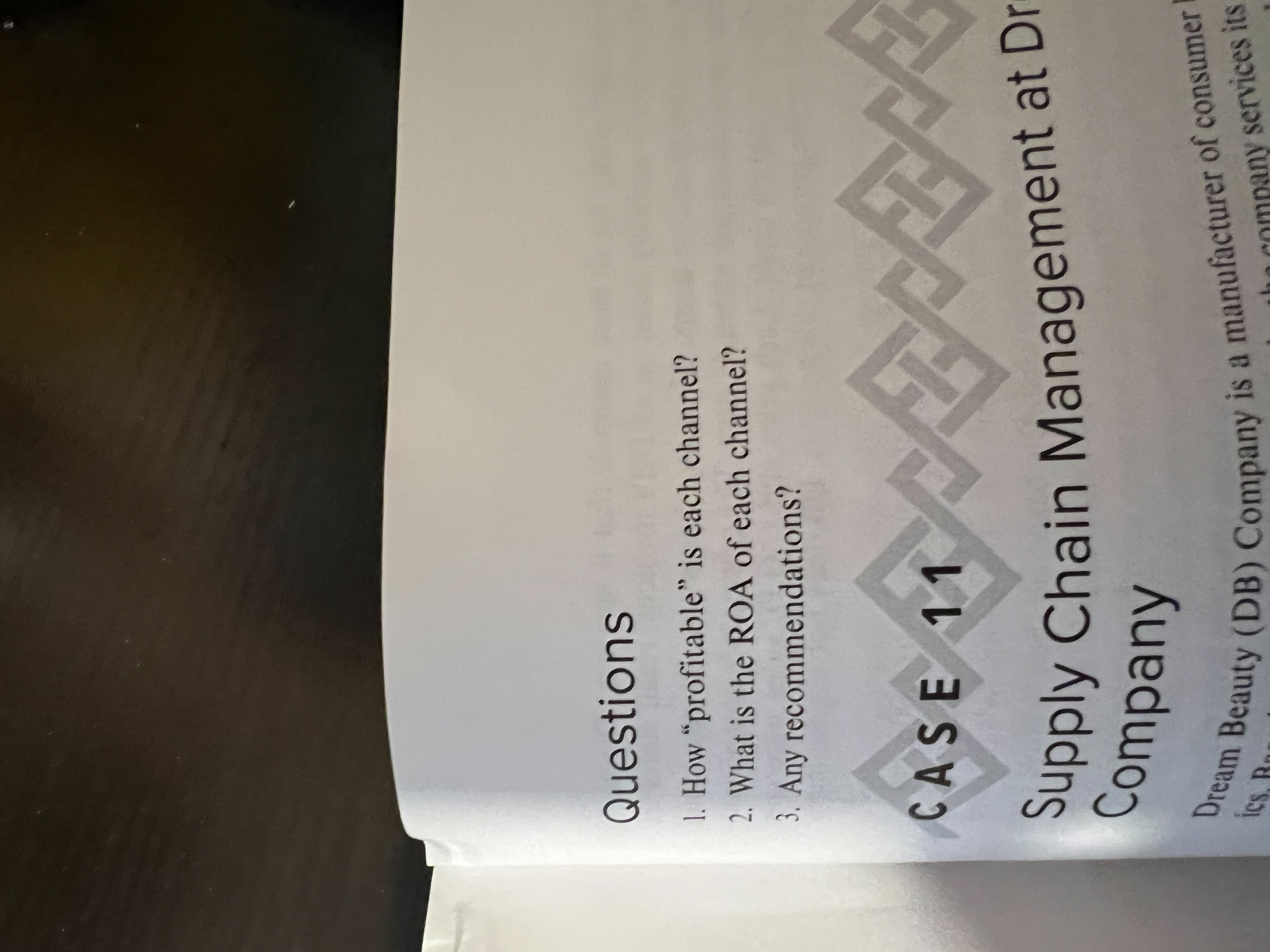
1 . What is the difference between activity-based costing and segment profitability analysis? How would you counter the arguments by other managers concerning the most attractive segments? Using relevant costs provided above, determine the profitability for each of Best Potato Chips' business segments. Based on your analysis, should Best Potato Chips consider the changes desired by Value Savings Stores? Why or why not? 3. Should Best Potato Chips eliminate any business segments? Why or why not! 4. If the price to mass merchandise stores were to increase by 20 percent, would that change your answer to the previous question? are they? 5. Are there factors other than segment profitability that should be considered? If so, what CASE 10 The Cooper Processing Company The Cooper Processing Company (CPC) is a manufacturer/processor of food products. Located in the city of Lansing, Michigan, the company services a national market with processed and packaged meat items such as hot dogs, bologna, sausage, etc. Because the company has been experiencing increased costs resulting from marketing and logistical activities, it has hired you as an expert to analyze costs and investments and make recom- mendations to management. In its most recent fiscal year, the company achieved sales of $100 million. The company sells its products through two separate distribution channels, and each is treated as a profit center with full financial responsibility for income statement and balance sheet. The first channel is to retail grocery stores and supermarkets. The second channel is to foodservice wholesalers who, in turn, sell to restaurants and other foodservice estab- lishments. According to the company accounting records, the retail segment accounts for 60 percent of sales and foodservice for 40 percent. The cost accountant believes that both channels are profitable. He says that the company achieves an overall average gross margin of 60 percent on its sales.Cases Questic The cost accountant also provides you with the following total costs for various market- 1. How "pro ing and logistics functions at CPC: 2. What is t 3. Any reco Personal selling $5,000,000 Sales promotions $8,000,000 Order processing $10,000,000 CASE Packaging $5,000,000 Labeling $2,000,000 Delivery $10,000,000 Total marketing & logistics costs $40,000,000 Suppl Comp The total of all other expenses at CPC is $15 million. Dream Bea The company's cost accountant has always allocated all expenses and investments to the channels based on the percentage of sales volume and has used the overall com- ics. Based c pany average of 60 percent gross margin to determine the profitability of each channel of States. Rec distribution. into supply You, being much wiser than the company cost accountant, decide to do a little further this area ha analysis. The first thing you discover is that, due to differences in product mix sold in each company a channel, gross margins actually are different in each. You find that the gross margin in the believed th retail channel is 70 percent, and in the foodservice channel, it is 45 percent. sales, but Next, you find that all of the salespeople are paid a straight salary and all receive exactly situation I the same amount of salary. However, you find that of the 50 salespeople employed by CPC, for that ma 30 of them are devoted to the retail channel, 20 of them are devoted to the foodservice chan- DB sup nel. Since there are no sales managers and each salesperson pays for selling expense out of nience sto their salary, this accounts for all of the personal selling expense. ter with f You learn that all sales promotions were conducted in the retail channel. sales, retai Next, you discover that there is a great difference in the number of orders placed by customers in each channel and the deliveries to each channel. You find that the retail chan- chants pic nel accounts for 70 percent of the orders placed and 80 percent of the delivery expense. All three The foodservice channel accounts for 30 percent of the orders placed and 20 percent of company' the delivery expense. Your activity-based approach suggests that this is a reasonable way to The or trace the costs directly to each segment. Next you learn that packaging differs for each channel. You discover that retail accounts for 80 percent of the packaging cost, foodservice for 20 percent. (Don't worry about how ou discovered this.) Next, you discover that only the retail channel requires "labeling." The company has a machine that applies these labels. The labeling expense of $2,000,000 includes materials, aber, and depreciation of the machine. The machine has an asset value of $5,000,000. Next, you find that the company has inventory of $10,000,000 (this has also been the average amount of inventory held by the company during the year). You learn that the inven- tory is specialized by channel. For the retail channel, the inventory is $4,000,000. For the The L foodservice channel, the inventory is $6,000,000. Inventory carrying costs for the firm are location. 20 percent. retail an Finally, you learn that the different channels have different terms of sale. Accounts receiv- Mass m able for the retail channel are (and have averaged) $3,000,000. Foodservice accounts receiv- company able are (and have averaged) $1,000,000. You found that the cost of financing accounts this char receivable is 10 percent. ing the As hard as you have tried, you cannot find a reasonable basis to trace any other costs or a labelin assets directly to the channel segments. historic equipmeQuestions 1. How "profitable" is each channel? 2. What is the ROA of each channel? 3. Any recommendations? CASE 11 Supply Chain Management at Dr Company ics R. Dream Beauty (DB) Company is a manufacturer of consumer company services its
Step by Step Solution
There are 3 Steps involved in it

Get step-by-step solutions from verified subject matter experts
 Study Help