



Question: 1. When a 1,500 kg car is accelerated, starting from a rest position, 5 1.5 X 10 J ofwork is done. What speed does the
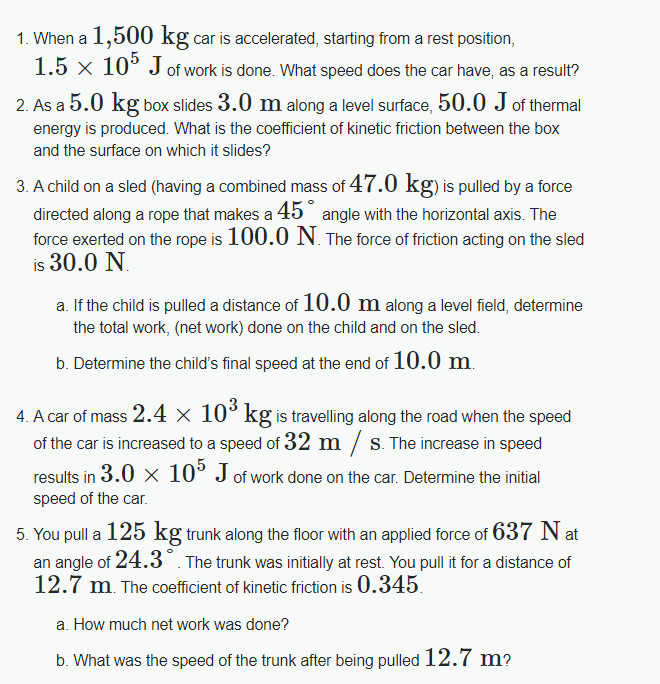
1. When a 1,500 kg car is accelerated, starting from a rest position, 5 1.5 X 10 J ofwork is done. What speed does the car have. as a result? 2. As a 5.0 kg box slides 3.0 111 along a level surface, 50.0 J of thermal energy is produced. What is the coefficient of kinetic friction between the box and the surface on which it slides? 3. Achild on a sled {having a combined mass N471] kg) is pulled by a force directed along a rope that makes a 45 0 angle with the horizontal axis. The force exerted on the rope is 100.0 N. The force of friction acting on the sled is 30.0 N. a. lfthe child is pulled a distance of 10.0 H] along a level eld, determine the total work, (net work} done on the child and on the sled. b. Determine the child's nal speed atthe end of 10.0 111. 4. Acar of mass 2.4 X 10³ kg is travelling along the road when the speed of the car is increased to a speed of 32 III / S. The increase in speed 5 results in 3.0 X 10 J of work done on the car. Determinethe initial speed of the car. 5. You pull a 125 kg trunk along the oorwith an applied force of 637 N at an angle of 24.3 a . Thetrunk was initially at rest. You pull it fora distance of 12.7 m. The coefcient of Kineticfriction is 0.345. a. How much net work was done? b. What was the speed of the trunk after being pulled 12.7 I11
Step by Step Solution
There are 3 Steps involved in it

Get step-by-step solutions from verified subject matter experts