



Question: 1- When would a researcher collect data on all the subjects in the population as opposed to working with only a random sample of subjects?
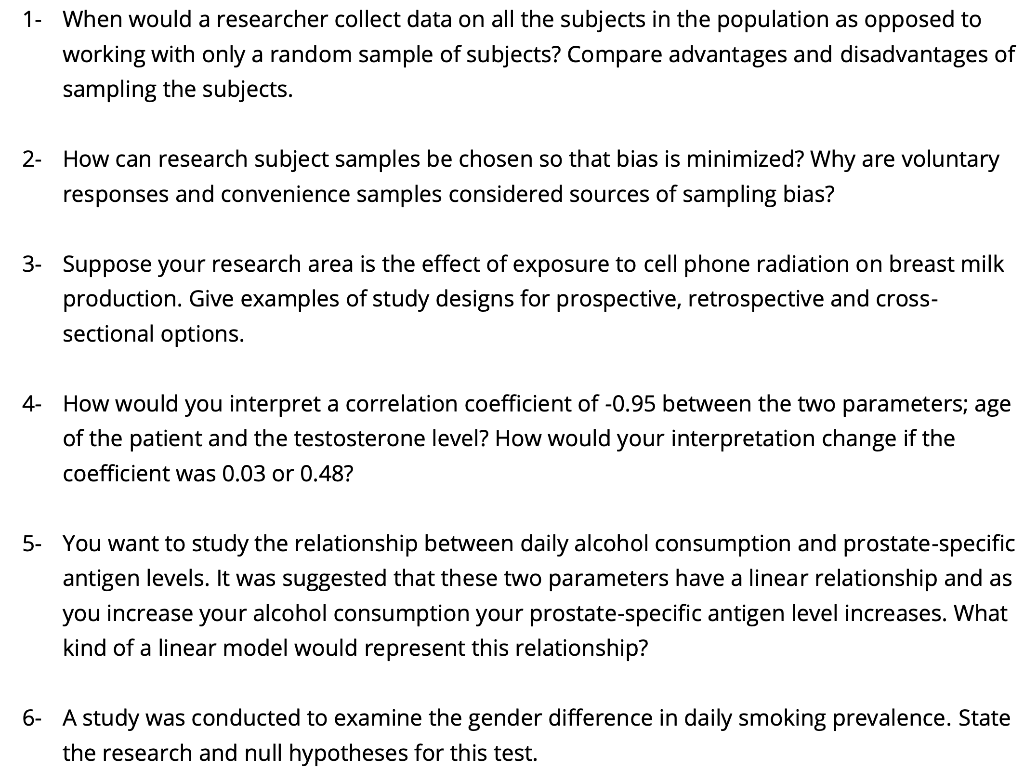
1- When would a researcher collect data on all the subjects in the population as opposed to working with only a random sample of subjects? Compare advantages and disadvantages of sampling the subjects. 2- How can research subject samples be chosen so that bias is minimized? Why are voluntary responses and convenience samples considered sources of sampling bias? 3- Suppose your research area is the effect of exposure to cell phone radiation on breast milk production. Give examples of study designs for prospective, retrospective and cross- sectional options. 4- How would you interpret a correlation coefficient of -0.95 between the two parameters; age of the patient and the testosterone level? How would your interpretation change if the coefficient was 0.03 or 0.48? 5. You want to study the relationship between daily alcohol consumption and prostate-specific antigen levels. It was suggested that these two parameters have a linear relationship and as you increase your alcohol consumption your prostate-specific antigen level increases. What kind of a linear model would represent this relationship? 6- A study was conducted to examine the gender difference in daily smoking prevalence. State the research and null hypotheses for this test. 1- When would a researcher collect data on all the subjects in the population as opposed to working with only a random sample of subjects? Compare advantages and disadvantages of sampling the subjects. 2- How can research subject samples be chosen so that bias is minimized? Why are voluntary responses and convenience samples considered sources of sampling bias? 3- Suppose your research area is the effect of exposure to cell phone radiation on breast milk production. Give examples of study designs for prospective, retrospective and cross- sectional options. 4- How would you interpret a correlation coefficient of -0.95 between the two parameters; age of the patient and the testosterone level? How would your interpretation change if the coefficient was 0.03 or 0.48? 5. You want to study the relationship between daily alcohol consumption and prostate-specific antigen levels. It was suggested that these two parameters have a linear relationship and as you increase your alcohol consumption your prostate-specific antigen level increases. What kind of a linear model would represent this relationship? 6- A study was conducted to examine the gender difference in daily smoking prevalence. State the research and null hypotheses for this test
Step by Step Solution
There are 3 Steps involved in it

Get step-by-step solutions from verified subject matter experts