





Question: 1. Which key(s) can you use to enter data into memory? a. WRT b. AUTO c. Both of the above. d. None of the above.
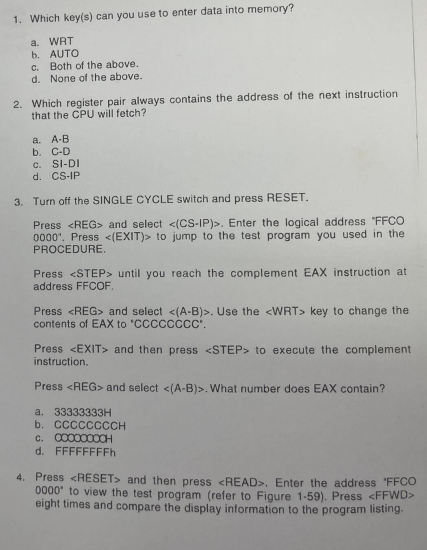
 1. Which key(s) can you use to enter data into memory?

a. WRT b. AUTO c. Both of the above. d. None of

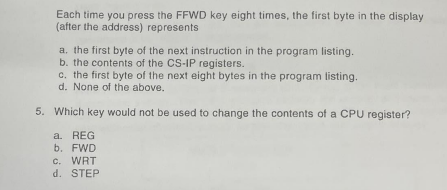
1. Which key(s) can you use to enter data into memory? a. WRT b. AUTO c. Both of the above. d. None of the above. 2. Which register pair always contains the address of the next instruction that the CPU will fetch? a. AB b. CD c. SI-DI d. CS-IP 3. Turn off the SINGLE CYCLE switch and press RESET. Press REG> and select (CSPP)>. Enter the logical address "FFCO 0000. Press to jump to the test program you used in the PROCEDURE. Press until you reach the complement EAX instruction at address FFCOF. Press and select . Use the key to change the contents of EAX to 'CCCCCCCC'. Press EXIT> and then press STEP> to execute the complement instruction. Press and select . What number does EAX contain? a. 33333333H b. CCCCCCCCH c. OOOOOOOH d. FFFFFFFFh 4. Press and then press . Enter the address "FFCO 0000 to view the test program (refer to Figure 1-59). Press eight times and compare the display information to the program listing. Each time you press the FFWD key eight times, the first byte in the display (after the address) represents a. the first byte of the next instruction in the program listing. b. the contents of the CS-IP registers. c. the first byte of the next eight bytes in the program listing. d. None of the above. 5. Which key would not be used to change the contents of a CPU register? a. REG b. FWD c. WRT d. STEP

Step by Step Solution

There are 3 Steps involved in it

1 Expert Approved Answer
Step: 1 Unlock blur-text-image
Question Has Been Solved by an Expert!

Get step-by-step solutions from verified subject matter experts

Step: 2 Unlock
Step: 3 Unlock

Students Have Also Explored These Related Databases Questions!